 |
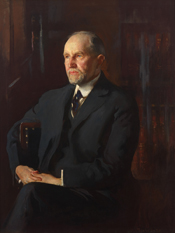
| Sen. Gillett (Wikipedia) |
The last Senator for Massachusetts from Western Mass (the four westernmost counties if you think Worcester is Western) was Frederick Gillett. Prior to serving one term in the US Senate, Gillett represented the 2nd Massachusetts Congressional district, the same that Richard Neal represents now. Gillett would also serve as Speaker of the House from 1919-1925. Like Neal, Gillett was from Springfield.
This bit of historical trivia is not directly tied to the questions among Democrats in their quest to unseat Scott Brown in 2012. It does, however speak to some of the challenges that will face the nominee whoever, he or she is. Western Mass went hard for Brown, save the cities, but then swung back hard for Gov. Deval Patrick last year. It seems that while Western Mass has lagged the rest of Massachusetts in terms of growth, it often becomes the margin of victory for statewide campaigns with a possible assist from the Cape & Islands. For the moment, Democrats' problems do include geography, but not east and west. Rather there problems lies between here and Washington.
 |
| Sen. Murray (Wikipedia) |
The Boston Globe , perhaps overplaying the discord a bit, did highlight the chasm between the national Democratic party and the State Party this past Saturday. Sen. Patty Murray of Washington, the chair of the Democratic Senate Campaign Committee is tasked with defending the Democrats' 23 seats up in 2012 and possibly grabbing one or two from the Republicans' 10 seats up next year. She said earlier this week that a strong challenger would be coming forward "within weeks." The Globe reported that this has rankled the declared candidates notably Alan Khazei, a philanthropist and Bob Massie, a former Lietenant Gubernatorial candidate. Setti Warren, Mayor of Newton, notably, had no comment.
In some ways the implications of a better candidate is insulting and could, as some in the story suggested, hurt fund-raising in the future if one of the declared candidates does become the nominee. Some also suggested that it was wrong for the national party to dictate terms as to who should become the nominee.
On the ground in Massachusetts, some Democrats seem to agree with Gov. Patrick's call for an organic process. However, the reality is that the field is weak, perhaps as the New York Times noted in a misleadingly titled story, because Ted Kennedy outshone any efforts to build up a bench for Democrats in Massachusetts.
 |
| Ex. State Sen. Rossi (Seattle Weekly) |
While Sen. Murray could be a bit more tactful in her language, her fear and her desire for a stronger candidate may come about due to her own experiences. Although on the winning side, Murray witnessed what happens when candidate rise with a track record of failure and the party on the outs lacks a bench. Dino Rossi an ex-legislator in Washington state, challenged Murray in last year's Senate election, but lost. Rossi had earlier run for governor in 2004, lost (after an acrimonious recount) and then went for a rematch against incumbent Christine Gregoire only to lose amongst the Obama wave by a larger margin. Why did Republicans pick him to run? They had nobody else. Republicans seem doomed to repeat this in 2012 against Murray's fellow Washingtonian, Senator Maria Cantwell.
While Rossi was hardly an "organic candidate," he was well-known in Washington State's Republican circles. His candidacy may be instructive for both supporters of an organic nominees and those who want somebody with star power (it may be a stretch to say Rossi had star power or was organic, however). Essentially his candidacy exposed the Republicans for reaching "into the Pickle jar" to quote Rachel Maddow. The organics should worry about an untested candidate lacking name recognition (like Setti Warren) or one with a track record of failure or no political experience...or name recognition. (like Massie, Khazei). Remember, Brown's best non-monetary strength is name recognition.
 |
| Sen. Brown (Wikipedia) |
While Scott Brown came from nowhere, his path cannot necessarily be replicated. Brown's candidacy and term thus far, were/are an exercise in political manufacturing. Once Coakley let her guard down, the Republican message machine led by Eric Ferhnstrom and others sensed their moment and swooped in. A combination of out-of-state financing and well placed tropes about Brown's Everymanhood shot him from Wrenthem to Washington. A Democratic candidate can become likewise known, but should not assume that mirroring Brown's path is possible or without its own perils.
Taking all of this in, risks and all, this leaves the field with three possibly four candidates, declared or otherwise, that can/could overcome the hurdles ahead. Mayor Warren, Elizabeth Warren the Harvard professor struggling to set up the Consumer Finance Protection Agency against generic Republican tripe about liberty and Mike Capuano, the Congressman from Somerville Coakley defeated in 2009. Other Congressmen are possibilities, but they seem more remote than Capuano.


 Posts
Posts


