 |
| Legislators, aides and union officials at Friday's Meeting (WMassP&I) |
With city schools already more than a week behind schedule and many students still living in temporary housing after last year's tornado, Springfield City Councilors and the city's Beacon Hill delegation are looking to delay the city's participation in Massachusetts Comprehensive Assessment Systems test. However, the proposal has received a cool reception from state education officials. A spokesman for the Commissioner of Elementary and Secondary Education seemed to foreclose any delay of more than a few days.
On Friday, at-large Councilor Kateri Walsh, chairwoman of the Intergovernmental Relations Committee held a hearing on home rule legislation allowing the city to push back MCAS testing from March-April to April-May. The proposal is cosponsored by Walsh, at-large Councilor Thomas Ashe, Ward 2 Councilor Mike Fenton and Ward 8 Councilor John Lysak. Representatives Sean Curran and Mike Finn and Senator Jim Welch attended. Staffers from Representative Brian Ashe and Ben Swan and officials from Springfield teachers unions were also present.
The original mover behind this legislation was, according to those present, Springfield Education Association president Timothy Collins. Collins himself was unable to attend the committee meeting as he was in Washington for an event with US Secretary of Education Arne Duncan.
While there was a consensus among all present that Springfield school children deserved the extra time, however that alone may not make it possible. The Commissioner for Elementary and Secondary Education, Mitchell Chester, seemed to pour cold water on the idea in a letter to Mayor Domenic Sarno dated February 8th. While Chester implied he had limited power to delay Springfield's testing schedule, he suggested that a Special Act would actually lead the city to default on meeting state education requirements. Under any circumstances, failure to meet testing requirements would have severe repercussions for the school district and for students including a loss of funding and a loss of students' chances to meet graduation requirements.
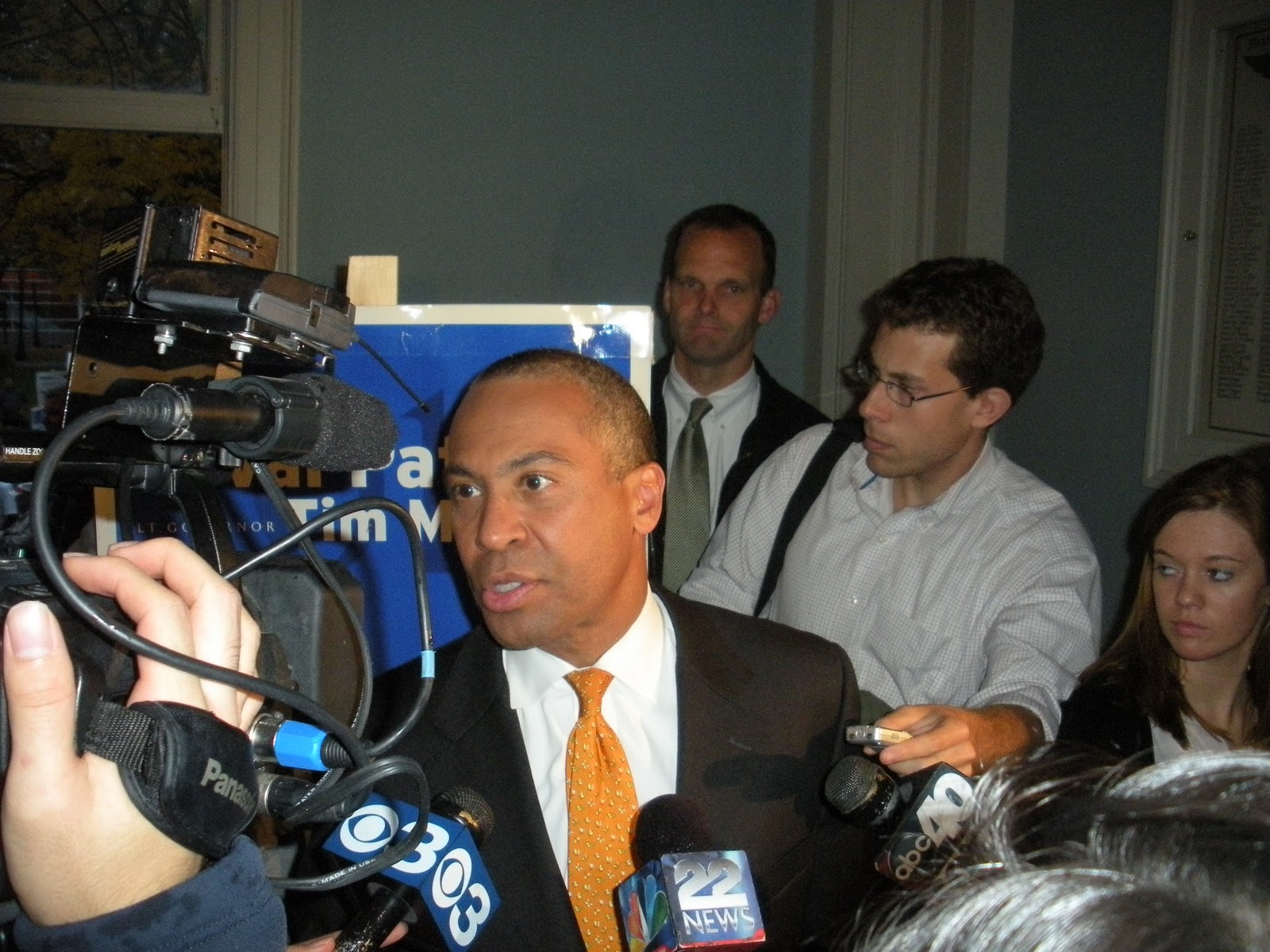 |
| Gov. Patrick in 2010 (WMassP&I) |
A home rule petition seems doubly unlikely as would require the Governor Deval Patrick's signature. As the commissioner is an executive appointee, it is likely that the governor would stand by Chester's assessment and veto home rule legislation that would create an exception to statewide policy the commissioner opposes.
While unmentioned in Chester's letter, the officials in attendance speculated that cheating among students may be a concern if Springfield takes the test later than its neighbors, which would take the test on time. J.C. Considine, the commissioner's spokesman, confirmed that the integrity of the test is one, but hardly the sole concern of state education officials
However, the legislative avenue presents other issues as well. Curran, who sits on the Education Committee and would likely have jurisdiction over the city's home rule petition, said that the legislative process itself could delay a home rule petition beyond March. Specifically, he noted that the bill would need to clear several committees with lead times of a week or two all before it could be passed by the House, assuming the Speaker puts it on the calendar at all. A similar process through the Senate would follow.
 |
| Councilor Walsh (Facebook) |
Considine, the education spokesman, described the power of the commissioner to give districts a "temporary extension" for testing as narrow. The commissioner could give districts like Springfield, "a few additional days," but little more than that. Furthermore, he explained, any longer than that would jeopardize the state's ability to get prompt turnaround from contractors grading the test. Given that the subject of the March/April tests, English Language, uses many open response answers, the turnaround time is already tight as answers must be graded by humans rather than a machine. This prompt turnaround has been requested by school districts who want the results to begin planning curriculum for the next year. Considine said test results in past did not come until some schools had practically reopened for the Fall.


 Posts
Posts


