Google

Thursday, September 03, 2009

Edward Moore Kennedy 1932-2009: A Life...

For anybody who knows the story of the Kennedy family, it should not be a surprise that Senator Edward (Ted) Kennedy would enter politics. Certainly, it surprised few when he ran and then won the seat his brother had vacated two years before to assume the presidency of the United States. However, what may surprise many, especially after a careful examination of the record, was how differently Ted Kennedy would live out his political career. Admittedly, his brothers, Jack the President, and Bobby, the Attorney General and later New York Senator, found their careers cut short by the assassin's bullet. However, their legacies and even their histories are often clouded and confused by myth and legend, be it for good or for bad. The result, is one, where Ted Kennedy's own reach, scope, and influence may pale in comparison. True, JFK inspired a generation into public service like nobody since FDR. However, in a more temporal way, Ted Kennedy touched the lives of millions, past and present, around the world, in way neither Jack nor Bobby ever did...or at least could.

Edward Moore Kennedy was born February 22, 1932 in the Dorchester neighborhood of Boston, Mass. The youngest of Joseph Kennedy and Rose Fitzgerald's nine children, he was probably the most affected by his father's frequent moves across the country and then the globe for either business or public service including the Court of St. James in London.

Upon graduation from high school, Ted entered Harvard as many of his siblings did before him. However, he was expelled for cheating on a exam. He joined the Army briefly before reenlisting at Harvard. He graduated and attended the University of Virginia Law School, where he met his first wife and mother of his children Virginia Joan Bennett.

The following years would lead to his brother's ultimately successful campaign for the Presidency. For whatever reason, either Ted or his family kept their eye on JFK's old Senate seat. Teddy, however, would not be eligible for it until 1962, when he turned 30. Governor Foster Furcolo, (factoid: the predecessor to Edward Boland and Richie Neal in the US House) appointed a replacement who would not run in 1962. That year, Edward Kennedy was elected and in January of 1963, began his career in the United States Senate.


When he entered office in the winter of 62-63, Ted Kennedy became the third Kennedy brother in elected office. His older brothers John and Robert were president and Attorney General respectively. However, that trifecta would not be long for this world as JFK was gunned down by Lee Harvey Oswald. Still younger than Bobby, it was not yet Teddy’s turn to take up the Kennedy mantle.

With Lyndon Johnson in the White House, Ted Kennedy would be serving in the Congresses that would pass the Great Society. In 1965, he would be joined by his surviving brother in the Senate representing New York. While serving together, Secretary of Defense Robert McNamara would call the Senators Kennedy and tell them that the navy yard in either Boston or New York had to close. Teddy, despite being the younger brother was the senior Senator and the Brooklyn Navy Yard was essentially shut down as a full-time military establishment. The Navy Yard in Boston at Charlestown would close within a decade.

As Lyndon Johnson’s presidency decayed between Vietnam and a growing frustration with the cost and effectiveness of the Great Society, it became clear that a new Democratic candidate would be necessary for 1968. With a recharged Richard Nixon eying the White House, many felt that only a Kennedy could rise to the occasion and defeat the former Vice President once again. Sure enough, RFK would rise to the occasion and light the campaign trail on fire. The optimism, would not last, however, and RFK would, like his brother five years earlier, fall to an assassin’s bullet.

The Democratic ticket collapsed over the following months and the convention wrought within turmoil both on the floor and outside on the streets of Chicago. An exasperated electorate sent Tricky Dick to the White House.

Richard Nixon, whose quest for control and reelection would ultimately lead him to resignation, scored more good news, politically at least, the following year. While driving on Martha’s Vineyard, Senator Ted Kennedy drove off a bridge, and while able to save himself, left the fate of his passenger, Mary Jo Kopechne to fate. Not even reporting the incident, police would later find the body of the woman not his wife and touching off a new scandal authorities charged the Senator with nothing. This incident, explosive as it was in Massachusetts, where Kennedy faced no political upheaval, essentially derailed any hopes of another Kennedy Presidential run in the immediate future. Between charges of privilege and outright corruption among the Kennedys the Bay State authorities, and the Senator himself, Nixon could only salivate at having bested the Kennedys out of their own hubris. Nixon was reelected in 1972.

The Chappaquiddick incident, named after the island off Martha’s Vineyard where the accident took place, might be seen as the first of three crucial events in the life of Senator Edward Kennedy as the Kennedy family torchbearer.

Kennedy continued to the serve in the Senate during the waning days of Vietnam and through the drudgery of the Watergate investigation. Nixon would resign before Articles of Impeachment could pass the House and formally put the matter before Kennedy and his 99 colleagues. Despite that the nation handed the presidency back to the Democrats in the well-intentioned, but ultimately overwhelmed hands of Jimmy Carter. His presidency beset by high inflation, the first significant breakdown in the economy since Korea and the Iranian hostage crisis. Taking his place an heir to a legacy, Ted Kennedy would challenge the president for the Democratic nomination in 1980.

The campaign would come at a rocky time for Kennedy. His marriage to Joan Bennett was falling apart, but the two stayed together during campaign. When it became clear, that Kennedy would not be replacing Carter at the top of the ticket, Teddy experienced the second event. With his ambitions for the presidency quashed, Teddy resigned himself to the Senate. His marriage would end in 1982, but between Reagan’s conservative pushes and budget cuts and popular appeal, Kennedy might at last have a cause and a face for its enemy.

Alongside Tip O’Neill the Speaker of the House from Cambridge, Mass, Ted Kennedy would fight tooth and nail for the funding and the programs the poor needed. Despite Reagan’s push and seeming popular support, millions of dollars were saved for countless federal program while still others were brought to life. Although liberalism would not have much support in the White House for twelve years, Kennedy’s own brand of politics centered less on horse-trading and more on congeniality and passion would earn the necessary votes and the signature of presidents such as George H.W. Bush’s on the American’s with Disabilities Act.

Despite the political passion and success, lurid details of Kennedy’s personal life would surface in the tabloid press. Eventually, the decadence would catch up to him once again, but this time landing him on the witness stand. His nephew, William K. Smith, son of this only surviving sister, Jean, was accused of rape. The trial provided fresh meat to reporters on the details of the Kennedy’s privilege and lack of responsibility. However, that was not the final event. Rather it merely set the stage for it.

Three years later, Ted Kennedy would face his toughest campaign for Senator. Five times after first being elected in 1962, Kennedy faced no real opposition. However, a young upstart, the son of a former Midwestern governor and cabinet secretary would give Kennedy a jolt. After years of assuming his image in Massachusetts could never be tarnished enough, Kennedy realized he needed something of a makeover. Kennedy fought harder and longer in the Senate and on the campaign trail, taking nothing for granted. He held his own against his challenger, Mitt Romney in debates and ultimately won reelection. During this time, he began dating and ultimately married Victoria Reggie, the daughter of a family friend. Cleaning himself up for the first time, for those willing to forgive him, he had restored his image to Massachusetts voters, if not many more across the country.

That year, was nonetheless a Republican’s year and the GOP took the Senate along with the House of Representatives. Kennedy would lose his chairmanship, but through friends like Utah Senator Orrin Hatch, was able to make deals and push for the rights of workers, the elderly, children, immigrants, and the uninsured. Even as health care reform went overboard in 1994, he still worked tirelessly not only for Massachusetts, but for all Americans.

However, his influence would prove invaluable from everything from securing federal funding to keeping the state from losing another seat in Congress in 2000. By the early 2000’s the hot issue was education and assuming that he could wrangle the same promises from George Bush the younger, Kennedy secured passage of No Child Left Behind. The bill would become a disaster for countless school districts as its standards remained in force even as the necessary federal funding failed to materialize. It is hard to know if Kennedy felt at all betrayed as a result of this, but it certainly seems possible.

In 2004, at least a small part of John Kerry’s defeat may be laid at the feet of Kennedy. Although an enthusiastic supporter of his fellow Bay Stater from the beginning, John Kerry’s reputation in the Senate paled in comparison to that of his counterpart. Simply put, Kennedy outshined Kerry on their worst and best days respectively. This is no indictment, but merely a statement of fact, given the political star power Kennedy had ever since he was born. However, the events of 2004 would come back to both bless and haunt Kennedy and his fellow Democrats in the years to come in other ways.

With Kerry defeated, but still in the Senate, Kennedy like other Democrats no doubt wondered who would carry their party forward. The year Bush took his second oath of office did not bode well for the Democrats who were only a hair’s breath from a filibuster-proof Senate majority. However, both an exasperated public and perhaps even the divine would not allow this to endure.

A string of violent outbreaks in Iraq, a number of Republic corruption scandals and Hurricane Katrina broke Republican’s grip on power. An ill-conceived and ill-planned attempt at Social Security eroded GOP credibility on policy as Democrats at last had their own issue that would resonate with voters. Democrats seized control of both houses in 2006.

The following year, with Bush reduced to a lame duck and both parties clamoring for new leaders, the 2008 presidential campaign began. Not too far into the 2007, freshman Senator Barack Obama, who spoke in Boston at the Democratic Convention that nominated Kerry, announced his own campaign for the presidency. Ted Kennedy’s colleague from New York, the former First Lady Hillary Clinton had also declared his candidacy.

A year later, despite significant ties to the Clintons, Kennedy, along with his son Patrick, now a Congressman from Rhode Island, and his niece Caroline, endorsed Barack Obama. Although his push to glean support for the Illinois Senator would be ignored in New Hampshire, Massachusetts, and Rhode Island, the move was heavily symbolic. Still a few weeks before that fateful diagnosis, Kennedy was acknowledging both the need and heralding the entry of new leaders on the political stage.

Kennedy would not be able to take part in the euphoria of Obama’s eventual victory over Clinton for long. In the summer of 2008, following a series of seizures Kennedy was diagnosed with brain cancer. Initial prognoses offered little hope and Kennedy traveled to North Carolina to consult with doctors and undergo surgery. Despite his infirmed state, Kennedy made a surprise--and his last--appearance at the 2008 Democratic Convention in Denver.

As the economic situation deteriorated, some of the work Kennedy had undertaken over the years became more important as part of that safety net he helped construct became all the more noticeable and needed. It would be that bad economy that made Barack Obama’s election to the presidency all but certain.

As the 111th Congress was gaveled into session the following year, legislators including Kennedy set to work on a wide number of issues. Health Care, a perennial favorite of Kennedy’s would quickly make it to the fore. Kennedy would make appearances in Washington, including on the Senate floor to push for reforms, but these would become increasingly infrequent occurrences. The issue would be pushed ahead as delay and work on economic stimulus took up Congress and the President’s time for the first half of 2009.

In July, Kennedy’s older surviving sister Eunice passed away. Her death returned the spotlight to Ted’s own health. Not too long after, Kennedy spoke out in favor of changing the state’s law that replaces US senators to allow for an interim appointment by the governor. The call was derided by some who noted that the law had be unscrupulously changed by Beacon Hill Democrat who feared then-governor Mitt Romney would appoint a Democrat to serve out John Kerry’s should the later win the White House in 2004. A short time thereafter, Kennedy died at his home in Hyannis Port.

It is impossible to know, now what Kennedy thought of his life. What he dwelled on and what he was able to let go. Equally impossible to know is how the powers that be have viewed the life of Edward Kennedy. What can be said, perhaps as a function of the greater time he had on Earth or not, Edward Kennedy was not only able to surpass his brothers in legislative achievement. He also had the chance to evolve and mature. To take the darkest moments, namely those brought on by himself, and channel them into something and something greater than himself. That passion and that drive to stand up for the little guys, could not have come from altruism alone. It was the product of suffering and doubt, but in the end, hopefully, it was the catharsis he sought. In any event, it is the legacy he left.

Wednesday, August 26, 2009

Edward Moore Kennedy 1932-2009...

Western Mass Politics and Insight has learned from various sources that Senator Edward Kennedy had lost his battle with brain cancer. The Massachusetts Senator died at his home in Hyannisport on Cape Cod.


The last of the Kennedy brothers from that generation, he leaves behind his wife Victoria Reggie and children by his first wife Joan Bennett, Kara Anne , Edward Jr., and Patrick, a Congressman from Rhode Island. His sister Jean Smith is the only surviving member of the senator's generation of the Kennedy family. In addition to his immediate family he leaves behind his brothers and sisters numerous children and grandchildren.

WMassP&I will post a more in-depth analysis of the Senator's life and legacy as soon as is possible. We extend our most heartfelt sympathies to the Kennedy family during this very difficult time.

Sunday, August 16, 2009

"Special" Lady Laid to Rest...

This past Friday, Eunice Kennedy Shriver, the third sister of Massachusetts Senator Edward Kennedy, was laid to rest. Her funeral was held at an invitation only mass at St. Francis Xavier Church in Hyannis.

Eunice Kennedy Shriver might be best known, outside of being the sister of her slain brothers John and Robert, but as the mother of Maria Shriver, wife of Arnold Schwarzenegger, Actor turned Governor of California. However, Eunice had a profound impact beyond being the Terminator's Mother-in-Law.

Her greatest contribution was founding the Special Olympics. Heavily influenced by her father's decision to give her older sister, Rosemary, a lobotomy that left the elder Kennedy sister incapacitated, Eunice worked for the rights of disabled peoples everywhere.

Special Olympics was just one part of Eunice's advocacy. While he was president, Eunice pushed JFK to appoint a special commission on mental retardation. That commission sought a greater understanding of the causes and condition of those with mental handicaps and more humane ways to treat them.

Often recognized as politically astute and active in JFK's campaign, perhaps had she been born to a family of all girls or in a later time she might have run for higher office. Her husband, Sargent Shriver, held numerous appointments and ran as the Vice-Presidential nominee in 1972.

Her funeral was attended by much of the massive
Kennedy clan, including her sole surviving brother, the ailing, but fighting, Senior Senator from Massachusetts and her son-in-law, the Governor of California. Celebrities from Oprah to Stevie Wonder to Jon Bon Jovi were at the mass in the architecturally modest, but large Barnstable church. Politicians, too, were on hand including Governor Deval Patrick and Vice-President Joe Biden.

However, Eunice's passing means a little bit more than just another Kennedy death. With Shriver gone, only Ted Kennedy and his sister Jean Smith, former Ambassador to Ireland, remain from that generation. The rest have all succumbed either to assassination or merely the passage of time.

With Senator Kennedy fighting brain cancer, but some accounts "day to day," it truly is a time to sit back and reflect on the legacy of Joe Kennedy's brood. For many there is an inclination to focus on the darkest elements from the affairs to Chappaquiddick. Others remember the brightest, if superficial parts, namely the Kennedy Administration as the style and opulence of Camelot. Neither do the family or that generation justice as both views, though very much a part of history, contribute just as much if not more to the myth as to the truth. Indeed, the myth, JFK said, not the lie, is the enemy of the truth.

Even if he wins his battle with cancer, it would seem that Teddy's days in the Senate are numbered. While it is possible that he may run again in 2012, the likelihood is low. Even now, his absence from the Senate, despite his image as the liberal lion, has made bipartisan negotiations during the Health Care debate all the more tenuous and rancorous.

The next generations has tried to fill the gap, but the grandchildren have faced their own demons, perhaps even more so than their parents. Many of that generation have tried in politics, but none have come close to the luster and power of Jack and Bobby and Teddy. Representative Patrick Kennedy has fought addiction while in office. Caroline Kennedy, lobbied to be appointed to Hillary Clinton's old Senate seat, but did not prepare herself for the onslaught by the press, that had respected her privacy since her mother, the late Jacquie Onassis, requested years ago.

Their greatest contributions have been in the area of Philanthropy, such as former Congressman Joe Kennedy II's Joe for Oil Program.

It is hardly too late for that generation and despite her comments to the contrary, Caroline, the best positioned to muster the star power and money as the sole surviving child of JFK, may yet move into the politics.

Back to Eunice, though. We cannot forget amongst all this dynastic political soul searching that a fellow human being has died. The cops and Secret Service Agents, notwithstanding, as the church bells tolled toward the end of the requiem mass, the scene became quite moving. Perhaps not as much for the gawkers who came for a chance to see the Governator or Oprah, but it was a powerful experience for any cognizant of the common humanity Eunice Shriver shared with her fellow man. Her children and others continue to further her causes and her mark on the world is assured.

Rest in peace, Eunice.

Sunday, August 09, 2009

Re-Ward for Springfield?...

As can be expected in the midst of Springfield's governmental shakeup, a great amount of interest has been generated in most if not all of the new races for Springfield City Council this year. While the mayoral race will attract attention, which has since been narrowed down to incumbent Domenic Sarno and City Councilor Bud Williams, the new ward seats are in the limelight.

Bill Dusty's Springfield Intruder has been keeping
tabs on who's running for what both for the City Council and the School Committee. Some seats will require primaries races and others will not. All but four incumbents in the city council are running again, all for at-large seats, namely, Tim Rooke, Kateri Walsh, Jose Tosado, and Jimmy Ferrera. Only a total of nine candidates have met the requirements for the at-large seats, thus not requiring a primary there. For those who do not know, although all municipal races in Massachusetts are non-partisan, if more than two candidates meet the signature and residency requirements by the deadline, a primary must be held to narrow the list to two for the November general election.

In a rare burst of
explanatory reporting, the Republican today gave a little history on ward representation in Springfield. It noted among other things, that the switch to an all at-large format for the city council was an attempt to modernize the archaic and probably sluggish 26-member city council of old. A strong mayor system was instituted and ironically, the man who would later bring ward representation back, Charles Ryan, was the first elected to the position.

Councilors had opposed reform for years, but as demographics changed, possibly endangering their political future anyway, the binding resolution to reinstitute ward-representation made it to the ballot with the Council's blessing. The only votes against, Bud Williams and Tim Rooke, remain on the scene. Oddly enough, however, four of their colleagues on that vote in favor of ward representation are not on this years ballot. It should be noted, however, that some of the candidates this year have been on the council before and certainly some of the today's incumbents could make a comeback in the future.

Supporters of ward representation spoke about re-enfranchising thousands into municipal politics. Minority populations were diluted or outright ignored under the at-large only system, they charged. While that may be true, the change will not attack the route problem, which plagues America more generally, but certainly Massachusetts particularly. Without an informed and interested electorate, whatever their reasons for not being so, real change cannot occur. Although councilors will need to be from more of the city neighborhoods, they will probably be elected by the same folks that showed up in those wards in the past.

What has been good about this change is the immediate shake-up in 2009 for the city council. Although, the Republican recalled the 1963 election, the second after at-large only came into being, as devoid of the political competition of two years earlier, the lower threshold might encourage more challengers. Conversely, will a ward rep get the ear of the press as readily as the at-large councilors do?

Moreover, the Republican article relates the fear of some that Ward Reps may become enmeshed in "pothole politics" and subject to conspiring with other reps to get projects in their respective wards. The concern about the latter, called logrolling in poltical culture, is real. However, there remains a hearty reality that Springfield does not have very much money and its Representatives in Boston already do a "good" job sending pork home. Moreover, the City Council cannot write the budget or include earmarks like the Mass General Court and Congress can. The City Council can only cut.

The pothole politics problem is more complex, but could have a positive side. It may encourage voters to pay attention to what their rep is or is not doing. It could even encourage heated races. They might be as banal as "she doesn't fix the holes as fast as I could." Even if they are, it will give neighborhoods a clearer connection to the government that fixes potholes and plows snow. This is particuarly important for the neighborhoods wherein present councilors do not live.

That, too, may affect the existing political machine that gets folks, both bad and good, into office. Today it is based heavily in Wards 5, 6, and 7. These are the whitest and wealthiest wards in the city and the best evidence the proponents of ward representation had. Wisely, the powers that be had connections in every other ward, such as to ensure victory and give them some kingmaking power in other elections like for the Massachusetts House and Senate whose districts criss-crossed the city. Other wards may have not had such connections, however.

Consider Ward 8. While Indian Orchard is only part of the ward, that neighborhood is almost entirely in the House District of Thomas Petrolati of Ludlow. With no City Councilors from the at-large system from Ward 8 and a House District controlled and based in Ludlow, what would be the point of building up any political infrastructure there at all? Somebody might have some pull, but who knows? We won't until Novemeber.

In an era when even the word "change" may seem tired and used and the media both good and bad, are shallow and insufficiently informative, the full effect of ward representation in Springfield may not meet expectations. The real test is not the 2009 election, but the 2011 election. Who will face competition? Does the electorate, beyond the damn fools that kept voting in the clowns that sent the city to hell in a handbasket, trust public officials any more? Are more people voting, particularly where ward rep proponents say voices are most often silenced? When these and other questions are answers, we will know whether this local great experiment has been a success.

Tuesday, July 07, 2009

For-Ward 2 the Future...

Last week, lifelong Springfield resident Michael A. Fenton announced his candidacy for the Ward 2 seat on the City Council. Fenton joins a crowded field of candidates for the newly created city council district consisting of East Springfield, Hungry Hill, and parts of Liberty Heights. Those who have announced include Tommy Sullivan, Gil Perron, and 2007 City Council Candidate Robert Underwood. Fenton's campaign website had been up and running for a few weeks before as he prepared his kickoff at Mykonos European Restaurant in the Springfield Plaza on Liberty St.

What makes Fenton's announcement particularly notable is the candidate himself. Fenton, 22, is perhaps one of the youngest candidates to run for elected office in the city and have an excellent chance at the seat. Having completed his studies at Providence College this past spring and set his sights on WNEC Law School for the fall, Fenton decided to go back home to the city and neighborhood in which he grew up and in which his family has deep roots.


At a point in life when many twenty-somethings' inclinations and desires extends little past their next beer or biological urge, Fenton is interested in something more. There is little doubt that Fenton was compelled to act having seen the same downward spiral residents and former residents have lamented for years.

At his announcement, Fenton emphasized his stance on lowering the business tax to encourage development and thereby improve the city's overall financial situation. Perhaps just as important, Fenton focused on what the future, not the past, holds for Springfield.

Fenton's direct confrontation with city and region's paralysis of nostalgia could prove one of the most pivotal parts of his campaign and, if elected, his term as Ward 2 Representative. As described in previous posts here and elsewhere, the city has for too long been in a vain and largely unsuccessful effort to recapture some of the glory and respect it had held up to about 20-25 years ago. These blatant efforts on the political level have had success for the politically connected, but a devastating effect for the city as it spent money with no reward while those elected using these tactics took whatever they could for themselves.

Save for a few factory closures, Fenton would have himself been less than 10 years old when the last of Springfield's most notable institutions folded like Steigers or Johnson's Bookstore. In other words, he never fully experienced that same Springfield first hand that many residents and former residents remember fondly. A fresh perspective such as his, free of those long past memories, might spur a revolution in popular thinking.

No doubt Fenton will be capitalizing on his youth both to inspire voters to look past a slate of traditional candidates, but also to encourage the participation of others his age. President Barack Obama won in no small part due to the activism of young voters. Should Fenton be able to likewise channel the youth vote it would be a boon not only to his campaign, but more importantly to the city as a whole. Let's face it, the previous generation will not be around forever, and sooner or later Generation Y will need to step up to plate both on the stump and at the ballot box.

As it stands right now, Fenton has a good shot for somebody thus far unknown to the political scene. First he's going after one of the ward seats, which were created with the express purpose and making it easier for people from the community to step forward and win. Second, he has political experience gleaned during his college years. Finally, and most importantly he has a significant group of friends and family who will no doubt go the mat for him to help him win.

If he and others like him are successful, Springfield might finally have the revolution it needs and indeed, it deserves!

Wednesday, June 24, 2009

Break the Cycle...

In any number of ways, it seems fitting that the saga over Winn Development's Longhill Gardens should coincide with the State Budget battle and tax hikes. The Compromise Budget put forth by the House and Senate includes the allegedly $1 billion sale tax hike while axing some $2 billion from services.

While some of the money will undoubtedly fall hard on the most vulnerable, there is a sense that part of the problem is a tendency for governments to overspend in their budgets, particularly on the state, but certainly the local and federal levels. Spending is not inherently bad. However, unlike the Feds the State budget must be balanced. As for municipalities, although such moves are devastating, they can fall back to the state and demand help, as Springfield did or more dangerously declare bankruptcy. Still, these are options that the states lack entirely. Just look at California, which some have suggested could walk away from its debts to weather its crisis and some $40 billion deficit.

Massachusetts' spending, however, has increasingly come under close scrutiny. Having already lost billions in sinking capital gains, income, and yes, sales tax revenue, Beacon Hill went into a scramble warning of layoffs, cut programs, and backpedaling on the state's health care reform. Legislators, in a vain attempt--note the double meaning--to gain sympathy said that they would not wish this budget axing job on anyone.

Let's face it. Over $2 billion in cuts is not chump change. However, questions remain over whether enough was cut. Massachusetts Treasurer and potential gubernatorial challenger Tim Cahill suggested today that the legislature DID NOT try hard enough to cut and should have looked to weaken or pull back on the commonwealth's landmark health care reform. Some cuts were made to the program, but not many considering that still a third of the state's budget goes to health care. As the Globe notes in that assessment, it is impossible to discern how much of those costs are because of the 2006 reform.

Part of the reason the legislature may not have tried all that hard may go back to lobbying. Is has been said that the Massachusetts legislature is the most lobbied body in the country, save for the US Congress. Perhaps some of those most frequently lobbying Beacon Hill represent non-profits. True non-profits do include some massive industries like health care, but many also stand in for smaller social services groups and activists.

Here is where the Springfield debacle comes in. As argued to some extent in Bill Dusty's
Springfield Intruder and by Robert Forrant, a former employee at American Bosch who wrote a book about Springfield's industrial decline reviewed by Maureen Turner in the Advocate, Springfield and other places, have become bereft any real industry or commerce. Much, though not all, of the money circulating is either government or otherwise non-profit generated. Again hospitals fall into this group, but they receive a great deal of their revenue from other entities like insurance companies. There is nothing intrinsically wrong with these government/non profit moneys, but when they stand on their own, they are a recipe for disaster. It creates an endless cycle of poverty and economic malaise, further complicated by the need to retain high taxes to support the status quo. Equally frustrating, and somewhat anachronistic in this post-Great Society, post-Urban Renewal time is the attempt to race-bait, class-bait, or use whatever other charged accusation to force such projects past the "Hey, wait a sec" stage. Thus Longhill Gardens.

It creates a mindset in politicians and officials, even the best of them, to do whatever is necessary to get money being offered. Ostensibly, part of Mayor Sarno's decision to abandon the Longhill site as a location for a new Forest Park Middle School, came from an impending deadline for education building funds. Moving forward with a Longhill Middle School would take time and cost the city a potential grant. Not wanting to risk money, least of all education money, the city pounced, knocking out the only viable impediment to the Winn Redevelopment.

This same mindset consumes the organization lobbying the legislature for money, perhaps with not the best of intentions and/or results. One legislator described a situation where a group will write a grant proposal for a program that does not even concern them just to get the money. The end results are programs or budget line items being duplicated or inefficiently assigned costing countless dollars across the board. It is probable that the legislature, knowing this and hopefully doing more than just paying lip service to it, did what it could to curb that practice in FY2010.

There are other examples, namely of programs established quickly to address an immediate need, but end up wasting money.
As reported in the Globe today, many families are living in motels at the state's expense after losing their housing. The thinking here is to keep families off the streets is both cheaper and less destructive long term. They are correct, but the urgency to put the program in place has the state footing a bill going for $89 dollars a night or $2550 a month. That is more expensive than an apartment in some of Boston's nicer neighborhoods. In other cities and towns, motel housing seems even more expensive. Meanwhile, incidents of code violations and crime skyrocket around the motels.

Still, social services lobby the legislature relentlessly. Many most assuredly have the best of intentions, but how many also have six-figure directors and leaders? How many use their influence to strong arm the legislature by targeting and guilting the family or friends of those who would theoretically benefit if said institution got said money? How much money do they waste lobbying by pushing for bills and not just educating officials? How many write proposals to grants for which they have no business applying just to get the money?

This is the sad, darker side of social services. We automatically think of them as pure altruistic institutions. In an era, where even under the best of conditions non-profits, namely social service groups and advocates, will play a huge role in the economy it is necessary that we scrutinize them. We must do so as we have come to scrutinize unions: institutions that have done a lot of good, but have their demons as well. Think of how much of a black eye labor has from the Teamsters alone? Just because the leader of a major non-profit did not end up in a hubcap smelter does not mean a similar dark side does not exist.

Scott Lehigh offered some
speculation that if the legislature fails to pass Ethics reform and the Governor then vetoes the tax hike the Senate may not override. Should the governor veto and the General Court overrule, Lehigh explains, Gov. Patrick gets the money and the political points for vetoing a tax hike. If they don't override, both the Senate and the Governor gain political points, but will need to cut another billion from the budget. That seems less likely now as the Legislature has released its compromise ethics package that excludes some of Gov. Patrick's requests, but retains the House's stronger provisions. Still, Patrick should insist on the greater reforms on Ethics, and also Pensions and Transportation, which he also demanded before agreeing to the sales tax hike.

He should also consider a veto so yet another look is taken at the moneys that are funneled into cities like Springfield, but also Holyoke, Pittsfield, Lawrence, Lowell, Fall River and elsewhere. These moneys support failed, self-defeating, or otherwise insufficient social and urban policies. The policies themselves need to be re-worked and reassessed before more money is thrown at them. Indeed, to quote both Senate President Therese Murray and later Gov. Patrick himself, "Reform Before Revenue."

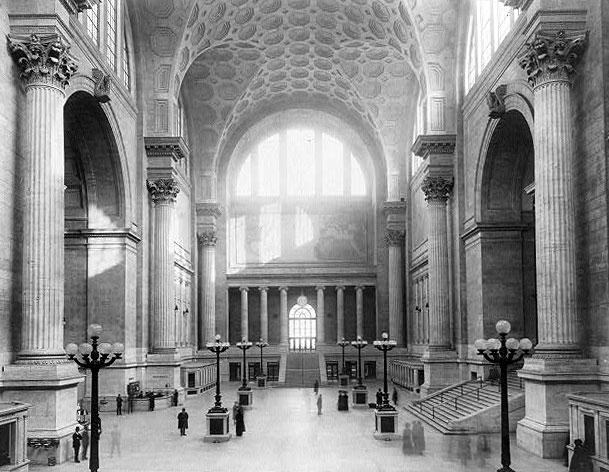
As for Longhill Gardens, barring unforeseen circumstances, it is a done deal. It is not exactly like old massive projects of old, but it will concentrate poverty into the site once again. With any luck, the warehousing of the poor notwithstanding, the worst of its opponents' fears will not come true. In the meantime, it can become, like the felling of Penn Station became to New York and national Historic Preservation movements: a clarion call and a symbol. To quote Ada Louise Huxtable, re Penn Station, "What was gained was more important than what was lost." If that same attitude can be applied to Springfield and its Longhill episode, perhaps the cycle of economic decay and mediocrity can at last be broken.

Forrant, in Turner's article, chastised the Control Board for failing to consider these things during its tenure, more concerned with the political/governing problems at 36 Court St. However, in their defense, they could only do so much with what they had, their tenured framed by not one, but two economic and budgetary crises. A much needed structural house cleaning of government was the priority while doing what it could economically.

The state remains largely disinterested in really stimulating the Springfield area economy, perhaps only seeing linking it to Boston as the solution. Gov. Patrick may try, but he is a man in a position utterly dwarfed by the legislature's power built up over 16 years and longer. Our local legislators may try, too, but they can often only find the same grant money that may complicate the above mentioned problems; other times they can siphon from programs that can benefit the UMASS Life Science partnership with Springfield hospitals, but are really geared for Boston's massive health and medical establishment.

No, economic redemption, sustainability, and ultimately viability can only come from within at this point. Forrant faults city leaders for failing to accept the inevitable about deindustrialization and take necessary action. There is more blame to go around, however. That failure is only compounded by a counterproductive popular nostalgia for the city's industrial past and vibrant exciting downtown. Money alone is hardly the answer. The city and its residents must face reality and reassess their values to truly transform Springfield and its environs economically while investing time, effort, blood, sweat and tears. Indeed much pain, some unfairly born on its most vulnerable. The end result can be no worse the rotten fruit of the current path. Or it may be the start of something new that remakes a city for a new decade and century.


*Cahill Photo from mass.gov, Longhill Gardens photo from Urban Compass, Jimmy Hoffa & Penn Station photos from wikipedia.

Friday, June 19, 2009

The (Sales) Tax Man Cometh...

The Massachusetts legislature has at last hammered out a compromise State Budget for FY2010 complete with cuts in programs and tax increases. Although at this time the results of the conference committee have not yet been voted on by the House and the Senate, the budget's passage is a foregone conclusion. It is possible that there may be many unhappy members of each body (besides the minute Republican minority) that could vote against it or otherwise later sustain Gov. Patrick's line-item veto cuts.

In addition to some $2 billion in program cuts, up to 15% cuts in local aid, borrowing from the rainy day fund, and stimulus aid, the budget relies on about $1 billion raised from a sales tax increase. Included in that increase was the decision to attach the state's sales tax to alcohol sales. The Senate version of the budget had exempted meals from their tax hike, but the Compromise version does not. Additionally, the final version permits cities and towns to impose their own local options tax on meals of up to .75% effectively capping the meals tax statewide at no more than 7%.

The decision to include the sales tax increase in the final version is a partial if pyrrhic victory for the restaurant industry. All the long, they opposed any tax hike, but were particularly stung by the effort by the Patrick Administration and folks like Boston Mayor Tom Menino, Amherst/Northampton Sen. Stanley Rosenberg, and a host of Boston area Reps to impose a tax on meals alone. The Massachusetts Restaurant Association did not like the taste of being singled out, for the first time, from a more general sales tax. In the end, the local meals tax remains a reality, but on a much smaller scale. They still will have to deal with a 6.25% sales tax, barring any community imposes the meals tax. It could and probably will have an impact on their business as it would on othe retail. Perhaps most disturbing, is not the direct impact on restarateurs, but on servers, whose wages have remained frozen in Massachusetts at $2.63 an hour, the lowest in New England. Servers rely almost exclusively on tips and the higher tax could discourage tipping, racking up bills, or going out altogether.

Ironically, the meager pittance that communities have been granted to impose could serve to discourage its implementation. No doubt officials from councilors to union officials to contractors to mayors salivated at what 2% of meals sold in a community could buy. Surely officials like Menino or Northampton Mayor Mary Clare Higgins must have fully anticipated pushing for the maximum tax indifferent to the damage it could impose on their cities' most vulnerable residents. Instead they only got 0.75%. What the hell is that? Even for a city with numerous eateries, that would generate a marginal amount of money. Perhaps the legislature, in a rare act of forward thinking, wanted the amount to be low so cities and towns will not miss it if the tax is later removed. Moreover, should a desperate community impose it, that locality will not be at as much as disadvantage as their wealthier neighbor.

In Western Mass, Mayor Domenic Sarno, in what will hopefully be a firm stance, said that any effort to impose a meals tax must be done in conjunction with surrounding communities so as not to create too much needless competition. Such a likely alliance would necessarily include Springfield, Chicopee, West Springfield, Holyoke and possibly one or two of the suburbs. Those four cities, however, only minutes apart from each other, contain the bulk of the area's restaurants.

The decision to impose the tax on alcohol sales may be more problematic. The ever looming specter of New Hampshire complicates any effot to raise sales related revenue in Massachusetts. The Bay State already has higher alcohol taxes (usually included in prices) than New Hampshire. This increase, which is effectively a 6.25% increase in price, will surely drive more people into the Granite State. The result will be worse on the border towns. However, this may encourage that rim of economic malaise along the border to creep deeper into the state.

The increase in the sales tax more generally will only further exacerbate the problem in retail more generally. However, the argument can be made that the damage may be limited because much of the border areas retail has already evaporated. The biggest malls beyond 495 north of Route 2 are all in New Hampshire. Whatever retail that does exist is totally convenience based i.e. people too lazy or without enough time to make the sojourn north. Should gas prices continue to rise, the damage might be mitigated. Moreover, restaurants have nothing to fear as the meals tax in New Hampshire tops out at 8%, still higher than anywhere it could be in Massachusetts.

In Western Mass, the CT border communities would lose whatever competitive advantage over the Enfield shopping areas.

There will remain—and this would go on with or without a sales tax increase—a conflict over Bay Staters who shop in New Hampshire, but bring their products back home. The state's Use Tax, essentially a mirror to the sales tax for purchases made out of state, should be imposed whenever a Bay Stater shops north of the border. However the responsibility for filing and paying that tax often rests with the consumer who, unless their truthfulness surpasses that of Honest Abe, would never even think about it. The tax is successfully imposed when an item purchased across the state line is delivered to a Massachusetts address or store. It works both ways for purchases made in Mass, but delivered in NH and with other states like Connecticut, where the sales tax amount differs.

Forgotten in this mess, however, are some great political complications. Although Massachusetts does not tax food or clothing under $175, the sales tax burden disproportionately affects the poor. Countless necessary items that they must pay for from health and beauty products to furniture will carry the higher tax. In claiming to speak for the weak and voiceless by preserving programs, Legislators may have indirectly made their plight worst as the economy continues to ail.

Moreover, there will remain a tremendous deficit for transportation projects. Despite suggesting that a sales tax increase would be a safe alternative to the rancor Gov. Patrick's proposed gas tax, the need for more transportation funding is critical. The prospect of a gas tax remains very real. Most of the State population, especially outside the 128 beltway, was dead set against the dedication of almost of quarter of the increase to the MBTA alone. If the Legilature proposed a fair gas tax before the sales tax increase, the voters might have accepted it. Now it might be politically dangerous.

Finally, as the sales tax dedication to the MBTA has shown, sales tax revenue has declined over the last ten years. While the economy may not be in free fall, we will not be out of the woods for months if not years; as a result incomes—and therefore the income tax, the commonwealth's main revenue stream—will remain weak. The legislature demonstrated this year that the social services lobbies (many of which, but not all, having the purest of intentions) still holds more sway. If revenues come in below expectations next year, what will happen then?

Given the reforms the legislature is enacting—at last—the public may forgive them next year. Still, they came with political risk, like standing up to the public employee unions. Moreover, Democratic Challengers and Republican could easily make the case that these abuses cost billions over the years and earlier action might have spared the state cuts in essential service or tax hikes.


*New Hampshire Seal from wikipedia

Wednesday, June 10, 2009

The Sixteen Acres I Hate About You...

Welcome Back.

As orginally reported in Urban Compass, Colvest development group, had proposed a new retail structure at the corner of Parker St. and Wilbraham Rd some months ago. The plot of land, diagonally across from the Pride Gas Station, was slated for a bank and a Starbucks. However, there was some community opposition, mostly concerned with the nature of the proposal.

The initial sketches placed the building several yards from the street, separated by a parking lot. Sixteen Acres Residents were disappointed, however, that the development would not be pedestrian friendly. In other words, the main entrances did not front the sidewalk. Parking lots were necessary, but would be preferably placed either behind or to the side of the building.

Because the development required a permit for the drive-thru at the bank and possibly the Starbucks, the matter found its way the City Council. The Council responded 16 Acres residents' concerns and returned the request to Colvest, urging them to reconsider a more pedestrian friendly set-up.

Between then and now, the economy went belly-up, financing became scarce, and panic reigned in the street. Having heard no progress on the Colvest 16 Acres Project, one might have assumed that it had be cancelled or at least indefinitely tabled.

However, this is not the case. The Reminder reported recently that Colvest has returned to 16 Acres, this time with CVS as a primary tenant. Given Starbucks' financial difficulties and an already high concentration of banks in the entire Springfield area, the switch in tenants is not surprising.

What has not been made clear is whether the CVS building would have an entrance facing the street. Given CVS's typical desire to have a drive-thru for its pharmacies, this matter will inevitably find its way to the City Council, where if the final plans do not integrate into the community correctly, it could find its way to the drawing board.

Colvest and CVS have had their ups and downs with the city and its neighborhoods increasing desire to make more community-oriented, less car dependent environments. Frank Colaccino, President of Colvest, has received a lot of flack for replacing structures like St. Joseph's church with bland new buildings. However, he did not appear totally opposed to community concerns raised in 16 Acres, and the design of the Columbus Avenue Starbucks (also believed to be a Colvest development), laid out the building with its parking lot on the side with a door facing out to East Columbus.

CVS resisted a more community friendly design fronting State Street, when its newer store near Mason Square was built, much to the dismay of community leaders there. A parking lot separates sidewalk from entrance. It is important to note that WMassP&I does not know whether this opposition came from CVS or its developer, whom we cannot confirm was or was not Colvest. In the alternative, CVS appears to have acceded to some of the city's demands with regards to improvements at its Forest Park property.

Perhaps what may complicate matters is the overall desire to transform communities into less car dependent ones. In 16 Acres this is particularly problematic. Sixteen Acres as we know it today was almost entirely built in the post WWII auto-centric era. Its "neighborhood centers" at Parker and Wilbraham and at Five Town Plaza in the Outer Belt area, epitomize that period, with its parking plentiful retail and dining venues.

Still, the attempt to encourage people to walk to their neighborhood or town center reinforces a sense of community, and this is paramount to any municipality. In a city like Springfield, with many such "centers" reinforcing communities is part of the path to overall municipal health. Indeed, the existing building at Parker and Wilbraham has tenants whose doors open out onto Parker's sidewalks.

Outside of the inherently more suburban post-war neighborhoods in Springfield, a focus on such traditionally urban storefronts and developments, whether in downtown or elsewhere will necessary to revive and sustain other neighborhoods. The CVS near Mason Square is a perfect example of what not to do.

However, another problem may be inherent in places like Springfield or other cities like it. Lacking a rail based mass transit system or even transit centers other than the Bus and Rail stations, it is very difficult to encourage transit oriented development, which naturally does what many of today's neighborhood leaders desire. In other words, Transit Oriented Development is en vogue and Springfield, nor Hartford, really have it...yet. However all of that assumes that cities that do use it wisely.

Whatever the case, many older industrial cities in the Northeast that are tight and compacted, unlike their counterparts out west, have greater difficulties getting developers and neighborhood movers and shakers on the same side. Larger cities like Boston and New York have resources and greater car alternatives to maximize their space. Ultimately, any moves to reassess how we develop in Springfield and even its suburbs, must bring people together, favor the pedestrian, while accommodate the car.

Monday, May 04, 2009

Mayor THIS!...

Although time remains for another contender to throw his hat into Springfield's mayoral ring, it seems at this point that the likely candidates will be incumbent mayor Domenic Sarno, City Councilor Bud Williams, and "non-establishment candidate" David Parkhurst. Certainly somebody else could appear, but this is how the field looks today. However speculation about a potential run by City Councilor Bruce Stebbins ended Thursday when the Springfield Intruder broke the news that Stebbins was neither running for mayor nor running for an at-large or district council seat.

The Valley Advocate's Maureen Turner recently produced some in-depth analyses of the impact of
increasing the mayor's term and whether mayors are the answer at all. As everybody knows(except you under a rock people, you), Springfield is in store for nothing short of an upheaval at 36 Court St. With only five at large seats available for the seven at large candidates still possibly interested in running again and eight district seats, the entire dynamic of municipal elections will be unlike anything seen in over two generations. Pile onto that the ruckus the mayoral election will have with Sarno defending his record against not one, but two challengers and, boy howdy, have we an election.

However, as Turner points out an equally important ballot question will be before the voters in November. If approved, starting in 2012, with the swearing in of whomever wins the 2011 election, the mayor's term would be four years long. The question was placed on the ballot as part of the Springfield Rescue Bill, which extended the repayment time the city would be given once the Control Board packs up. The bill itself was fraught with infighting amongst the Springfield delegation, some members of which appeared more interested in their own political ends than the welfare of the city.

Turner's article goes on to describe some of the process, which pushed this proposal into the public forum. It traces back to the Affiliated Chambers of Congress of Greater Springfield. The Chamber seemed to agree that a longer term would give the mayor more time to govern before the specter of reelection turns him or her back into a pumpkin. The downside, the article points out would be a situation as in Boston where the mayor can amass a huge war chest and blast his opponents with professional political operatives, all the while defending none of this record. However, Springfield found itself in a similar ditch when former Michael Albano was mayor and easily reelected every two years.

The proposal has received some support from officials like City Councilor Tim Rooke and Co-Founder of Arise for Social Justice Michaelann Bewsee. However, there exists a concern on the part of some that the drive for this change originated with the Chamber of Commerce. From a strictly philosophical viewpoint, that concern is valid. However, in reality, a great deal of campaign cash for the city's elected officials, both municipal and state, comes from outside the city. Residents of Longmeadow, for example seem particularly generous to Springfield's elected officials winners, losers, sinners, and saints all. The argument might be made that outside forces already have quite a hand in the city's inner workings that transcends its business community.

A longer term does have its benefits for the city, however. As Rooke and Bewsee mentioned in the Advocate, it gives the person in the position a greater length of time to enact an agenda and shepherd projects through. What do you do, however, when the mayor starts pushing something down the throats of the city that it may not really want. For the politically good, a longer term could reap great rewards for the city. For the politically vile, it could lead to the rape of the city.

Additionally, the concern must be addressed for what would become midterm elections. City Council and School Committee elections would face chronically lower voter turnout if the Boston 2007 Municipal Election is any guide.

Turner's Second Article, however, raises the question about whether a mayor is even necessary. After all, in the first article, Turner mentions how legislators seemed intent on dictating policy to the city via the General Court. The second article focuses on Plan E, or the Council-Manager system under Massachusetts Law. Under a Council-Manager system, according to the article, the council hires a professional manager for the city. Although responsible to the Council, a manager is often hired under a contract and therefore insulated from the political pressures put upon a mayor. However, nothing could stop the council from hiring or seeking qualifications for managers that might be inclined to bow to public employee unions or business interests.

The article pulls back and even asks whether local government is even relevant. In Massachusetts, where counties became political anachronisms soon after the last square inch of the commonwealth was incorporated, a "no" answer is not immediate. Additionally, New Englanders as a whole, tend to have a greater identification to their hometown, only generalizing when they leave the Northeast. The irony may be, however, is that New England cities and towns are all creations of their respective states and guaranteed little rights under their constitutions. Nobody is suggesting restoring the old inefficient counties in Massachusetts, Connecticut, and Rhode Island, where counties are basically null.

However, as voters remained apathetic during municipal elections, it might provide the room to expand some services (like education) beyond town lines by legislative fiat. Cities like Springfield, Boston, Lawrence, Holyoke, and Lowell will never be able to raise enough money without taxing themselves into oblivion in order to correct half a centuries worth of accumulated urban problems and flawed policies. Moreover, blurring the lines of municipalities might limit the risk these cities have in losing business and development to the suburbs.

Back to Springfield's November decision. The office of Mayor of Springfield is not going anywhere. A wider charter revision, often appearing in the constellation of Springfield Political Speculation, is unlikely to recommend abolishing the office. At best, it might seek to limit some of the mayor's authority or rework how commissions, which often do much of the work of gov't, are operated. However, the legislature may want to consider some changes, too. The state's local government laws have permitted absuridities like a near-prohibition on the Boston City Council to hire its own lawyer without mayoral approval.

In any event, the ballot question, as Turner points out may be a referendum on Sarno, too. Whether reelected or not, Sarno's rocky term may discourage voters from taking a risk on longer periods of bumpy governance. The question may not get the fair analysis it deserves from voters scared to death of four years, rather than two, of disappointing, if not crooked government.

Wednesday, April 22, 2009

Unencumbered and Incumbent...

The Boston Globe reported today--to nobody's surprise--that Boston Mayor Tom Menino will be seeking an unprecedented fifth term to head New England's largest city. His plans for reelection have been rather overt, despite constant refusals to declare his candidacy or not. In the meantime, the 2009 mayoral race has already attracted three opponents, City Councilors Michael Flaherty and Sam Yoon and Boston Businessman Kevin McCrea.

Massachusetts law requires a non-partisan primary for any local office which has more than three candidates so as to narrow the general election to two candidates on the ballot. This is why we had no more than 18 names on the November ballot for Springfield City Council Elections until this year. With Menino's impending announcement and near-certain success in the primary, the focus now will turn to which of the three challengers shall survive to challenge Menino in the general election.

At the moment, given their existing political success and renown, Flaherty and Yoon are the most likely front-runners to challenge Menino. The Summer Primary Campaign will no doubt focus on Flaherty, Yoon, and McCrea hitting each other while attacking Menino. Whichever one suffers to the least damage to themselves while engaging in attacks on Menino that resonate best will be the challenger in November.

Why, you may ask, is this issue being taken up as a general heading for WMassP&I and not as a Boston Beat issue? Well, the issue of incumbency is an important one in Massachusetts in general. WMassP&I discussed the effects of incumbency and the minimal number of contested races in the legislature for 2008 and finds this race to plug into a wider discussion.

The problem with the legislature was that so few of the races were contested which presents a more serious problem with democracy. If the races are contested, but the incumbents are guaranteed to win, there are implications for democracy, but the real problem comes down to the efficacy of government and the decisions of voters.

Take for example, Congressman Richard Neal. His continued electoral success over 20 years of service, has no doubt been connected to his status as the "successor" of the late Edward Boland. Add onto that his popularity as Mayor of Springfield and his election in 1988 and since has been almost a sure thing. Although largely uncontested this century, Neal did face some stiff competition from both the right and the left in primaries and in generals throughout the 1990s.


In any event, Neal has delivered much needed federal dollars to Springfield and the 2nd Massachusetts consistently (Let's leave a discussion of what constitutes pork for another time). He has been an advocate for reform of the Alternative Minimum Tax and Tax Dodgers that reincorporated themselves offshore after 9/11. Additionally, his support for peace in Ireland is very important to many in his district. There are a number of people who would disagree with this assessment, many of them in the Valley Blogosphere, but WMassP&I feels Neal has served his district and the US House well. That he is able to do because of the Springfield political machine and the natural entrenchment of incumbency presents only a philosophical problem, not necessarily a tangible one.

Unfortunately, many are able to remain in office because of machines and successful glad-handing, schmoozing, grin-and-greeting sans the good service. That does not make them bad, evil, unethical, or felonious people. It just makes them ineffective. Although Springfield has had challenges in its City Council races over the years, the incumbents often remained with little or no effort even as they drove the city over the edge of financial security.

Not everybody gets a free ride with incumbency. Just look ask Charles Ryan. Domenic Sarno, whom some say hoodwinked residents into voting for him, may be singing a similar tune a year from now. History has yet to write the book on Ryan and certainly Sarno, but many would say that at least the former did what had to be done to break the deadlock and bring true reform to 36 Court. Still, it did not guarantee him reelection.

Menino has not been a corrupt mayor at least as far as we know. In a city that has grappled with legendary corruption, this is a relief. His electoral success is based on those same "grin and greet" tactics and the mayor's campaign website claims over 50% of Bostonians have actually met him. As a result Menino has been called a neighborhood or urban "mechanic" and has sought to resolve problems within neighborhoods and not just treat the city as one massive entity. Over the years, he has also successfully engaged in numerous economic development projects that have benefited the city as a whole.

That notwithstanding, as some editorials in the Boston Globe and elsewhere have suggested, Menino is also showing signs of another problem with incumbency: ossification. What is that? Well he's settled in. One cannot go as far as to suggest power corrupts and all that. However his grandiose plans for a new city hall, dropped amidst the economic turmoil, or the ostentatious 1000 foot skyscraper may suggest a man who is reaching to the point that legacy is trumping service to his constituents. Additionally as he has basically gained control over all board and commissions as terms expire, he has forced his own agenda through with little debate or explanation. Personal slights by developers or plans that contradict his own vision have been known to be dead on arrival before the Boston Redevelopment Authority for example.

Menino has pursued a post-industrial economy a little bit too vehemently as well. While nobody is asking him to reinvigorate the factories long a thing of Boston's past, he has endorsed excessive luxury housing construction and retail expansion beyond what Boston can support and often beyond the means of the average Bostonian. This tactic is similar to the one taken by Mayor Michael Bloomberg of New York who defends these tax-revenue rich projects as a means to pay for social services for the poor. A not entirely un-admirable prospect except it squeezes out the middle class, essential for any community to thrive.

Taken with his administration overall, this does not lead to any cause for removal. However, in a democracy politicians should need a reason to be reelected just as much if not more than a reason to be kicked out of office. I realize, however, that is seldom works that way. Looking back at 2005, Menino dodged debates with his opponent former City Councilor Maura Hennigan and tells he stands on his record. Well, what is that record and how do we challenge it? It is incredibly arrogant to simply say that and then offer little more than vague examples.

There is also a whiff of potentially foul play. Yoon's campaign headquarters was warned in what the City's Inspectional Services indicated was a sweep of the area that is needed several permits and had to remove signs from the windows.

I think it would be hard to argue that Tom Menino has not been good for Boston, but the question is can he continue to be good for Boston? Has he been good more recently? Is there some hypocrisy or arrogance in claiming to know what is best for everyone? Is there something disingenuous about relocating City Hall to a seaside setting, significantly less accessible to the public while asking for more taxes on meals produced in the city and often eaten by residents? These are questions that need to be asked both by the press and by his opponents in a true debate. If Menino refuses to do this then that alone should disqualify him for reelection.

If he goes through the whole process again and doesn't rely on his incumbency, then he like Sen. Ted Kennedy in 1994 can emerge reinvigorated and better able to serve his constituents.

These are lessons that Massachusetts from Boston to Lowell to Springfield to Fall River need to learn and practice. Contesting elections is just the beginning of improving the process and enfranchising more people. The 2009 mayor's race in Boston will be a major battle ground as the commonwealth attempts to work through the corruption, malfeasance, misfeasance, and incompetence that has hampered us for so long
*Menino Photo from wikipedia, Michael Flaherty & Sam Yoon photos from respective campaign websites

Wednesday, April 08, 2009

Green(er) Mountain State Marriages...

Tuesday, Vermont became the first state in the country to legalize Same-sex marriage by legislative action. The Vermont House of Representative overrode Gov. Jim Douglas' veto, passing the legislation. The state joins Massachusetts and Connecticut, where the marriages are now legal, and by the time the legislation is enabled in September, Iowa, will have same-sex marriages as well. Quite possibly, New Hampshire may join this group by that date, too.

Same-sex marriage hits people on an emotional level on both sides of the issue. Although you could easily find a majority in almost any state opposed to same-sex marriage, it is not an issue that motivates voters outside of few states. Certainly, it has had little effect on Massachusetts legislators who did not forward a constitutional amendment banning same-sex marriage here.

Ballot questions are quite different. It is easy to stir the masses, and frankly the public at large is nonplussed by the "separate but equal" argument made by marriage advocates. Trying to equate a difference in terminology with a substantive evil made possibly by racist laws diminishes the latter. Refusal to grant the same rights to same-sex couples is wrong; however calling their legal contract, which is what marriage is, something different in no way diminishes the force and effect of that contract. One cannot say if this whole process goes on the mind of a voter, but certainly pieces of it might.

Consider what happened in California. Same-sex marriage came, none too surprisingly, by way of the California Supreme Court. A ballot initiative was already underway. A court ruling, instead of a legislative avenue, made people upset. Courts are to interpret law, not create it. Add onto that same-sex marriage supporters like San Francisco Mayor Gavin Newsom (who is actually a good guy and would make a good gubernatorial candidate) who said same-sex marriage was coming "whether you like it or not." There was some fear-baiting going on, too, which was uncalled for. Either way, the amendment to the California Constitution passed in no small part to the public's indifference to the "separate but equal" argument.

If the separate, but equal mindset must prevail, then marriage must be reevaluated. It is and will be impossible to divorce--pun intended-- marriage from its religious roots. Although some churches have agreed to bless same-sex unions, do not expect this to happen en masse ANY time soon. Therefore, if all everybody is getting excited about is words, maybe the word we used to describe the union of two people should be reconsidered in a legal context.

All these arguments aside, Vermont's same-sex marriage bill is the best way to institute these changes. Although the world has not ended in Massachusetts, nor will it in Connecticut or Iowa, these victories were achieved by judicial fiat. Certainly in Massachusetts, this is the case, where the Supreme Judicial Court substituted its own feelings for the law. The Late Justice Martha Sosman, who dissented in Goodridge V. Board of Health worried that it was a dangerous precedent for the Court to fit the law to its agenda. Sosman, who was mocked in the majority ruling for being behind the times, was a liberal-minded justice whose dissent shocked many in the legal and gay communities.

Not knowing the full legal basis in the California, Connecticut, or Iowa rulings it is hard to dissect those decisions. What is probable and would be a worse precedent than anything done by the courts so far, would be overturning Proposition 8's passage in California. The proponents of the amendment, as stated, did some awful things to get the public to vote for it--and they did. Prop 8 opponents are claiming the amendment was a revision, which must pass through the California Legislature before it can go to the voters, something that would not happen. As such opponents call for it to be stricken down. They also claim that no ruling has ever removed rights from a group, an argument meant to grant a moral imperative, but does attempt to bolster the revision versus amendment position. However, should the court invalidate the amendment, the result would send a chill down democracy's spine. The electorate does not always make the best or even right decision and is prone to demagoguery; nonetheless its wisdom CANNOT be substituted for the wisdom of the courts. Waiting until the next election and overturning the amendment is the best way to correct whatever wrongs or evils inherent in Prop 8's passage.

Whether the amendment stands or not, it would be foolish and wrong to invalidate the already performed marriages. The amendment was not written retroactively and undoing them could be likened to ex post facto laws. Ex Post Facto refers to laws meant to criminalize an act that was not illegal when it happened, and is prohibited by the US constitution.

Such a move would also grant it public ascension, strengthening the minority's rights. Whether we want to think of it this way or not civil rights and women's rights were ultimately gained through the democratic legislative process. Some might argue that we do not need to go through that process because of the gains made in both of those movements. However, racism, sexism, and homophobia are not the same things. Hate is hate. Discrimination is discrimination. However, all discrimination, however equally wrong, is not equal, ironically enough.

Back to Vermont. one should not be surprised to see some heads roll come the next election, but overturning the law now is unlikely. Vermont has always been a little off-beat with its socialist Congressman turned Senator. Whatever its politics and culture may be, they have shown us that democracy still does work. You may disagree about same-sex marriage; however opposition to or support of it is like being on opposite sides of a tax increase.

Gays and Lesbians deserve to be happy. However, happiness cannot be defined by a piece of paper. Marriage includes a number of legal rights and responsibilities, but it is really about the two people. What they make of their lives makes the union, not what the government calls it.

*Vermont State House photo and Prop 8 protest photo in Sacramento both from wikipedia

Tuesday, March 31, 2009

Lighting Up an Issue...

The passage of Question 2 is in many ways one of the greatest victories in the history of drug reform in the United States. Say what you will about Massachusetts' leftward political bent, but the results from last November would have been reproduced in all but the most conservative states that have not already decriminalized. Even in those conservative states it would have failed by a close margin, not a lopsided gap such as the one by which the Massachusetts initiative passed.

Just to show, however, that Massachusetts' leftwardness is isolated to a few issues, the ballot question only a few months is already being challenged. No, the legislature is wise enough not to invent a problem for itself there. Rather, many communities, Springfield included have sought to increase the fine or even make it punishable with criminal prosecution. The crime, by definition, would be "smoking marijuana in public" and be fined just as drinking in public would be.

The lunacy of that, however, is the implicit fact that most citations for marijuana use would be issued to those stupid enough to be caught outside with the drug. Admittedly, the fine could not be imposed if a police officer had cause to search and only discovered a small bag of thus-far unsmoked weed.

Boosters of the law in Springfield made the specious argument that Springfield could become a haven for pot smokers. Given that the law is the same everywhere in the commonwealth, it seems unlikely that Bay Staters would truck into Springfield to toke up, because the city just has the stoner feel. Likewise, why would Connecticut residents come to Springfield and not somewhere else in the area? The entire state is up for grabs.

The dubious wisdom of these added punitive measures notwithstanding, the entire issue speaks to the wider problem with marijuana in society. Marijuana decriminalization and legalization groups estimate that 80 million Americans have at least tried pot and fair number of those have done so in the last five years. Millions more do share the notion that marijuana is essentially harmless.

Marijuana is not harmless. Unlike other drugs, the threat is almost entirely to the user. People can become dependent on the feeling when high and not feel they can enjoy life or otherwise function unless high. The compulsion is psychological, rather than physiological. Some extreme cases need and enter rehab. A few others enter rehab out of the fear and confusion of friends and family. Some people experience true burnout, but it is rare; otherwise the greatest threat from continued heavy use, which represents a fraction of marijuana users, is lack of ambition.

It is, therefore, not worthy of the Schedule I narcotic rating given to it by Congress in the 1970s and kept in place by the Drug Enforcement Administration and the Department of Justice. Schedule I drugs, like heroin, ecstasy, LSD, and others have no recognized medical value, represent a direct threat to human health, are incredibly addictive, and other terrible, awful things. Even Cocaine, a very dangerous drug does not fit into Schedule I because of its anaesthetic use as a local, however rare today.


Enough doctors in thirteen states have said marijuana has medicinal uses. Furthermore it is not fatal. The cells in the brain that could be killed by delta-9 tetrahydrocannibinal are not ones that control primary functions. As far as health risks elsewhere, it can mirror some effects of smoking tobacco, but most users do not use it often enough to cause any long-term or corollary effects.

As with Question 2 and other bills in other states, the move to reassess marijuana is underway on the federal level. Eric Holder, President Barack Obama's Attorney General, has said that the DOJ will not overtly pursue marijuana producers, dispensaries, or patients that are sanctioned by state health authorities. In other words, glaucoma patients have a reprieve at last! That should not be confused with approval of marijuana for medicinal purposes. It represents a respect for state laws, essentially ignoring Gonzales v. Raich. Gonzales was a Supreme Court decision in which the court ruled that federal law preempted state law on medical marijuana and the medical marijuana community of California could not stop the Feds from enforcing federal law. Holder's position may sit well for now; however, absent a change in law, regulation, or even policy, that respect for state law is conditional, based on the mood of the DOJ and the Oval Office.

That being said, there could be hope elsewhere. Pres. Obama's nominee for Director of National Drug Control Policy, Seattle Police Chief Gil Kerlikowske, had put marijuana law enforcement on the low end of priorities for his force. A similar move as Drug Czar, as the position is unofficially called, could allow a friendly Secretary of Health and Human Service, possibly Secretary-designate Kathleen Sebelius, to begin in earnest the cannabis rescheduling process.

Outright legalization is far off, if likely to materialize at all. Even the Netherlands, famed for its "coffee shops" has begun to pull back from its position as a stoner's Shangri-La. Americans are most likely to follow countries--other than Holland--that simply ignore all but the worst problems associated with pot, like the current violence on the US-Mexico border, which involves a range of drugs. Legalization will likely only occur if the government becomes so desperate for cash it overlooks its 70+ years of racist cannabis laws and allow legitimate business to bankrupt the street trade.

That is still years off and there are legitimate concerns to be had when considering teenage cannabis use. Adults, hopefully, can balance their lives appropriately and engage in responsible use, whereas teenagers, just starting their adult lives and facing new changes and challenges in high school cannot. In any event, the time has come to have that serious discussion about pot in American society.

Thirty-fives years after the end of Vietnam, the drug has fallen out of association with radicals and finds users from one end of the political and social spectrum to the other. Politicians have treated marijuana as delicately as it has treated Social Security, a third rail issue. However, their fear is unreasonable. When Michael Phelps got caught with a bong and Kellogg's ended any future endorsement deals, the cereal company's sales fell off. Americans may not be the most sophisticated people on all issues, but they have had enough time and experience with this issue to at least be frank and open about a substance so many of them have used and maybe, on occasion, still enjoy.
*Marijuana Leaf, Springfield skyline, and Eric Holder photo all from Wikipedia

Wednesday, March 18, 2009

Give Us Liberty or We Sentence It to Death...

There has been a lot of buzz in the media and in political circles about Massachusetts' abysmally low rate of contested Legislative races last year. Only 35 of 200 races were contested, the lowest rate of all the states that held legislative races here. The previous year, Boston had its lowest voter turnout during for its midterm City Council races. It has led many, such as the Boston Globe's Jeff Jacoby to observe that Cradle of Liberty may have witnessed the death of democracy within its own borders.

Both Jacoby, Commonwealth magazine, and others have drawn parallels and lessons from Minnesota. The two state both have similarly sized populations, with its biggest block of people clustered in the capital areas. Both states have a reputation for progressive/liberal politics, especially in the last century. However, all of Minnesota's State legislative races were contested. Sure, the bluest and reddest districts remained unchanged, but there was debate and perhaps most importantly there was choice.

What makes Minnesota "more democratic" if you will, boils down to a few things. Amassing campaign war chests is impossible. Unspent campaign money cannot be carried over year to year in excess of $15,000. Moreover, the state has a more effective public campaign financing system than Massachusetts did its brief affair with public financing of campaigns. Money is collected and allocated to a party based on taxpayers checking off a box on their taxes. Moreover, the parties are encouraged to field candidates for every partisan office or risk losing their allotment of public financing for that district. Notably, Minnesota's Constitution requires that its House Districts fit into its Senate districts as there are exactly twice as many Reps as there are Senators. This may result in a system that makes it easier for voters to figure out who their officials are.

What further vexes people is how the Minnesota legislature, which is part-times passes the same number of bills as the Massachusetts General Court, a full-time legislature. Rate of bill passage, is not, however, indicative of anything. Certainly many bills should not pass and that is part of the process. However, since so many bills that do pass are of a local nature or somewhat inconsequential (and not knowing how that shakes out in MN), it does give one pause.
So what to do about it?

Well, the reforms in the campaign finance system would be a great, if unlikely start. The legislature is probably not going to legislate a limit on annual campaign carryovers. The public cares, but not enough to serious contemplate voting for somebody else in the ostensibly unlikely event that their rep or senator is challenged. However, a ballot initiative may have some hope there. Who could oppose it? Maybe some groups that have a misguided sense of how campaigns work. Certainly no politician would say "Vote this down because its unfair to me, your Rep or Senator for life, who benefits by the status quo." The other parts including a new financing system are quaint, but doubtful since it would inevitably entail some start up money from the state, which it does not have.

Then there is the question about the part-time, full-time nature of the legislature. Despite the similarities, it seems unlikely that Massachusetts would benefit from a part-time legislature. First of all, it seems doubtful that the state could sustain its pace with less time. The legislature would likely remain one of the most lobbied in the country and the political infrastructure, which extends into the cities and towns would take years to yield any benefit.

The alternative would be to further professionalize the legislature, which entails more money for lawmakers. More money might attract more qualified candidates. That, simply, will not happen. Bay Staters remain angered by pay increases guaranteed to lawmakers under the state Constitution. Boosting them to six figures, as California lawmakers have, would be anathema to voters. It is important to note, however, that California's forty Senators in Sacramento have more constituents than any US Congressman from the most populous state.

There is also a question about attitude. Both Jacoby and Commonwealth magazine note how Minnesota legislators hand out their private numbers "like candy." I think the mindset in Massachusetts simply doesn't fit that kind of behavior. Should Reps and Senators have gatekeepers than limit access by Constituents to them? No. However, all 200, the Speaker and Sen. Pres included must make a concerted effort to be available and limit screening, from Constituents mostly, as much as possible. Keep the staff to filter out the lobbyists and nuts, however.

It is frightful to think that Springfield had 18 candidates for City Council in 2007 for 9 spots, while the following year only 35 seats were contested in the Legislature. For the rest of the state, particularly its affluent communities to cast aspersions upon the City of Homes, is odd. Sure, the city kept electing yutzes who brought the city near bankruptcy, but we maintained a democratic spirit and competition throughout, unlike many of them, including Boston.

Change is glacial and in Massachusetts it skips a few ice ages. One way or another something must be done. It will take more than laws. It will take a more involved citizenry, including people willing to challenge incumbents, however hopelessly. It will mean legislators who decide to retire after a period of time, not relying on legislating as a career. Nobody is saying term limits. We're just saying let somebody else have a chance. Then, Massachusetts may have a chance to live up to its name in both history and lore.

Thursday, March 05, 2009

Gas Me Up, Gov'nah...

Although other revenue options remain in the background, the most tax that has generated the most buzz and discord more than any of the others is Gov. Patrick's plan to raise the gas tax 19 cents on the gallon. The result would be over 40 cents of state collected tax. Although the amount is extremely controversial, it is the intended use of this extra money that has roiled Bay Staters more than anything else.

Of the nineteen cents to be imposed more than half would go to debt service at the MBTA and the Turnpike. Failure to add these moneys, the Administration claims, would result in service cuts/increased fares and higher tolls respectively. However, the outrage coming from Western Mass and some of the outlier areas of the Eastern regions has made set the stage for bruising battle.

The governor was in Springfield yesterday pushing his plan for a higher tax. He called upon the crowd at STCC to put aside "Regional Grievances" and take one for the team. Funny how the governor would call for the entire state to be "one for all and all for one" when he is simultaneously peddling an options tax that will pit communities against one another, but I digress.

The governor suggested that such disparities are made up for with other legislation, namely the Springfield recovery. That money will be paid back, however (It is for reasons like this that is good the stabilization loan was simply not forgiven)

It is possible to make an argument that some of the money go toward the Turnpike. It does extend along the entire state and the far western portion has not had tolls for ten years. Still, the state decided that the Turnpike should suffer to carry the Big Dig, which substantially affects only the Boston area. Additionally, it is hard to sympathize with those paying tolls for the Ted Williams tunnel for example, which is the only actual component of the Big Dig that is tolled.

However, it is asinine to think that almost one third of the proposed increase should go for the MBTA. Unlike the tunnels and the Turnpike, the MBTA is overwhelmingly used only by the people in the Boston area. Despite the promise that 3/4 of the overall tax would go back to "transportation districts," (thus far poorly defined) this remains a bad deal for the non-Boston parts of the state. Promises like this have been made before--and reneged. The math does not add up, either. Finally, extra compensation for the regional transit agencies across the state still does not make up for this second statewide directed subsidy for the MBTA. Already 20% of all sales tax paid in the entire state goes to the MBTA exclusively.

Legislators in the Boston area--in a rare example where what they say will probably not go--actually want a higher gas tax, as do Boston Business Groups and the Massachusetts Taxpayer Association. One legislator's bill would dedicate twelve cents of the gas tax to the MBTA. If six cents was asinine, what exactly would you call twelve? For all Boston area legislators and officials' gripes about the West and Cape's parochialism, how provincial is it for them to call for an even steeper tax when many of their constituents do not drive and do not need to? Certainly cuts in service at the MBTA and higher fares are a problem; however it is difficult for the rest of the state to care when the Boston area has enjoyed lower fares and less drastic cuts than virtually any other transit agency in the state.

A gas tax increase is inevitable. However both how much and where it goes is crucial. Areas unaffected by the MBTA and the Pike, too, should not be forced to deal, once again, with those agencies malfeasance. We should not also demand that all the money has to go for roads either. In New Hampshire, for example, the Supreme Court ruled the Gas Tax there could not be used on rail, hampering development in that state. We can have a gas tax that will benefit rail, but over here in the Pioneer Valley, not in Boston.

The answer may be more broad tax increases, followed by a direct infusion of cash by the commonwealth. The result may be the same, but non-Boston area residents can feel less cheated and in fact they will be. It is time for the West and other areas to stand up and demand that the Metro Boston area pay for its own mistakes. It could lead to region-based tax increases, but it could also mean better fiscal responsibility both on the state and local levels.

Tuesday, March 03, 2009

Shortest Months of the Year...

February was a bad month on so many levels. Transportation funding and miscellaneous taxes have set passions ablaze. Libraries and Public Works face drastic cuts in the City of Homes. The economy, well, what can one say?
And WMassP&I has not been here for you. If its any consolation, we're working on a big(ger) article about politics in Massachusetts in general and once the time is found to parse the fat from it, the post should go up. In the meantime, I hope whoever is still reading can take some enjoyment from these Daily Free Press columns out of Boston.