Google
Showing posts with label Amaad Rivera. Show all posts

Friday, February 10, 2012

Not for Entertainment Purposes...

Mayor Domenic Sarno (WMassP&I)
Under any circumstances it cannot be said often enough that we do not believe that Domenic Sarno has anything but the best of intentions for the City of Springfield.  We have often disagreed with his policies, but when we endorsed his opponent last November, our position was not a personal one.  Nor did we think that Sarno lacked the dedication, conviction or affection necessary to govern our city.  We simply felt it was time for a change.  The voters disagreed and, frankly we were always far more disgusted with their lethargy and absence at the polls than the decisions they made there.  Our faith in Sarno's dedication to Springfield remains intact.

However, the mayor's decision this week to impose new rules on the cessation of entertainment as food and beverage establishments in the city is misguided, hurried, counterproductive and doomed to achieve none of its goals while inviting further problems for the city.

Under his authority under the General Laws of Massachusetts, Sarno has promulgated new rules requiring a separate application to maintain entertainment until 2 a.m. in restaurants and bars.  Once these rules take effect, entertainment must cease at 1 a.m. unless the permit for the additional hour is approved.  Assistant City Solicitor Alesia Days recommended the proposal over the fierce objection of bar owners in the interests of public safety.  The theory is that earlier cessation of entertainment will effectively close the bars earlier, even though they may continue to serve liquor until the statutory closing time of 2 a.m. unless otherwise prohibited by their liquor license.

However, it is our view that this process was flawed from the beginning and represents a desperate attempt to contain a very real problem, but via a means that will in fact not correct that problem.  Instead it will inflict economic harm to the city's entertainment district and to its property and meals tax base while providing no more safety and security to bar patrons and Springfield Police Officers.

The risks to the city fall into two broad categories.  The first is the risk of legal action.  While bar owners are not prepared to file suit, yet (there has to be an injury, that is denial of a permit first), the city's case for promulgating these rules may not stand up to scrutiny.  The mayor's cited his authority to protect public safety and order and limit nuisances under M.G.L. 181 & 183A to create this new rule.  However, the connection between this proposal and the reasons stated, that violence is happening at closing time is defeated by the logical conclusion that violence will merely happen an hour earlier.  It is circular reasoning that we will reduce violence by pushing back the effective closing time or limiting the time people will be imbibing because it assumes that people will not start drinking any earlier or will not "pre-game" a bit more before going out.

Saturday, December 31, 2011

The Year in Springfield, 2011...

(WMassP&I)
With another year under Springfield’s belt comes another edition of the Year in Springfield.  In its 375th year of existence the City of Homes suffered through one of the most erratic year of weather on record which brought a range of immense destruction and gross inconvenience.  Politically, it was also a tumultuous time from Springfield City Hall to Beacon Hill to the steps of Harvard University.

The year 2011 opened in Springfield with an eye, as in other places, to Washington, where a cadre of increasingly nihilistic “citizens” took their place in Congress and in state capitals across the nation.  While the boat rocked in Massachusetts with a shrunken, but still massive Democratic edge in the State House, Governor Deval Patrick took the oath of office once more. 


However, America was rocked only eight days into January when Arizona Congresswoman Gabrielle Giffords was shot in the head, by quite literally a madman.  Early accusations pointed to tea party extremism, but ultimately mental disease and not right-wing anarchy drove the young man to shoot Giffords and twelve others while murdering six.  Gifford suffered a traumatic shot to the head, be saved by the quick thinking of her intern of five days.


Cong. Gifford w/ her Mother weeks

after the shooting (PK Weis via Facebook)
President Barack Obama, given his first significant opportunity to play the healer-in-chief gave a stirring speech at a memorial service attended by Arizona’s Senators, its governor with Obama has frequently clashed, Giffords’ husband, Mark Kelly and Supreme Court Justice Anthony Kennedy, who oversees the Ninth Circuit within which the slain judge, John Roll, served.

The event took on somewhat of a local relevance when Congressman Richard Neal held a press conference after the shooting noting that he had known Giffords and had raised money for her ahead of what had been a difficult reelection in 2010.  However, he also urged that parties take down a notch the vitriol and anger that had become pervasive in politics whether Loughner was driven by politics or not.


Also in January Amaad Rivera took office as the Ward 6 Councilor following the resignation of Keith Wright.  He took office because the city’s succession law is only written with only at-large councilors in mind and fills vacancies with runners-up.  Technically, Rivera was a runner-up even though he lost the 2009 election.  The chorus of dissent included this blog and came to a head on a vote for eminent domain as part of Forest Park Middle School renovations.  Rivera invoked Rule 20, the council’s parliamentary motion to delay the project to the shock of other councilors.  While we would settle our differences with Rivera, many remained incensed over the use of Rule 20, ironically including some who would encounter similar anger over its usage.


Councilor Amaad Rivera (WMassP&I)
However, the focus on Rivera would lessen as he became one of a super-majority of councilors that opposed a wood-burning biomass plant.  The special permit had been granted in 2008 by the last council on a 7-2 vote.  All ward councilors and two at-large councilors, including Jose Tosado who voted for the permit in 2008.  The Callahan Family, owners of Palmer Renewable Energy and like-named paving company poured money into experts who dismissed, often condescendingly, the health concerns raised by opponents.  Against the din of protests and threats of legal action the council revoked PRE’s permit on a 10-2 vote.

Thursday, November 24, 2011

Take My Council, Please: Council Talks Turkey on Biomass...

(WMassP&I)
With the holidays around the corner, the turkeys of the Springfield City Council gathered Monday for a Thanksgiving week meeting to handle some issues that had been at a simmer for several weeks now.  Some of the hottest items were taken care of before they boiled over.  Others had the heat turned up higher for next week‘s special meeting.

Among the minutiae before the council was a series of utility reports, permit revocations for non-renewal, several property donations and grants.  The revocations were for underground storage tanks and parking lots permits brought up by the City Clerk because the permittees failed to respond to renewal notices.  The city formally accepted some parcels of property for public use and the council accepted grant money for Health & Human Services, Dispatch Services and tornado relief.


Bill Gibson of Springfield Speaks in Opposition to Biomass
Plant Permit (WMassP&I)
A speak-out before the meeting included several opponents of the biomass facility on Page Boulevard, which controversially received a building permit despite the council’s revocation of its special permit.  Among the speakers were local activist Michaelann Bewsee and a representative from the Conservation Law Foundation, a New England environmentalist group.  Kevin Sears of the Sears Real Estate Company spoke to oppose to the city’s Foreclosure Ordinances adding in an un-sourced claims of retaliation by lenders who would refuse to loan in the city (a legally suspect action, if true).

Budgetary updates showed the city more or less on target, but the monthly reports are off because City Hall was closed at end of the October when the city often receives tax money.  Ward 7 Councilor Tim Allen requested more information on the Tornado and now October Snowstorm costs to the city.  Those numbers were not included in officials’ reports because spending for disasters is done in separate emergency accounts.  Budget officials promised a detailed report on disaster spending by the next meeting.  In a pleasant surprise, the city also clocked in a higher than expected surplus last year of $4.7 million.

Ward 2 Councilor Mike Fenton, chairman of the Finance Committee, also announced an end to the city’s budget drama with the transfer of $6.2 million from stabilization reserves to close the city’s budget deficit.  Fenton praised the council reduction to $6.2 million from $10.5 million from stabilization reserves used to balance the city’s budget.  The reduction was made possible through cuts and an increase in local aid to the city.  Fenton called it a “much more reasonable position,” for the city in light of still-unknown disaster costs, union contract negotiations and another deficit expected next year.  Fenton also alluded to using some stabilization to mitigate an increase in the property tax rate for the city.

Saturday, October 22, 2011

Take My Council, Please: Anatomy of a Feud...

Sorry for the delayed post of this week's Take My Council, Please.  If it make you feel any better, part of the reason was due to the relatively minor items that were before the council.

(WMassP&I)
The Springfield City Council pulled out a quick meeting despite some divisiveness on non-binding issues and ordinance revisions  The meeting took place following a rally of Occupy Springfield and Take Back Springfield, two separate groups arguably focused on the same issues.  Many from those protests, who were on hand to support a resolve against Bank of America and technical changes to the city's foreclosure ordinance, filled the council chamber and milled around city hall.  Although the chamber and the hall were much fuller during the Biomass debates, police were deployed throughout the building.  Ultimately, the proposal fueling much of the crowd's interest was sent to committee deflating the crowd and causing them to release their anger in not-so-veiled, but somewhat overstated political complaints to the council generally.

Disposing of the minutiae, non-controversial ordinance revisions of the city's vicious dog and criminal disposition ordinances passed second steps.  Fire, Library, Health & Human Services and the Health departments all got approval to receive grants.  Director of the Health and Human Services Department Helen Caulton-Harris once again showed off her departments grant-writing prowess with a $100,000+ haul.  The council received reports from Ward 1 Councilor Zaida Luna on a literacy program and Ward 2 Councilor Mike Fenton on prior year bills.  Payment of the bills was approved without objection.  A permit and some zoning changes were approved and deed delivered to the developer of a tax-foreclosed property.

Councilor Rivera (Facebook)
Toward the end of the debate the council considered two resolves.  Once sponsored by Ward 6 Councilor Amaad Rivera called for the city remove its remaining funds from Bank of America and another calling for greater enforcement of the city's residency ordinance.  The residency ordinance encouraged the mayor to negotiate in residency to the upcoming employee contracts while working to see the spirit if not the letter of the residency ordinance is applied to non-bargained employees.  The city ordinance is rarely enforced and Mayor Domenic Sarno has not appointed the enforcement commission as required by law.  More to the point, he frequently uses its exemption provisions.  Councilors ultimately sent the resolve to committee to discuss broader options to enforce residency.  At-large councilor Jimmy Ferrera called for a home rule petition, but such a petition would require the mayor's signature and would almost certainly die in the legislature.  This was a point noted by at-large Councilor Tim Rooke, but he also pointed out the politics behind legislators avoidance of the issue.  However, neither point suggested a way to actually enforce residency broadly nor a recognition that legislating away residency as a negotiable item is political impossible in this political environment.

On the Bank of America resolve, Ward 7 Councilor Tim Allen rose to ask the city's Treasurer-Collector how much money the city really had in the Bank of America account.  The treasurer said that the money is there because one payee to the city continues to wire the money into that account, despite continued protests to the contrary.  The treasurer went on to say that the only reason the city left the bank anyway was because they got a better RFP from Citizens Bank, a Scottish-owned firm.  Allen was uncomfortable singling out Bank of America, however much the institution deserved it, especially in light of the city's broader efforts of the city to  rein in renegade financial institutions.  Rivera, who sponsored the resolve disagreed and voted against an effort to send the resolve to committee, where it went.  The crowd overheated from the earlier rally attempted to call out "shame" for each councilor that sent the measure to committee, but Council President Jose Tosado squelched that.  The crowd exited chanting, "We'll be back!" as if the measure had died, which it did not.  Rivera said afterward that the dialogue of sending the measure to committee was a positive thing, although he would not have done so.

Thursday, September 01, 2011

Intersection of Andrew & Wilmont...

City Council Chamber before meeting (WMassP&I)
Days after at-large Councilor Jimmy Ferrera offered his cynically and politically worded resolve before the Springfield City Council and Ward 3 Council Melvin Edwards slapped him down with a rhetorical stroke that summoned a cheer from the audience, irony struck.  In the period of less than a week, the city clocked in two homicides in as many days bringing a deadly total for the summer and pushing the city perilous close to a recent high in annual homicides.  Troubling still is that both victims, appear, according to press accounts, to be innocent bystanders.

Jonathon Tallaj was killed on Wilmont Street in the city's Forest Park neighborhood, a street that has had a particularly troubled history over the years.  Meanwhile not far away Kevin Gomez was murdered at a party on the one year anniversary of the murder of Cathedral student Conor Reynolds.  Another youth died from a gunshot wound on Washington Street this summer.  The murders frame, to some extent the roughest parts of Forest Park, vaguely defined by Belmont and Dickinson to the West, White Street to the East, Orange Street to the North and either Washington or Fountain Street to the South.

The city's other recent homicide victim, Carmen Melendez, 16, was killed on Andrew and State street seemingly the victim of a stray bullet.  She died near where the all too ironically named Sheldon Innocent was murdered by an escaped convict whose rampage included other victims, including cops, that survived their injuries.  All but three of the fifteen victims this year, have been under 40 and most were under 30.

Councilor Ferrera (Urban Compass)
It would seem that after the most recent barrage of gunfire that Ferrera was right and that more overtime and more money is automatically the answer.  The police need to get tougher and offer a display of force, some may say.  Such decisions can certainly be made after the council returns from its huddle with the mayor and police commissioner, the only tangible demand left credible from Ferrera's resolve after Edwards slapped his colleague down.

If the council, the mayor and Commission William Fitchet divine any insight from such a meeting, if it ever happens, we should hope knee-jerk reactions or the throwing money is not the result.  The answer to the city's crime problem will not, in itself, be more cops on the street or more overtime available to the police department.  It will not be more gunshot detection technology or cameras downtown alone.  The problems are simply to complicated to be solved with such glib answers.

As Edwards somewhat wryly put it last week, he could kill his wife in the privacy of his own home regardless of the number of cops on the street.  Likewise, is there anything that more police would have done to prevent the most recent back to back killings?  It is possible that were more police on the street or riding in a patrol car, their mere presence might have stopped the perpetrators from pulling the trigger.  However, that may have only delayed the bullets by minutes and different victims may or may not have been come to be.  As for the victims with known histories of drugs or violence, if their killers were determined not even the best policing the world could stop them.

Wednesday, August 24, 2011

Take My Council Please: Grocery Ills...

The Springfield City Council held the equivalent of a double feature Monday night.  A regularly scheduled Hearings meeting, during which the council approves or denies permits, followed a special meeting where numerous items were debated.  City Council President Jose Tosado had scheduled the meeting to complete the final steps to pass ordinances related to foreclosures.  However, like any meeting, councilors could and did tack on whatever they wanted.  As momentous as the foreclosure ordinances were, it did not provoke the same level of back and forth, among the councilors at least, as other items.

First the easy stuff.  The Council formally accepted the withdrawal of a petition for an electronic sign on Dorset Street for the Martin Luther King, Jr Charter School.  Reports came from the General Government and Audit Committee over progress at the Putnam High Construction site, specifically possible violations of the city's Responsible Employer Ordinance.  Also discussed, but ultimately referred back to committee was the agreement to a Tax Incremental Financing for a new warehouse for F.W. Webb, a plumbing supply company.  The TIF is a condition for the city to sell some of the remaining land on the city's Smith & Wesson industrial park.  There is a great deal of controversy over the shockingly low number of jobs the project will create and concerns that the developers will make little or no effort to employ city residents.

(WMassP&I)
The council also undertook the second and third steps necessary to approve two ordinances related to foreclosures.  The first ordinance requires the banks that own foreclosed homes to post a $10,000 bond that can be used by the city to maintain the property.  Presently, the city must cover the cost of maintenance necessary to keep the foreclosed properties from blighting the neighborhood.  This ordinance would transfer that cost, if any, to the banks.  They would recover the bond fully upon sale of the property.  The other ordinance mandates mediation between the bank and homeowner when foreclosure become likely.  Banks would be fined for refusing to attempt mediation consistent with the ordinance.  After the second step passed, many of the people in the council chamber in support of the bill erupted in cheers.  Little did they realize that the ordinance had not yet become law.  As they marched out of the chamber and onto the steps of City Hall the council debated several resolves before finally passing both ordinances with a pair of 13-0 votes.

The foreclosure legislation is believed to be a model in the commonwealth if not the nation as a whole.  There are some rumors that congressional Democrats have contacted City Hall for more information about the ordinance.

Some of the biggest fireworks, however, occurred over a resolve, sponsored by at-large Councilors Jimmy Ferrera and Tim Rooke.  The resolve, whose campy language could appeal to anybody favoring style over substance, called on the mayor, police commissioner and Chief Administrative and Financial Officer to meet with the council to find money to add to the police overtime budget to combat the rise in crime.  In short, the resolve wanted more police overtime money because that would reduce the city's crime rate.  Ferrera suggested that the city should raid its cash reserves and other backups immediately to fight crime, even though the city's overtime budget was left completely intact in the 2012 budget.


Councilor Edwards (Facebook)
Ward 3 Councilor Melvin Edwards, however, was not amused or impressed.  In an impassioned, biting and articulate speech, Edwards slapped Ferrera down for advocating pouring money down a very specific hole to solve a problem as complex as the city's crime problem.  He asserted that he fully supported the police department and whatever it needed to keep the city safe.  However, Edwards rejected the notion that throwing money at the problem (or put another way, playing stat games) was the solution.  "If I choose to strangle my wife in the privacy of my own home," Edwards said, "it would not matter if there were a thousand cops on the street."  Even though Ward 5 Councilor Clodo Concepcion stood up in support of the resolve saying "We're scared,"  it was clear that Edwards speech had a deep and instantaneous impact.

Councilor Rooke, a sponsor of the resolve, quickly pivoted saying the call for a meeting with councilors should and must "look more broadly."  Other councilors also stood in support of the resolve, but with the intention of looking more broadly as Rooke suggested, mindful of their sense that the mayor does not include the council often enough in policy discussions.  When Ferrera spoke again on the resolve, it was clear he was on the defensive.  He hastily pointed out that his resolve called for a meeting and that increasing overtime for the police department was merely an idea.  He even pointed out that the city clerk and not he had put titled the resolve as one advocating more overtime.  Tosado acknowledged Ferrera's concerns and City Clerk Wayman Lee promised that the record would reflect it.  The resolve passed in a brilliant display of political theater.

Monday, August 22, 2011

Campaign High Finance...

**This post has been updated to reflect new information obtained from the governor's office.**

Councilor Rivera (Facebook)
It is always hard to measure what impact scandals will have on a politician.  Nobody seemed to care that Rick Perry received a $25,000 donation from Ken Lay and an Enron executive got a seat on the Utility Commission in Texas.  Likewise, prognosticators assessments notwithstanding, it is hard to know exactly what impact Ward 6 Councilor Amaad Rivera's failure to file his campaign finance disclosure forms will have.  Part of the problem is that there is an open seat and well-known names win.  Another complicating factor is that Rivera courts, more than virtually any at-large candidate has in recent memory, a segment of the electorate that has historically low voter participation rates.

However, the entire affair has spurred us to investigate, not Rivera's doings, but rather the municipal campaign financing in general.  As we have said for years, and especially during the Biomass debate, the same pool of donors tend to give to anybody running for office in Springfield.  However, what about the laws of disclosure themselves?  How have they changed and what impact do they have?  Just as important, what is the record of Springfield candidates generally?

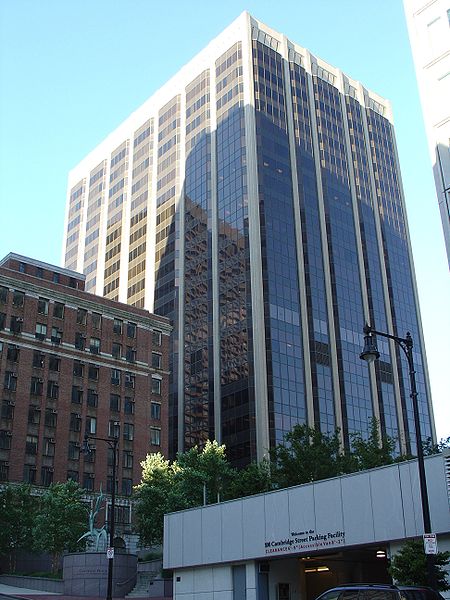
McCormack Bldg, Boston (Wikipedia)
Campaign finance laws are administered by the Office of Campaign and Political Finance.  That agency, headquartered in the McCormack Building next to the State House, enforces campaign finance laws in the commonwealth.  Established in 1973, the office was among many that were established, nationwide, during and after Watergate amid concerns about the influence of money in politics.  While those concerns have erupted once more after Citizens United v. FEC and the Supreme Court's striking of a Arizona Public Financing Law, disclosure requirements, which exist in most states, remain a crucial, if shaky, foundation of efforts to clean up elections.

Chapter 55 of the Massachusetts General Laws, and nominally 55c, the commonwealth's emaciated public financing law, are the laws that OCPF enforces.  However, the office is also the "depository" venue for most candidates to file their fund raising, expenditures and other reports.  Under current law, all candidates for State Office, including the legislature, governors council and the executive constitutional officials, must file with OCPF. 

However, before January 1, 2010 only mayoral candidates and city councilors running for at-large seats in the commonwealth's five largest cities needed to file with OCPF directly.  Even if you were not required to file with the state, candidates raising money for their campaigns for any municipal office had to file reports with their town or city's clerk, or in the case of Springfield, the Election Commission.  Just as Springfield undertook its first ward-based elections in decades, whose candidates needed to file only with City Hall, the commonwealth's municipal campaign finance law received a major shake-up. 

Gov. Deval Patrick in 2008 (WMassP&I)
The laws that changed this came about amid scandals, resignations and public pressure.  After former State Senator Dianne Wilkerson was arrested for bribery, Governor Deval Patrick convened a task force to suggest changes to public integrity laws.  Ultimately the legislature and Governor Deval Patrick enacted legislation that would toughen the commonwealth's ethics, lobbying and campaign finance laws.  However, passage of that bill, along with reforms to pensions and transportation were in doubt until Patrick said he would veto an increase in the sales tax unless the reforms reached his desk first.  At the bill signing, Patrick said at the time, "This law demonstrates our firm commitment to governing with integrity, with openness and with the public's interest foremost."

The changes expanded the crop of municipal candidates who needed to file wtih OCPF.  On the first day of 2010—less than two months after the last municipal election—mayoral and all city council candidates in Boston, Worcester, Springfield, Lowell, and Cambridge were required to file with OCPF.  Mayoral candidates with populations in excess of 40,000, too must now file with OCPF.   For example, a mayoral candidate in Chicopee needs to file with the Boston-based agency, but city council candidates in that city as well as mayoral candidates in Agawam, do not.

Another notable change, though one mostly irrelevant to Springfield, required that city and town clerks put online the campaign finance reports candidates file locally. All of the above revisions to campaign finance law were contained in Chapter 28 of the Acts of 2009.


Friday, July 29, 2011

Moving on Up...

Councilor Rivera (WMassP&I)
The numbers out of the Election Commission indicate plenty of interest in the citywide races slated for this November.  At last count thirteen interested candidates have qualified to compete for the city's five at-large seats and three candidates have qualified for mayor.  As a result there will be a primary in September for both of those offices.  However, the relatively high interest in the city's elected offices at-large were only matched by a near-indifference on the ward level.  The only contested ward race will be in Ward 8 where Orlando Ramos will seek a rematch with current Ward 8 rep John Lysak.  Even ward 6, one of the city's most politically active wards is facing a one man race with Ken Shea seemingly destined to take that seat in January.  

The current occupant of that seat, Amaad Rivera, however, kicked off his campaign for election to one of the city's at-large seats.  At a somewhat humble, but intimate gathering of core supporters, Rivera formally launched his candidacy.  The event was held in the Hall of Local 108 of the Carpenters Union and attended by twenty-five to thirty people, many of them crucial backers of his  2009 run for the Ward 6 seat.

Several long-time supporters of Rivera spoke.  First up was Katie Stebbins a member of the Springfield planning board and wife to former city councilor Bruce Stebbins.  Stebbins, who described both herself and her husband as big supporters of Rivera, recalled several late-night conversations in her kitchen with Rivera regarding issues affecting the city.  Although her husband is a Republican and not necessarily in perfect political sync with Rivera's progressive values, she, her husabnd and Rivera are united in fighting for a stronger Springfield and good government.

Michaelann Bewsee (WMassP&I)
Michaelann Bewsee, the head of Arise for Social Justice, a Springfield advocacy group scolded Amaad for not running Ward 6 because there would be no race there after all (she made a point of noting no disrespect for Shea).  The faux criticism aside, Bewsee extolled Rivera's virtues calling him a "champion for progressive causes" on the City Council.

Arlene Rodriguez, a dean at Springfield Technical Community College called Rivera one of the most "honest, charismatic speakers" that she knows.  She also praised his "passion for people."  Dominic Basile who has known Rivera for years called him an "intensely loyal friend."

Rivera, trying not to play the politician with assurances of a short speech, spoke next.  He led off thanking his family which he described as a group of people where, "It was okay to express what you felt."  He also described how throughout his life in Springfield he felt there existed this (false) notion that there was something wrong with Springfield.  Instead he argued, "We can make a better, stronger Springfield.  

Wednesday, July 13, 2011

The Great Experiment: From the Council's Mouth...to Mayor's Ear...

(WMassP&I)
Today we debut a new series, "The Great Experiment," a look at the transition that has begun at City Hall since the switch to Ward Representation in the City of Springfield.  In the coming weeks and months, it is our goal to investigate the changes that have occurred within the City Council and city government as a result of the somewhat dramatic change in municipal government.  That investigation will look into how councils work in Springfield's peer cities throughout New England as well.

For today, however, we are staying closer to home.  The City Council Finance Committee met today to discuss the remaining items on the budget that needed passage.  Specifically, there were questions about raising the city's hotel tax, increasing the demand fee charged to late and delinquent taxpayers and furloughs.  On top of that were questions about how much money from reserves would be used to cover the remaining gap in the budget.  The council's reasons for cutting $2.7 million from the budget was to limit the use of those reserves.

Councilor Walsh (Facebook)
Some councilors expected to walk into today's hearing, held in a sweltering council conference room, and find an impasse with Mayor Domenic Sarno over reconsideration of the furloughs enacted by his administration.  At-large councilor Kateri Walsh had put forward a proposal not long after the mayor announced furloughs, that would reduce the number of furlough days for lower paid city employees, mitigating the financial impact on their pay.  While the council did not exactly rally behind her proposal, there was concern among councilors that the lowest paid city employees were sharing a disproportionate level of the furlough's impact.

Instead, however, the city Chief Administrative and Financial Officer, Lee Erdmann told the council that the mayor had accepted the premise of the "tiered" furlough.  Erdmann presented a proposal that would reduce the financial benefit of the furloughs to the tune of $250,000.  Still, the furloughs would be redistributed more equitably.  Councilors in attendance, which included at-large Councilor Tim Rooke, Ward 2 Councilor and Finance Committee Chairman Mike Fenton, Ward 6 Councilor Amaad Rivera and Ward 7 Councilor Tim Allen, received the mayor's proposal positively and were grateful for his decision to respond to their concerns.

Elsewhere, the council discussed raising the so-called demand fee charged to late or delinquent tax for the "demand" letter that politely reminds taxpayers they are either late or dirty rotten scoundrels.  This fee would rise to $12.50 from $5.00.  Councilors discussed the possibility of raising the fee more in order to eliminate the processing fee the city now charges taxpayers who pay their taxes with a credit card.  There were legal questions raised by City Solicitor Ed Pikula, but councilors promised to study it further.

Thursday, June 23, 2011

Take My Council, Please: Fiscal Discilpline, 30 Years Overdue and Still Fresh...

(WMassP&I)
Tonight a somewhat strange thing happened at 36 Court Street.  The City Council fulfilled one of its legal obligations and actually did so by substantial majorities.  Through relatively few votes, the Springfield City Council cut more than $2.8 million dollars from the budget the mayor filed with the city last month.  Among the council's chief concerns, articulated by City Council President Jose Tosado and Ward 2 Councilor and Finance Committee Chair Mike Fenton, were the significant use of stabilization funds to plug the city's yawning budget gap.  That chasm was created through rising personnel costs, weak tax revenue and yet another cut to local aid from Beacon Hill.

Even with the cuts, the city will ultimately rely on roughly $7.5 million in stabilization reserves and another $5 million from an overlay account administered by the Assessors' Department.  Additionally, the city risks losing additional property tax revenue from damaged homes and businesses caught in the June 1st tornado.  Still, with next year's budget looking even more gruesome than this year's (and it will be paired with union negotiations with virtually all city bargaining units), keeping stabilization revenue intact is essential.

Tosado made some comments early on encouraging fiscal discipline only a year after he had refused to lift a finger to support cuts last year.  Still, the council president, perhaps knowing his mayoral aspirations remain dimmed by the tornado no doubt used the opportunity to jab the mayor, yet still doing what was right.

Councilor Tosado (Facebook)
Councilors kicked off the budget session with a vote to eliminate funding for vacant positions within the budget.  Although the mayor protested and even trotted out Police Commissioner Bill Fitchet to support funding for heretofore unfilled dispatch positions, the council rejected the entreaties and eliminated the positions.  Ward 5 Councilor Clodo Concepcion, who would become among the most reliable votes for the mayor's budget as is, attempted to play to councilors' political fear of cutting from public safety.  However, the council eliminated the unfilled positions.  At large councilors Jimmy Ferrera and Tom Ashe joined Concepcion in opposing the cuts.

Next the council proposed a broad cut of 5% to "other than personnel services" across city departments.  These items could be anything from support services to office supplies, basically anything that is not on payroll.  This cut elicited some minor protest for the mayor, but, representing more than a million and a half dollars all by itself, it passed the council easily 11-2. It made up the lion's share of other the budget reductions.  Ferrera and Concepcion dissented.

Ward 6 Councilor Amaad Rivera made an appeal to cut overtime budgets (which would largely come from police, fire and DPW) to save the jobs of eleven or so employees in the budget.  However, the political sensitivities could not be extended that far.  That cut failed 2-11, Rivera and Ward 3 Councilor Melvin Edwards casting the two yes votes.

Councilor Fenton (Facebook)
Whole swaths of the budget were cycled through without so much as a peep from councilors.  Ultimately proposals for cuts of $100,000 were proposed for Information Technology and Finance each, which will likely result in a handful of job losses.  Concepcion, Ashe and Ferrera were the three noes on the finance cuts.  Cuts to IT were much closer on a 7-6 vote.  Tosado, Fenton, and Ashe joined Ward 8 Councilor John Lysak, Ward 7 Councilor Tim Allen, Ward 1 Councilor Zaida Luna and Ward 4 Councilor E. Henry Twiggs to make those cuts.

Later on, Citistat, an office intended to find efficiencies in city government was all, but gutted by the council.  Although Citistat has made considerable progress for the city, it has been accused of hyping minor fiscal victories for the political benefit of city officials.  It died an ignominious death on a 10-3 vote, Rivera, Concepcion and Ferrera casting the votes to spare the office.

Tuesday, May 24, 2011

Take My Council, Please: REVOKED!...

(WMassP&I)
After all of the drama, all the testimony, all the passion, the Springfield City Council voted this evening to deny a permit for a used car dealership on Newhouse Street in the City’s Outer Belt Neighborhood.  Yes, the tension and the anxiety over what may be among the council’s most important votes this year gave way as councilors accepted the concerns of neighbors about the impact the dealership would have.

No, there really was a vote on a car dealership, but it by far overshadowed by the vote of the city council to revoke the permit for Palmer Renewable Energy’s proposed biomass plant on Cadwell Drive and Page Boulevard just off I-291.  Although the chamber was not as packed as it was for last week’s testimony phase, there was a significant showing of plant opponents and a few supporters, mostly craft union members.


Councilor Fenton (Facebook)
Ward 2 Councilor Mike Fenton read into the record a report from City Solicitor Ed Pikula which said that the council had sufficient evidence upon which it could base its decision to revoke the permit.  The City Solicitor stated the changes from the original project may deviate from the permit, could have a profound impact on the neighborhood, environment and public health and may justify the council’s revocation.


Ward 4 Councilor E. Henry Twiggs announced his support for revocation in remarks which outlined the council’s role as a regulatory body.  In that spirit, Twiggs noted that he resisted efforts to broadcast his position.  “We are here to be neutral,” Twiggs said explaining that he felt the contradictions and changes to the biomass proposal led him to oppose the plan


Councilor Walsh (Facebook)
At-large Councilor Kateri Walsh opened the debate for those in support of sustaining the permit.  Walsh said that her own research and calls to state environmental officials had led her to conclude that the impact of this project would not be different from the original plans (WMassP&I’s twitter feed misidentified Walsh’s position as saying it was different).  Absent that difference, Walsh said the city council should not revoke the permit and that she would vote likewise.


Ward 6 Councilor Amaad Rivera reminded the council that they were sitting in a regulatory setting and that their job was to make a judgment as to the status of the permit based on the evidence before them.  It was the council’s duty, Rivera argued, to determine whether the current project was different from the project originally approved, but to do so without being swayed by the prospect of job creation alone.


At-large Councilor Tim Rooke took a similar, but more forceful stand than Walsh.  He suggested that there was “no just cause” for the city to revoke the permit.  He also implied that the council was on a “dangerously reckless path” by voting to revoke.  Rooke appeared to argue that the city was acting out of turn.  Although it is rare for the council to so revoke a permit, it has with time practically become a reserve power of the council, in part because of misunderstanding or indifference to the council’s functions.  In that way, Rooke may have missed the mark in his broad admonition to the council.


Councilor Lysak (Official Site)
Undaunted, Ward 8 Councilor John Lysak, whose district include the site of the plant, replied “no amount of money was worth the risk” to to the health and safety of his constituents and others throughout the Springfield area.  Council President Jose Tosado also reminded Rooke of the posture of the council with regard to the permit.  The council was not acting as a legislative body, but a regulatory one, however elected.  Walsh attempted a parliamentary maneuver to get Tosado to step down to speak (which would have yielded her the dais), but he resisted.  After some additional comments from councilors, the vote was taken.


As the vote proceeded, it became increasingly clear where the result would come down.  Some of the biomass supporters could be heard during the meeting muttering that it was over.  Revocation required nine votes, consistent with special permit actions.  At-large councilor Jimmy Ferrera was absent due to a family emergency, but it clear that by the time City Clerk Wayman Lee had made his way to councilor Amaad Rivera, jubilation was pulsing through the crowd.  With the ninth vote cast for revocation (it happened to be Fenton), the crowd burst out in cheers nearly drowning out the recording of Tosado’s vote.


Wednesday, May 18, 2011

Take My Breath Away...

(WMassP&I)
In many ways, we have abdicated our responsibility on the Biomass issue.  When the permit was rammed through the city council on a 7-2 vote in 2008, it was hailed as a jobs creator period. Since then there has been a growing movement to stop the plant, slated for development off of Page Boulevard near I-291.  Palmer Renewable Energy, owned by the Callahan family that owns a paving company by the same name sought to use renewable energy grants to build the facility.

The plan calls for a power plant fueled by wood chip.  At first biomass was seen as being a great alternative energy source because it was renewable and ostensibly admitted less pollution.  However, it may be helpful to think biomass in the same way as LASIK laser eye surgery.  It is so new we do not have any idea what the long term effects are. As what data we do have began to come to light, the power plant began to look more and more like a liability for public health in the Greater Springfield area.

(WMassP&I)
The council faced a room filled with supporters and opponents of the biomass plant, but the supporters clearly had an advantage in homemade signs and possibly numbers as well.  Both sides were fairly civil throughout the process, but the opponents of the plant held their colorful signs highest on their experts' best points and throughout much of their opponents' comments.

From a legal standpoint, the Council's options are limited to revocation of the 2008 permit.  According to some legal sources, they can vote to revoke it, but as with granting a special permit they need 9 votes.  If last night's vote to close the meeting is any indication, they probably are close if not past that threshold.  However, the council can only revoke it for "just cause." 


As former City Solicitor and City Councilor Pat Markey put it to the Council, they get to decide what just cause is, but they have plenty to base their conclusion on.  Markey noted (he was one of two councilors in 2008 that voted no, Rosemarie Mazza-Moriarty was the other) that the original permit was for a recycling center.  Markey explained that that made sense at the time because the original project called for burned construction and demolition waste to power the plant.  That idea was later abandoned as skeptical regulators demurred.  As such, the new plan uses so-called green wood chips.  These chips are sometimes from tree debris, but other times from living trees.  Markey argued that the new plan fails to be recycling as that term implies previous used material.  This plan is an incinerator, instead, which requires a separate special permit, Markey said.


Pat Markey with Karen Powell in 2007 (WMassP&I)
Markey said the permit change, the change in truck movements, the lower threshold for regulation, and the EPA's own misgivings about biomass amount to plenty of "just cause" for the council.  Furthermore, he assured the council, the worst Palmer Paving could do is sue, win and get their permit anyway.  Susan Reid, Massachusetts Director of the  Conservation Law Foundation, a New England environmental legal group, argued that the increase in relative pollution by the plant could actually negate any positive effect.  Among her arguments was that the pollution increase could raise local temperatures and thereby increase energy usage for Air Conditioning.


A Northampton doctor that works in Springfield noted that the added pollution could have a particularly deleterious effect on days with air quality alerts.  Others spoke to the additional harmful effects caused by the additional truck trips.  Michaelann Bewsee, an activist in the city, took great pains to note that she and others had done their homework on the situation.  An asthma sufferer noted a connection to asthma rates and school absenteeism.


Representing the Biomass plant were Attorneys Frank Fitzgerald and Thomas Mackie.  Fitzgerald protested the legitimacy of this hearing and claimed that the only "just cause" for the city to revoke the permit was non-compliance with the original permit. At times he and his co-counsel claimed that even the original permit were unnecessary.  Fitzgerald also made several references to the direct economic benefit to the city.

Tuesday, May 17, 2011

Take My Council, Please: Trash Fee Lives...Biomass Looms...

 **Programming Note** WMassP&I will be live-tweeting today's BioMass Meeting.  Check out Hashtag #Biomass or visit our Facebook page or Twitter Feed.

(WMassP&I)
Yesterday's City Council meeting in Springfield had some wind taken out of its sails when three potentially contentious issues were unceremoniously withdrawn from the agenda.  Home rule petitions on the Council's succession and term were sent back to committee while the Tax Incremental Financing Plan for F.W. Webb was also withdrawn as questions arose about the fairness of the deal.  Left on the table were plenty of scraps worth digesting, but in many ways the victories of the night were overshadowed by the looming monster of tonight's Biomass Permit hearing.

The speakout was only attended by Springfield Education Association President Tim Collins, who called upon the council to minimize or even reverse declines in spending for the schools and reject suggestions that money allocated for schools be redistributed to the city side of the budget.  The School Department budget typically makes up more than half of the city's overall budget and is almost entirely financed by the state, save for a mandatory 10% contribution from city funds.  With unrestricted local aide in context, it could be argued that the school department is completely funded by the state.

(The Second Speaker was your Editor-at-Large.  Not knowing if the home rule petition to disastrously expand the Council's tenure to four years was withdrawn, I made a plea to not limit Democracy by means of extending the term.  Specifically, the concern rests with the possibility of laziness or inertia that could otherwise check overreach by the Mayor.  Comparisons were drawn between anti-voter bills in Wisconsin and Florida.  Because I did not have prepared remarks I have nothing to post, but when this issue resurfaces, I will again advocate against it.  For now it has again returned to the back burner.)

Councilor Ferrera (Urban Compass)
Boilerplate approvals were granted to transfer funds among departments.  Transfers included funding for advertisements in the newspaper for sales of property (as required under state law) and snow removal.  There were some questions from at-large Councilor Jimmy Ferrera and Ward 4 Councilor E. Henry Twiggs as to the source of additional money needed by the law department.  However, the Law Department urged the council not to worry, but that they would provide more details in a less public setting to satisfy privacy concerns.  Approval was granted to accept a grant as well.

The F.W. Webb proposal drew scrutiny at a recent Finance/Economic Development Committee meeting.  That meeting, according to minutes collected by the City Council office, generated skepticism from councilors in attendance.  The company's proposal includes a minimum promise of less than 40 jobs over the 20 year life of the agreement.  Additionally many of these jobs would probably pay wages topping out at $18/hour.  The city would receive full market value for property on the Smith & Wesson Industrial Park, but the net job creation seems minimal. 

Additionally, the long term tax revenue, when the incremental financing is included, would amount to about $3 million over 20 years.    During the first ten years, the tax incremental financing would save F.W. Webb on average about $50,000 annually.  Perhaps if the job numbers were better this may seem like a deal.  Needless to say the TIF has been postponed.  The property's sale, controlled by the Springfield Redevelopment Authority, is contingent on Council Approval of the TIF.

Councilor Rivera (Facebook)
The home rule petitions on the Council were also withdrawn.  Because we have discussed the Four year term in the past and above (cough, power grab! cough, cough), we will set aside that debate to move onto the other.  Council President Jose Tosado somewhat improvidently called the petition the "Amaad Rivera bill." It was spurred by the resignation of Keith Wright and seating of Ward 6 Councilor Amaad Rivera as the next highest vote getter.  The succession touched off a maelstrom of chatter and outrage among many Forest Park residents (where Ward 6 is principally based) and some councilors.  However, the determination by the City Solicitor and Election Commissioner was correct.

Tuesday, April 05, 2011

Take My Council, Please: We Want More...

(WMassP&I)
Monday was a night of stunning defeats and equally stunning chutzpah.  A dozen or so cops filled the council chamber ostensibly as a show of solidarity ahead of the civilian review vote.  Other measures up included the trash fee, a petition to extend council terms and other measures that were liberated from committee.

Lee Erdmann, the city’s Chief Administrative and Financial Officer briefed the council on finances first.  Essentially, the city projects, based on revenue estimates and expected state aid to have a $40 million deficit.  Erdmann told the council that he and others in the mayor’s administration had pared that down to about $16 million.  That reduction came through department reduction and changes to health and pensions.  It also assumed that there would be additional revenue from the trash fee.

As it stands now, the mayor’s office expects to request that roughly $13 million be used from stabilization funds to cover most of that gap.  Additional reductions and consolidations, thus far undetermined, unused overlay account money and would a 2% increase on the hotel tax would cover the rest.  The increase would put Springfield at the same rate as Cambridge and Worcester, but still under Boston’s rate.

Councilor Ferrera (Urban Compass)
Erdmann also indicated that the city would seek concessions from labor, but would do so primarily to avoid layoffs, which may become necessary absent concessions.  During the debate at-large councilor Jimmy Ferrera pressed Erdmann for the source of his projections.  Erdmann, apparently used to Ferrera’s theatrics, waved off his question, assuring him that he was using the best estimates available given the political and financial situation.

Erdmann also briefly discussed the city’s capital budget, which included replacing 20% of trash bins.  Ferrera also pressed the city on why it was spending money to buy new trash bins.  Allen Chwalek, the city’s Public Works head, anecdotally mentioned that his own trash bin wore out as all of them eventually will.  Chwalek also reminded Ferrera that the current bins were rolled out 12-13 years ago and have an expected life of about ten years.


Rendering of Holiday Inn as a La Quinta (WMassP&I)
From there the discussion switched to less controversial items.  Boilerplate votes were called on accepting grants for the library, fire, emergency management and elderly affairs departments.  A resolve was also passed to support more money from Beacon Hill for Shannon Grants and approval granted to other Shannon Grants, Ward 1 Councilor Zaida Luna sent to committee last time.  A report on the Biomass plant was also accepted by the council.  Blessings were also granted to a 5 year contract for school food service (after details as to the need were presented to a subcommittee) and to Community Block Development Grant loan guarantee for the renovation of the former Holiday Inn.

A report from the finance committee on the trash was given somewhat before the actual debate on the item itself.  Ward 2 City Councilor Mike Fenton, chairman of the finance committee explained how his amended ordinance would increase the discount for seniors, veterans and indigent homeowners to 33% from 25% (the base fee would remain $75).  Fenton noted that leaving an additional $3 million gap in the budget was unacceptable.

Tuesday, March 15, 2011

The Insight: "Amaad" About You?...

Today we start a new series on WMassP&I called "The Insight" consisting of interviews of politicians, officials and other newsmakers within the Greater Springfield universe.

Councilor Rivera (Facebook)
Springfield, like many cities, has long been a place where politics is a contact sport.  Campaigns can be “messy,” especially as candidates scramble for elusive votes amidst low turnout.  Still, as the city stares into the abyss of a new budget problem (partly the work of rising costs and foreclosures) and suffers a weekend of homicides, the biggest political news this year has been the situation in Ward 6.  Keith Wright resigned his office citing family issues leaving Amaad Rivera, who lost the race (or placed second under municipal law) to ascend to his position.

While the volume of the uproar may be in dispute, its existence is undeniable.  Angry residents grumbled over the outcome brought on by a quirk in the law while others made more strident (and unsubstantiated) accusations that Rivera was not even a resident of Springfield.  Even as that furor died down, Rivera, however unintentionally, reignited it when he invoked a parliamentary maneuver intended to delay a vote for eminent domain as part of the renovation project at Forest Park Middle School.  That move prompted accusations in both directions and a torrent of criticism directed at Rivera from this and other blogs and several mainstream media outlets.

This blog sought comment from Rivera for some of these stories, but due to a desire for expediency, we did not hold off publication pending his reply.  An exchange of emails followed, which may be characterized as contentious, and ultimately culminated in an interview with the Ward 6 Councilor.  Western Mass Politics & Insight is based in Ward 6.

During the interview, Rivera appeared eager to cool temperatures walking back some of his complaints directed at WMassP&I, but not others.  Still, he and this blog were interested more in clearing the air then engaging in a dispute.  Rivera was fairly at ease and appeared less upset than concerned that a media institution, however self-important and self-appointed like WMassP&I (our tongue-in-cheek description), would fail, in his view, to relate the whole truth.

Forest Park Middle School (School Dept. Site)
By far this was among Rivera’s biggest concerns politically.  Media should work, Rivera said “to ensure people can make [informed] decisions for themselves.” He gave examples, which he felt failed to meet this standard: the omission of certain details of his stance on Forest Park Middle School; an allegation that public opposition to his council-designation in December was overblown (the election commission only received a few letters and councilors‘ constituent correspondences are not public record) and the Valley Advocate’s depiction of some of his endorsements as being largely from out-of-town.

Rivera also spoke about a source of friction between himself and the Forest Park Civic Association.  While he claims that he was added to the agenda of the civic association without his knowledge and on short notice, Rivera acknowledges the group’s complaint given his use of Rule 20, the delaying tactic.  That said, Rivera claimed while he had canceled other trips, the event in Boston on February 13, the tweets from which WMassP&I published, had been planned months in advance.

That friction, Rivera notes, is part of the divisions that run deep in Ward 6 and Forest Park generally, arguably among the city’s most diverse neighborhoods by any measure.  Rivera noted that these divisions are older than he.  While the civic association is by no means the sole voice of displeasure, they and their members have become his most outspoken critics not otherwise elected to something at 36 Court Street.  Still, Rivera maintains that “building bridges,” rather than burning them, is his mantra as he insists that he wants to engage all of his constituents.