Google
Showing posts with label Deval Patrick. Show all posts

Monday, February 13, 2012

Testing Home Rule...

Legislators, aides and union officials at Friday's Meeting
(WMassP&I)
With city schools already more than a week behind schedule and many students still living in temporary housing after last year's tornado, Springfield City Councilors and the city's Beacon Hill delegation are looking to delay the city's participation in Massachusetts Comprehensive Assessment Systems test.  However, the proposal has received a cool reception from state education officials.  A spokesman for the Commissioner of Elementary and Secondary Education seemed to foreclose any delay of more than a few days.

On Friday, at-large Councilor Kateri Walsh, chairwoman of the Intergovernmental Relations Committee held a hearing on home rule legislation allowing the city to push back MCAS testing from March-April to April-May.  The proposal is cosponsored by Walsh, at-large Councilor Thomas Ashe, Ward 2 Councilor Mike Fenton and Ward 8 Councilor John Lysak.  Representatives Sean Curran and Mike Finn and Senator Jim Welch attended.  Staffers from Representative Brian Ashe and Ben Swan and officials from Springfield teachers unions were also present.

The original mover behind this legislation was, according to those present, Springfield Education Association president Timothy Collins.  Collins himself was unable to attend the committee meeting as he was in Washington for an event with US Secretary of Education Arne Duncan.

While there was a consensus among all present that Springfield school children deserved the extra time, however that alone may not make it possible.  The Commissioner for Elementary and Secondary Education, Mitchell Chester, seemed to pour cold water on the idea in a letter to Mayor Domenic Sarno dated February 8th.  While Chester implied he had limited power to delay Springfield's testing schedule, he suggested that a Special Act would actually lead the city to default on meeting state education requirements.  Under any circumstances, failure to meet testing requirements would have severe repercussions for the school district and for students including a loss of funding and a loss of students' chances to meet graduation requirements.
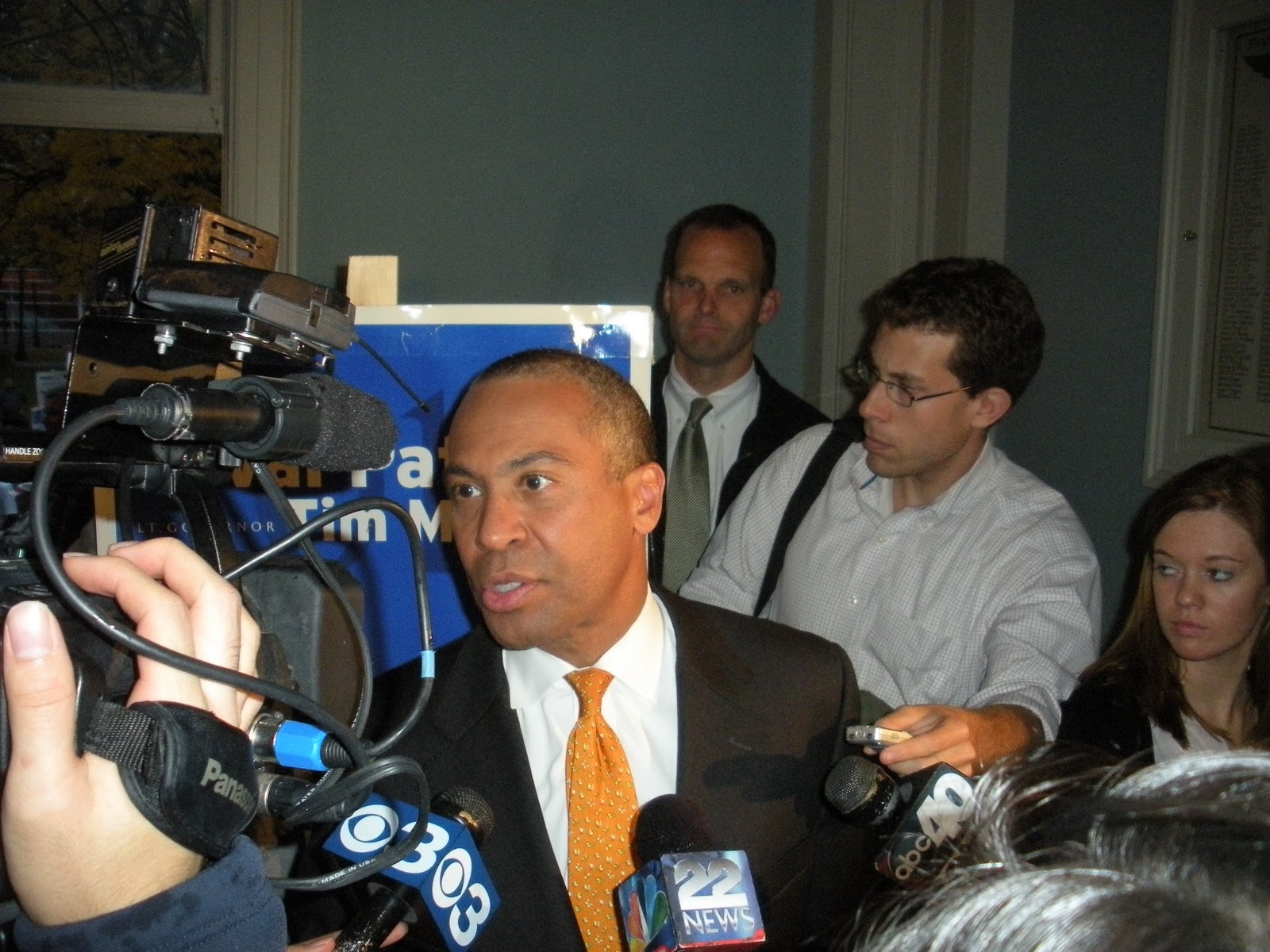
Gov. Patrick in 2010 (WMassP&I)
A home rule petition seems doubly unlikely as would require the Governor Deval Patrick's signature.  As the commissioner is an executive appointee, it is likely that the governor would stand by Chester's assessment and veto home rule legislation that would create an exception to statewide policy the commissioner opposes. 

While unmentioned in Chester's letter, the officials in attendance speculated that cheating among students may be a concern if Springfield takes the test later than its neighbors, which would take the test on time.  J.C. Considine, the commissioner's spokesman, confirmed that the integrity of the test is one, but hardly the sole concern of state education officials

However, the legislative avenue presents other issues as well.  Curran, who sits on the Education Committee and would likely have jurisdiction over the city's home rule petition, said that the legislative process itself could delay a home rule petition beyond March.  Specifically, he noted that the bill would need to clear several committees with lead times of a week or two all before it could be passed by the House, assuming the Speaker puts it on the calendar at all.  A similar process through the Senate would follow.

Councilor Walsh (Facebook)
All officials in the room seemed agreed to pursue a two-pronged effort of home rule legislation and lobbying of the Governor and Chester.  Assistant City Solicitor Thomas Moore assured Walsh that if the Council acted on the petition Monday and the mayor signed it soon thereafter, the measure would be in the office of the clerk of the House of Representatives with a day or so.  However, the Byzantine bill-making process leaves executive action as the likeliest scenario.
Considine, the education spokesman, described the power of the commissioner to give districts a "temporary extension" for testing as narrow.  The commissioner could give districts like Springfield, "a few additional days," but little more than that.   Furthermore, he explained, any longer than that would jeopardize the state's ability to get prompt turnaround from contractors grading the test.  Given that the subject of the March/April tests, English Language, uses many open response answers, the turnaround time is already tight as answers must be graded by humans rather than a machine.  This prompt turnaround has been requested by school districts who want the results to begin planning curriculum for the next year.  Considine said test results in past did not come until some schools had practically reopened for the Fall.

Saturday, December 31, 2011

The Year in Springfield, 2011...

(WMassP&I)
With another year under Springfield’s belt comes another edition of the Year in Springfield.  In its 375th year of existence the City of Homes suffered through one of the most erratic year of weather on record which brought a range of immense destruction and gross inconvenience.  Politically, it was also a tumultuous time from Springfield City Hall to Beacon Hill to the steps of Harvard University.

The year 2011 opened in Springfield with an eye, as in other places, to Washington, where a cadre of increasingly nihilistic “citizens” took their place in Congress and in state capitals across the nation.  While the boat rocked in Massachusetts with a shrunken, but still massive Democratic edge in the State House, Governor Deval Patrick took the oath of office once more. 


However, America was rocked only eight days into January when Arizona Congresswoman Gabrielle Giffords was shot in the head, by quite literally a madman.  Early accusations pointed to tea party extremism, but ultimately mental disease and not right-wing anarchy drove the young man to shoot Giffords and twelve others while murdering six.  Gifford suffered a traumatic shot to the head, be saved by the quick thinking of her intern of five days.


Cong. Gifford w/ her Mother weeks

after the shooting (PK Weis via Facebook)
President Barack Obama, given his first significant opportunity to play the healer-in-chief gave a stirring speech at a memorial service attended by Arizona’s Senators, its governor with Obama has frequently clashed, Giffords’ husband, Mark Kelly and Supreme Court Justice Anthony Kennedy, who oversees the Ninth Circuit within which the slain judge, John Roll, served.

The event took on somewhat of a local relevance when Congressman Richard Neal held a press conference after the shooting noting that he had known Giffords and had raised money for her ahead of what had been a difficult reelection in 2010.  However, he also urged that parties take down a notch the vitriol and anger that had become pervasive in politics whether Loughner was driven by politics or not.


Also in January Amaad Rivera took office as the Ward 6 Councilor following the resignation of Keith Wright.  He took office because the city’s succession law is only written with only at-large councilors in mind and fills vacancies with runners-up.  Technically, Rivera was a runner-up even though he lost the 2009 election.  The chorus of dissent included this blog and came to a head on a vote for eminent domain as part of Forest Park Middle School renovations.  Rivera invoked Rule 20, the council’s parliamentary motion to delay the project to the shock of other councilors.  While we would settle our differences with Rivera, many remained incensed over the use of Rule 20, ironically including some who would encounter similar anger over its usage.


Councilor Amaad Rivera (WMassP&I)
However, the focus on Rivera would lessen as he became one of a super-majority of councilors that opposed a wood-burning biomass plant.  The special permit had been granted in 2008 by the last council on a 7-2 vote.  All ward councilors and two at-large councilors, including Jose Tosado who voted for the permit in 2008.  The Callahan Family, owners of Palmer Renewable Energy and like-named paving company poured money into experts who dismissed, often condescendingly, the health concerns raised by opponents.  Against the din of protests and threats of legal action the council revoked PRE’s permit on a 10-2 vote.

Monday, September 05, 2011

What is the Matrix...uh, Establishment?...

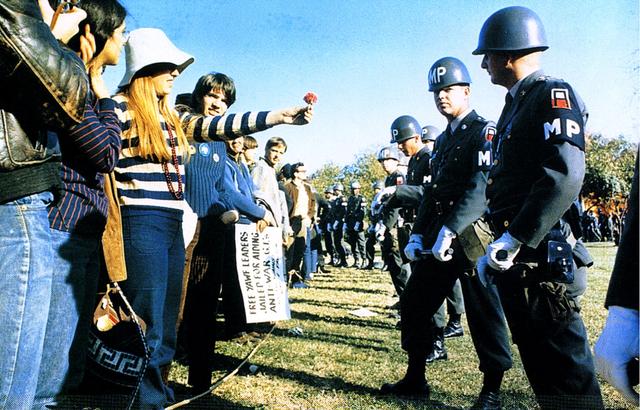
Opponents of Vietnam War at the Pentagon (wikipedia)
The answer to what the "establishment" is has never been clear, but use of the term “establishment” has escalated since it was used as a generic stand-in for the enemies of 60’s radicals.  Today, in political spheres, the term implicitly refers to the power brokers of a party or region, party elders, or special interest groups.  No candidate wants to be affiliated with the establishment or at least be described as such in public.  Still, the malleability of the term suggests that when the media or even other candidates use it to describe another candidate, greater care needs to be taken.

Today in Boston, Elizabeth Warren, the Harvard law professor and consumer advocate who set up the Consumer Finance Protection Bureau at President Barack Obama’s request, spoke to the Greater Boston Labor Council at their annual breakfast.  Her speech was seen as further, if not explicit evidence that Warren is on the verge of joining the race officially.  There was some minor griping by Bob Massie, the one-time candidate for lieutenant governor and liberal activist, that other candidates were not given a chance to address the group.  Others like Alan Khazei, who can be defined as the candidate with the best fund raising record, welcomed Elizabeth Warren to the race, but indicated he would contrast himself her status as the favored pick of Washington and Massachusetts “establishment” Democrats, as the Boston Globe phrased.  But is that description fair?

Elizabeth Warren (Facebook)
The way that Democrats in the nominating race are likely to paint Warren in a bad light by linking her to the establishment consists of two components.  First of all, Democratic Senate Campaign Committee Chairwoman Patty Murray rocked the boat of the implicitly non-establishment Massachusetts Democratic establishment by announcing a new candidate would emerge "in a few weeks."  It has been months.  Murray, who is tasked with holding the US Senate for the Democrats, has been accused of issuing pronouncements to the insult of the Bay State’s grassroots.  At the time, Massachusetts Democratic Party chief John Walsh was supportive of the candidate field at the time.  More recently, he has appeared to encourage Warren’s entry into the race.  Many other Democrats in Washington and in Massachusetts have followed suit.

The other component of the attack will be stirring up the argument that Martha Coakley, too, was the “establishment” candidate and that bore no fruit.  Notably, Coakely announced her intention to run at the same breakfast two years ago that Warren spoke at today.

However, the second part of the attack runs aground the facts.  Coakley, was not, actually, widely pushed by the establishment.  She received substantial backing from state and national party folks, but there was a definite split within the party.  Many Congressman who serve with Rep. Mike Capuano, including Richard Neal, supported their colleague over the popular Attorney General.  Many liberals broke from the centrist Coakley and voted for Khazei, who also ran in 2009.  The splits were deep enough that it became one of a number of secondary contributing factors to Coakely later loss to Scott Brown.

Monday, August 22, 2011

Campaign High Finance...

**This post has been updated to reflect new information obtained from the governor's office.**

Councilor Rivera (Facebook)
It is always hard to measure what impact scandals will have on a politician.  Nobody seemed to care that Rick Perry received a $25,000 donation from Ken Lay and an Enron executive got a seat on the Utility Commission in Texas.  Likewise, prognosticators assessments notwithstanding, it is hard to know exactly what impact Ward 6 Councilor Amaad Rivera's failure to file his campaign finance disclosure forms will have.  Part of the problem is that there is an open seat and well-known names win.  Another complicating factor is that Rivera courts, more than virtually any at-large candidate has in recent memory, a segment of the electorate that has historically low voter participation rates.

However, the entire affair has spurred us to investigate, not Rivera's doings, but rather the municipal campaign financing in general.  As we have said for years, and especially during the Biomass debate, the same pool of donors tend to give to anybody running for office in Springfield.  However, what about the laws of disclosure themselves?  How have they changed and what impact do they have?  Just as important, what is the record of Springfield candidates generally?

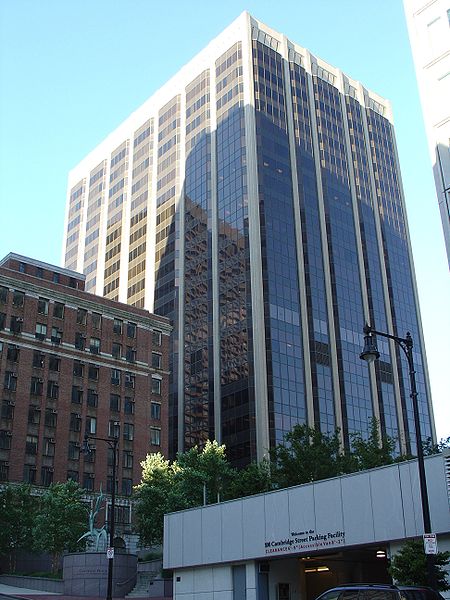
McCormack Bldg, Boston (Wikipedia)
Campaign finance laws are administered by the Office of Campaign and Political Finance.  That agency, headquartered in the McCormack Building next to the State House, enforces campaign finance laws in the commonwealth.  Established in 1973, the office was among many that were established, nationwide, during and after Watergate amid concerns about the influence of money in politics.  While those concerns have erupted once more after Citizens United v. FEC and the Supreme Court's striking of a Arizona Public Financing Law, disclosure requirements, which exist in most states, remain a crucial, if shaky, foundation of efforts to clean up elections.

Chapter 55 of the Massachusetts General Laws, and nominally 55c, the commonwealth's emaciated public financing law, are the laws that OCPF enforces.  However, the office is also the "depository" venue for most candidates to file their fund raising, expenditures and other reports.  Under current law, all candidates for State Office, including the legislature, governors council and the executive constitutional officials, must file with OCPF. 

However, before January 1, 2010 only mayoral candidates and city councilors running for at-large seats in the commonwealth's five largest cities needed to file with OCPF directly.  Even if you were not required to file with the state, candidates raising money for their campaigns for any municipal office had to file reports with their town or city's clerk, or in the case of Springfield, the Election Commission.  Just as Springfield undertook its first ward-based elections in decades, whose candidates needed to file only with City Hall, the commonwealth's municipal campaign finance law received a major shake-up. 

Gov. Deval Patrick in 2008 (WMassP&I)
The laws that changed this came about amid scandals, resignations and public pressure.  After former State Senator Dianne Wilkerson was arrested for bribery, Governor Deval Patrick convened a task force to suggest changes to public integrity laws.  Ultimately the legislature and Governor Deval Patrick enacted legislation that would toughen the commonwealth's ethics, lobbying and campaign finance laws.  However, passage of that bill, along with reforms to pensions and transportation were in doubt until Patrick said he would veto an increase in the sales tax unless the reforms reached his desk first.  At the bill signing, Patrick said at the time, "This law demonstrates our firm commitment to governing with integrity, with openness and with the public's interest foremost."

The changes expanded the crop of municipal candidates who needed to file wtih OCPF.  On the first day of 2010—less than two months after the last municipal election—mayoral and all city council candidates in Boston, Worcester, Springfield, Lowell, and Cambridge were required to file with OCPF.  Mayoral candidates with populations in excess of 40,000, too must now file with OCPF.   For example, a mayoral candidate in Chicopee needs to file with the Boston-based agency, but city council candidates in that city as well as mayoral candidates in Agawam, do not.

Another notable change, though one mostly irrelevant to Springfield, required that city and town clerks put online the campaign finance reports candidates file locally. All of the above revisions to campaign finance law were contained in Chapter 28 of the Acts of 2009.


Tuesday, July 19, 2011

Take My Council, Please: No One Leaves...Not Like That...

(WMassP&I)
In a rare display of expediency (or small agendas) the Springfield City Council breezed through its appointed task Monday night and in the process actually did a few useful things other than the typical housekeeping.  Items on the agenda included resolves opposed to the Federal Government's Secure Communities initiative and home foreclosure ordinances.  Because of those two items in particular the un-air conditioned council chamber was packed with supporters, further exacerbating the room's stuffiness.

Many of the agenda's items consisted of acceptance of funds for various departments within the city including the Library, Elder Affairs and Health and Human Services.  Much of the money accepted Monday for HHS was actually directed at the Thomas J. O'Connor Animal Control and Adoption Center.  Other moneys included an anticipated grant from the Springfield Library Foundation for the Mason Square Branch Library.

The council also granted the mayor authority to sell the School Department Building to a developer for the sale price of one dollar.  The nominal sale price was intended to be the only subsidy to the redevelopment of the school department building, which will otherwise be renovated using private money.  The plan is market rate condos that should yield the city thousands of dollars in tax revenue.  The vote was 10-1, with Ward 5 Councilor Clodo Concepcion as the lone no vote.  He told the Republican that the city should have waited for a better price.  At-large councilors Kater Walsh and Tim Rooke were not present.  The latter has made the cost of the school department's lease at the former federal building a crusade of sorts.  His absence kept the temperature on the issue fairly cool.

Another property on Tyler Street was also sold.  The present structure will be demolished and a new one built.

However, all this dry stuff came after the votes on the resolves against Secure Communities and the foreclosure ordinances.  The local branch of the Service Employees International Union had organized a large crowd, likely with the help of the local group "No One Leaves" that assists those facing foreclosure.  Both groups were likely there to support the ordinance, while SEIU, which represents many Hispanic workers, probably was there for the resolve, too.

ICE Badge (Wikipedia)
Secure Communities is an effort by the federal government to detect illegal immigrants, particularly those with a violent history.  This is undertaken by deputizing local law enforcement agencies to enforce federal immigration law to the extent that they can ascertain detained individuals legal status.  However, the program has come under fire for encouraging racial profiling and deporting largely non-violent illegal immigrants.  The second point notwithstanding, the initiative has been a band-aid on the broken leg of the nation's immigration laws and a poor substitute for true comprehensive immigration reform.  Moreover, it may have a negative impact on law enforcement.

Wednesday, May 18, 2011

Take My Breath Away...

(WMassP&I)
In many ways, we have abdicated our responsibility on the Biomass issue.  When the permit was rammed through the city council on a 7-2 vote in 2008, it was hailed as a jobs creator period. Since then there has been a growing movement to stop the plant, slated for development off of Page Boulevard near I-291.  Palmer Renewable Energy, owned by the Callahan family that owns a paving company by the same name sought to use renewable energy grants to build the facility.

The plan calls for a power plant fueled by wood chip.  At first biomass was seen as being a great alternative energy source because it was renewable and ostensibly admitted less pollution.  However, it may be helpful to think biomass in the same way as LASIK laser eye surgery.  It is so new we do not have any idea what the long term effects are. As what data we do have began to come to light, the power plant began to look more and more like a liability for public health in the Greater Springfield area.

(WMassP&I)
The council faced a room filled with supporters and opponents of the biomass plant, but the supporters clearly had an advantage in homemade signs and possibly numbers as well.  Both sides were fairly civil throughout the process, but the opponents of the plant held their colorful signs highest on their experts' best points and throughout much of their opponents' comments.

From a legal standpoint, the Council's options are limited to revocation of the 2008 permit.  According to some legal sources, they can vote to revoke it, but as with granting a special permit they need 9 votes.  If last night's vote to close the meeting is any indication, they probably are close if not past that threshold.  However, the council can only revoke it for "just cause." 


As former City Solicitor and City Councilor Pat Markey put it to the Council, they get to decide what just cause is, but they have plenty to base their conclusion on.  Markey noted (he was one of two councilors in 2008 that voted no, Rosemarie Mazza-Moriarty was the other) that the original permit was for a recycling center.  Markey explained that that made sense at the time because the original project called for burned construction and demolition waste to power the plant.  That idea was later abandoned as skeptical regulators demurred.  As such, the new plan uses so-called green wood chips.  These chips are sometimes from tree debris, but other times from living trees.  Markey argued that the new plan fails to be recycling as that term implies previous used material.  This plan is an incinerator, instead, which requires a separate special permit, Markey said.


Pat Markey with Karen Powell in 2007 (WMassP&I)
Markey said the permit change, the change in truck movements, the lower threshold for regulation, and the EPA's own misgivings about biomass amount to plenty of "just cause" for the council.  Furthermore, he assured the council, the worst Palmer Paving could do is sue, win and get their permit anyway.  Susan Reid, Massachusetts Director of the  Conservation Law Foundation, a New England environmental legal group, argued that the increase in relative pollution by the plant could actually negate any positive effect.  Among her arguments was that the pollution increase could raise local temperatures and thereby increase energy usage for Air Conditioning.


A Northampton doctor that works in Springfield noted that the added pollution could have a particularly deleterious effect on days with air quality alerts.  Others spoke to the additional harmful effects caused by the additional truck trips.  Michaelann Bewsee, an activist in the city, took great pains to note that she and others had done their homework on the situation.  An asthma sufferer noted a connection to asthma rates and school absenteeism.


Representing the Biomass plant were Attorneys Frank Fitzgerald and Thomas Mackie.  Fitzgerald protested the legitimacy of this hearing and claimed that the only "just cause" for the city to revoke the permit was non-compliance with the original permit. At times he and his co-counsel claimed that even the original permit were unnecessary.  Fitzgerald also made several references to the direct economic benefit to the city.

Wednesday, April 27, 2011

The Health of the Bargain...

Beacon Hill (WMassP&I)
Yesterday, the Massachusetts House of Representatives effectively voted to give cities and towns the unilateral right to set deductibles and co-pays for their employees health insurance.  Additionally, communities would no longer required to seek public employee approval to transfer insurance to the state's Group Insurance Commission (GIC).  The 111-42 vote surprised organized labor, while drawing caution from the Senate and Governor Deval Patrick.

The effort to allow communities to join the GIC has been building for years.  It has been consistently road blocked by the public employee unions, largely without explanation.  That the legislature has decided to grant this right over the objection of the unions is not really the news.  While the unions still oppose it, in all likelihood, they knew it was never an important loss to them.

By way of information, Springfield joined the GIC during the Control Board's tenure.  When asked what the deductible/co-pay provision's impact would be on Springfield's budget, the office of Mayor Domenic Sarno had no comment.

What is more striking is the ability to set deductibles and co-pays unilaterally.  Well, technically it is not unilaterally. Under the amendment, which can be read here, municipalities and other government bodies would call the affected public employee reps together and begin negotiating.  However, after 30 days, if no agreement is made the employer's offer wins.  Notably, none of this amendment takes effect unless the governing body like a city council or town meeting "accepts" it as is the language of such local administrative laws.

Speaker DeLeo (WBUR)
Unions are screaming that this is like Wisconsin or Ohio.  House Speaker Robert DeLeo contends that this is a necessary tool to save cities and towns during yet another tough fiscal crisis and that this is exactly the same rights the commonwealth has with its employees.  Frankly, however, neither of them are entirely right.

The unions are right that the ability of municipalities to set their own rates is like what has happened in Ohio.  That state's SB 5, among its many draconian provisions, essentially forces unions to accept the local community's first offer if an impasse ensues.  However, there are some important caveats in the Massachusetts bill.  The unilateralism only appears if the community joins the GIC.  Realistically, only a few communities gain anything by NOT joining, but still.  Additionally, unlike SB 5 in Ohio, virtually all of labor's rights to bargain is intact.

Tuesday, February 08, 2011

Take My Council, Please: Forest Park Face-off...

(WMassP&I)
It was a hot time in a cool town’s halls of power Monday.  The regular city council meeting, like all the others it seems, appeared destined to be a big snooze.  Instead, it was full of sound of fury, much of it signifying nothing or told by an idiot.

Springfield’s recently certified free cash was transferred by the council to the stabilization fund for safekeeping.  The fund presently exceeds $40 million dollars and finance officials projected the city to run a $2 million dollar surplus for the fiscal year.

However, what drew much of the attention and time during the meeting was the renovation of Forest Park Middle School.  After years planning, the school committee recently approved a plan to build an addition and secure a new parking lot (the present one will be taken up by the addition).  Alternative locations like Diamond Match (too far from the neighborhood) and Longhill Gardens (idea was submitted WAY too late) were ultimately rejected.  The density of the Forest Park neighborhood limited choices that would not include a massive land taking by the city.

Forest Park Middle School (school website)
The selected plan carried a coveted 90/10 state funding (The Massachusetts School Rebuilding Authority will be paying 90 cents on the dollar for the renovation).  That plan called for taking multiple family dwellings on the east side of Sumner Terrace, a dead-end off of Sumner Ave that backs the school.  A restaurant, Sam’s, is also included in the taking, ostensibly for new parking.

In order to qualify for the state funding, the city must put up its own (non-school) money to pay the 10% and obtain the land.  The takings, relocation of tenants, and demolition is projected to cost $1.9 million of which $700K will cover the actual property purchase.  The money needed to be transferred and eminent domain authorized which only the City Council can do under state law.

Councilors Tim Allen (Ward 7), Mike Fenton (Ward 2), Kateri Walsh (at-large) and others stood in support of the project.  Assistant City Solicitor Kathleen Breck detailed the meticulous process by which the city ascertained the value of the property, worked with tenants, and assisted with relocation.  Case closed, right?  Ha!

Councilor Rivera (Facebook)
Ward 6 City Councilor Amaad Rivera, whose district includes most of Forest Park and the middle school in particular, raised objections to a lack of meetings (or at least ones of which he was aware), despite ample evidence to the contrary.  Rivera went on, rambling at times, about traffic and that charter schools were able to use public money to build schools in the neighborhood, although he did not say which ones.  Rivera must have been referring to Horace Mann New Leadership and MLK Jr. charter schools, which occupy existing buildings formerly Holy Name School and Goodwill Industries respectively.

Things heated up after Walsh rose to support the renovation.  She noted the long search and that the clock was running out not just on the time frame to get the money (the city will fail to qualify for the funding if the property is not seized by the end of February).  She wondered how much longer kids can be reasonably educated absent this renovation and addition.

Friday, December 31, 2010

The Year in Springfield 2010...

So comes again another year the wide world of Springfield.  As is tradition, WMassP&I will recount the events and news that made 2010 different from 1876 in Springfield.  As both a city and as one of 351 parts of Massachusetts, Springfield saw its share of ups and downs that may come back to haunt, er, define us in the coming decade.  I guess it really depends.

City Hall (WmassP&I)
The year's most important event may very well have been a continuation of an event we mentioned last year.  The Springfield City Council underwent a paramount shift not only in structure, but in composition as it expanded form nine to thirteen in order to welcome new councilors from the city's eight wards.  Five seats remained at-large.  Four of those seats were retained by councilors under the old setup, with former School Committeeman Thomas Ashe filling out the fifth.  The diverse group of newcomers included time-tested figures like E. Henry Twiggs and past city council candidates John Lysak and Clodo Concepcion.  New faces included the city's youngest councilor in its history, Michael Fenton, Tim Allen, Melvin Edwards, Zaida Luna, and Keith Wright, a Springfield schoolteacher.

Not long afterward, Massachusetts rocked the national political landscape by electing State Senator Scott Brown to the United States Senate.  While national Republicans spun a fairy tale that the President Obama's allegedly left-wing policies were to blame, determined tea partiers aside, the result was due to a dismal campaign by Attorney General Martha Coakley.

Beacon Hill was not without its share of attention.  Budget troubles meant more cuts, particularly for cities and towns meant a reduction in school and unrestricted aid.  The entire situation was laid against the backdrop of an election for governor, which even early in the year was thought to be a bruiser for Democrats.  Charles Baker was coming at Gov. Deval Patrick from the right, Tim Cahill, former Democrat, was coming from the further right, while Jill Stein attempted to slip in from the left.  

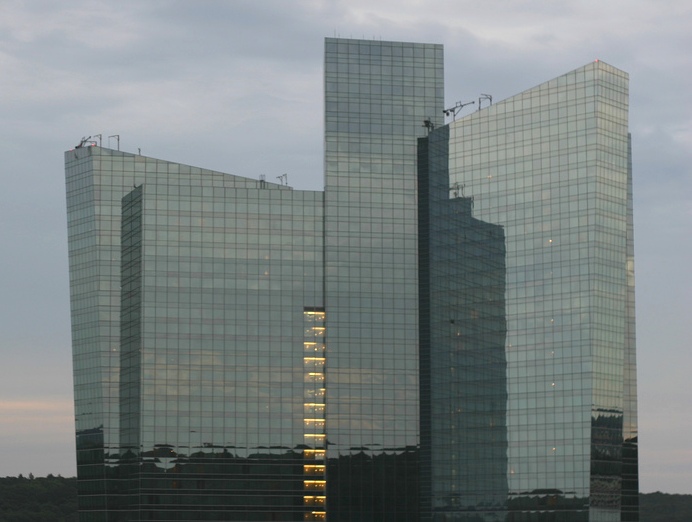
Mohegan Sun (wikipedia)
Casinos, too, became an issue that would crest at the end of the session.  Massachusetts Speaker Robert DeLeo rammed through casino legislation that would have essentially given dying racetracks the right to open slot parlors in an attempt to make it like it never was when Deleo's father worked at the tracks.  Locally Mohegan Sun, who forays into non-Connecticut states has not been without controversy, got behind building a casino right off the Mass Pike in Palmer.

Longtime Hampden County District Attorney William Bennett announced his intention to retire this year. 

Tuesday, November 23, 2010

Pro Tempore Today...On Probation Tomorrow...

Fallout from the release of a damning report on the administration of the commonwealth's Probation Department has finally landed on the head of State Representative Thomas Petrolati.  The Ludlow Democrat, whose district includes Indian Orchard in Springfield was the Speaker Pro Temp of the Massachusetts House of Representatives.  He has held that position, which serves little, if any purpose, since the last Speaker, Salvatore DiMasi clawed his way into the speakership.  Speaker Robert DeLeo announced Petrolati will step down from the post when the legislature convenes in January.

Rep. Petrolati (mass.gov)
The Probation Scandal, about which you can read more at Boston Globe, in short consisted of rampant favoritism, corruption, mismanagement, and possible pay-for-play personnel decisions.  Petrolati was called the king of Western Mass Patronage, implicated as being among the more flagrant probation jobs-for-donations participants.

When the scandal broke, the Supreme Judicial Court appointed Boston attorney Paul Ware to investigate the corruption.  During his probe, he subpoenaed Petrolati who attempted to behind some legislative privilege as a reason why he need not testify.  The SJC told him otherwise, but reportedly, Petrolati made heavy use of his Fifth Amendment Protection against self-incrimination.

Gov. Deval Patrick (WMassP&I)
Petrolati may actually be remembered best as the sole dissenting voice of any consequence against placing the State Backup Data center at the site of Springfield former Technical High School.  For reasons never completely understood, Petrolati wanted the center put at the STCC's Technology Park, despite the complex lacking the adequate security that could be easily built into the Tech building during its gutting and renovation.  The considerable sway of Petrolati's constructed office gave him the power to change the bill that funded the data center to suit his needs, possibly out power-playing Cong. Richard Neal.  In the end, wishing to avert an inter-party war over a non-issue, the Legislature decided to leave that final decision of the data center's location to Gov. Deval Patrick.  Patrick, to the surprise of few, picked Tech over Technology Park.

This controversy and Petrolati's odd continuance in the pointless House office even after Robert DeLeo became speaker might have inspired somebody, anybody, to oppose Petrolati in his race to continue as representative.  Not so.  Even in a Republican year (or the impression of one in Massachusetts), nobody Democrat or Republican, opposed Petrolati.  If for no other reason, the GOP should be ashamed because, again in their logic, the town of Ludlow went Scott Brown in January.

Even in the dysfunction and complicity of Democrats in the Springfield area and Massachusetts as a whole, Petrolati has come to stand out.  His Pro Temp appointment raised eyebrows and his involvement in the data center raised objections--from virtually everybody.  Like many politicians he has remained glued to his seat in large part because of his intimate connection to the people of Ludlow (we are largely of the opinion Petrolati has done squat for I.O.).

Speaker DeLeo (mass.gov)
In dismissing Petrolati, WFCR reported that Speaker Robert DeLeo implied that Petrolati's refusal to answer Paul Ware's questions was part of the reason the Ludlow representative was leaving the leadership.  Although couched as a mutual agreement as reported by the Globe, the writing on the wall as it is, DeLeo's account is very likely very generous in how things actually played out for Petrolati.

While the yawning scandal may very well capture more members of the legislature, the reports have only highlighted a few so far.  Inspector General Gregory Sullivan has begun an investigation and Attorney General Martha Coakley and US Attorney Carmen Diaz may yet open investigations, which may turn up more evidence and official corruption.  However, none locally or even statewide have been implicated quite so damningly as Petrolati.  It may be premature to call his political career over, but do not be surprised if the voters in Ludlow and Springfield find themselves springing for an election ahead of schedule.

If anybody will miss Petrolati, it may only be those diehards in Ldulow, who, for whatever reason, continued to support him even as his shine had long since dimmed.  It is hard to say what Petrolati's fate is or for that matter what good he has done for his district.  However, if the allegations are true regarding his involvement in the Probation office and were there some malfeasance in his data center position, it seems likely if not certain the representative had his hand in many other less than honest endeavors.

Thursday, November 18, 2010

Surveying the Wreckage: The View from Beacon Hill...

Gustave Dore's The Enigma
More than two weeks from the election, here in Massachusetts too, bodies litter the political battlefield.  Their stricken bodies lay there, teeth still gnashed, fists clenched, and determined scowls plastered to their faces.  While more than a few Democrats add to this scene, overwhelmingly, the slain are Republicans, many with teabags still in hand.  Democrats swept every Congressional District, 36 out of 40 state Senate seats, and every statewide office, most notably the governor's.  Republicans only made gains on a handful of seats in the Massachusetts House of Representatives.

CT Senator-elect Richard Blumenthal (wikipedia)
This event would be just another Massachusetts political quirk were it not for two things.  One, as a state, we are to some a godsend and to others a culprit for Democrats losing their 60 seat majority in the Senate by sending Republican Scott Brown to fill out the late Edward Kennedy's term.  Two, we were not alone.  In Connecticut Democrats swept statewide races and all Congressional seats, including the open Senate seat going to AG Richard Blumenthal.  In Rhode Island, Democrats took both seats including the open seat of retiring Congressman Patrick Kennedy, son of the Bay State's late senator.  Former Republican Senator Lincoln Chaffee, a liberal, won the governor's office as an independent.  Across the country in Washington state, only one Congressional seat went Republican and the same appears true in California.  While in many crucial Midwest states and others like Florida, Democrats were beaten soundly, in states most akin to Massachusetts the damage was much less severe.  Indeed, only in New Hampshire was there a true Republican takeover (or takeback) in New England.  In Maine, while Republicans did win the Governor's office (by a limp 38% plurality) and the state house, both Congressional seats remained Democratic.

So while Scott Brown's election may have heralded the Democratic losses nationwide, the message was largely ignored or otherwise not felt in the good Senator's own home state.

US Rep-elect Bill Keating (candidate site)
Notably, the only Massachusetts congressional seat that was not secured with an absolute majority was the open seat of retiring Congressman William Delahunt whose South Shore/Cape Cod district went heavily for Scott Brown.  Despite heavy lobbying by the state's Republican US Senator, Norfolk County District Attorney Democrat William Keating beat Cape Cod state House rep Republican Jeff Perry by four percentage points, missing a majority by as many points.  Perry lost traction after his role in a strip search controversy when he was a police sergeant came back to haunt him.  The story had come up when Perry first ran for state rep in 2002.  Notably, Keating pulled off the win despite Deval Patrick losing much of the district.

In other Congressional races, Reps Ed Markey and Stephen Lynch both took in 2/3 of the vote.  Niki Tsongas and John Tierney also held off challengers in their North of Boston districts.  Tierney's race deserves some notice as his wife had plead guilty to tax fraud in an October surprise, but it did not translate into any traction for his opponent Bill Hudak, who filed a lawsuit for defamation in the campaign's closing days.  Barney Frank survived a tough challenge, but secured a respectable majority as well.  Worcester area Congressman Jim McGovern also survived a challenge.  Cong. Mike Capuano, who represents most of Boston, as well as Cambridge and Somerville was unopposed.

Cong. Richard Neal (WMassP&I)
To hear the right-leaning commentators tell the story, the results in Western Mass would suggest wins for Congressmen John Olver and Richard Neal by a hair.  In fact, Olver secured the third highest percentage of the vote of the nine contested Congressional races.  Olver, who by far has the largest district in terms of geography scored several decisive wins in a town by town analysis.  He carried some towns in the conservative Westfield area, including that city.  He won big in the cities, Holyoke, Pittsfield, the Adamses, and Amherst and carried many small towns.  The Republican Bill Gunn scored only significant wins in some towns including, notably Southwick.  Olver lives in Amherst.
 

Richard Neal, by comparison, may not have won by the same margin as Olver, but still cleaned up.  His decisive, if not massive, fourteen point spread was right in the middle of for Mass Congressional victors' margins.  Neal dominated in Springfield, Northampton, and the surrounding suburbs.  His opponent, Tom Wesley, only picked up leads in the far eastern small towns of the district.  However, Wesley, a tea party supported candidate, lost the district's metaphorical eastern punctuation mark, Milford.  The preponderance of Wesley signs belied the actual support he had in the Western more populous end of the district.  Even with low turnout in Springfield, the city's conservative suburbs flocked to Neal, obviating any absolute need for an edge in the city itself.  Had turnout been higher in Springfield, it seems unlikely that Wesley could have broken Neal's four-to-one edge. The city's lowest turnout was in areas that almost universally go Democratic  Neal lives in Springfield.

Gov. Patrick in Springfield  (WMassP&I)
On the statewide level, Governor Deval Patrick scored a major victory by winning, by plurality, a second term.  A graphic from the Boston Globe showed a town by town result of the Governor's race.  It is clear Western Massachusetts, the islands and Metro Boston form the governor's strongest support.  Notably Western Mass exercised considerable sway in this election.  Otherwise, the Worcester suburbs and the North and South Shore suburbs were friendly to Republican Charlie Baker.  These numbers are distorted, however, because the race was a four-way.  While Green Party candidate Jill Stein negligibly hurt Deval Patrick, the conventional wisdom was that Independent Tim Cahill siphoned conservative votes from Baker.  However, Cahill's pro-tea Party proclivities were not widely reported, so it is just as possible that towns that Patrick lost narrowly might have gone to him if some Cahill votes went to him.

Auditor-elect Suzanne Bump (WMassP&I)
Still, Patrick won by 140,000 statewide.  Strong turnout in Democratic bases and in the above areas pushed him over the edge.  Generally good economic news raised Patrick and the spat between Tim Cahill and his staff defections to Baker probably hurt both candidates.  Further evidence of an overall Democratic tilt to the electorate can be seen in the other Constitutional office races.
 

Martha Coakley, who lost to Scott Brown in January trounced political newcomer James McKenna.  Suzanne Bump a former Patrick cabinet member beat out Mary Connaughton, who was this blog's token Republican endorsement also by plurality, the Globe map mirroring Patrick's.  Notably, the Green party candidate in that race captured more of the vote than Stein.

Treasurer-elect Steve Grossman (WMassP&I)
Perhaps part repudiation of his opponent and part his more realistic plans for the office he sought, Democrat Steve Grossman handily defeated GOP candidate state rep Karyn Polito.  Grossman's campaign focused on common sense changes to the Treasurer's office and government openness.  Polito is probably best remembered for slowing down passage of a supplemental spending bill in the State House of Representatives even after her party gave the green light.  Ironically, the bill passed when Polito got caught in traffic on her way to Beacon Hill.

Republicans did pick up a dozen or two State House seats.  In western Massachusetts Nicholas Boldyga defeated Rosemarie Sandlin.  The Agawam Democrat's loss has been attributed, at least in part, to a third party race.  Otherwise, incumbents like Angelo Puppolo and Brian Ashe won their races.  Puppolo's victory was pretty solid.  Ashe won by two points.  In a Republican year, his opponent seemed a shoe-in, but a Democratic bend in Longmeadow, and help from Monson and the lone Springfield precinct in the district along with Republican Marie Angelides poor personal turnout in past elections left her weak going into the race.  The open West Springfield seat vacated by Jim Welch to run the seat of retiring State Senator Steve Buoniconti went to Democrat Michael Finn.

State Senator-elect Jim Welch (Facebook)
In the State Senate, Republicans actually lost a seat as Richard Tisei, Charlie Baker's running mate left an open seat snapped up by state rep Katherine Clark.  Senate President Therese Murray survived a tough challenge, but came out on top by four points.  In Western Mass, Jim Welch won the seat of Stephen Buoniconti (who lost his bid for District Attorney to Mark Mastroianni, who ran as an independent).  Welch only lost the hometown of his opponent City Councilor Robert McGovern.  Gale Candaras won every town in her district except for East Longmeadow.  Senator-elect Welch and Senator Candaras' districts split Springfield in half.

The half and half victories on Beacon Hill for Republicans may actually benefit Deval Patrick more than the GOP as they may form an inadvertent bulwark for any potential Patrick vetoes.  Otherwise, it may simply serve as an incubator for later races for the State Senate or Congress.

The true victory, may not come in the form of Democratic sweeps, but in voters' wise rejection of Question 3, which would have slashed the sales tax to 3%.  The vote would have severely hampered the state's ability to deliver essential services ahead of a projected deficit for the next fiscal year.  This blog has been critical of the increase in the sales tax and remains sure some savings still exist, but the ballot initiative was too far.  Voters, apparently agreed.  Registering some concern for taxes, voters did approve chopping the sales tax from alcohol purchases.  Oddly, polling had until the end consistently suggested the opposite result, but ads that explained, if a little oddly, the double taxation of the alcohol tax won the day.  This will likely signal to Beacon Hill that while voters rejected slash and burn budget cuts, they are not to be taken for granted.  Voters in Massachusetts recognized the need for taxes, however, inconvenient, especially during a recession.  However, the argument that education resonated with voters and having seen layoffs already, voters decided to hold the line to extent that they can.

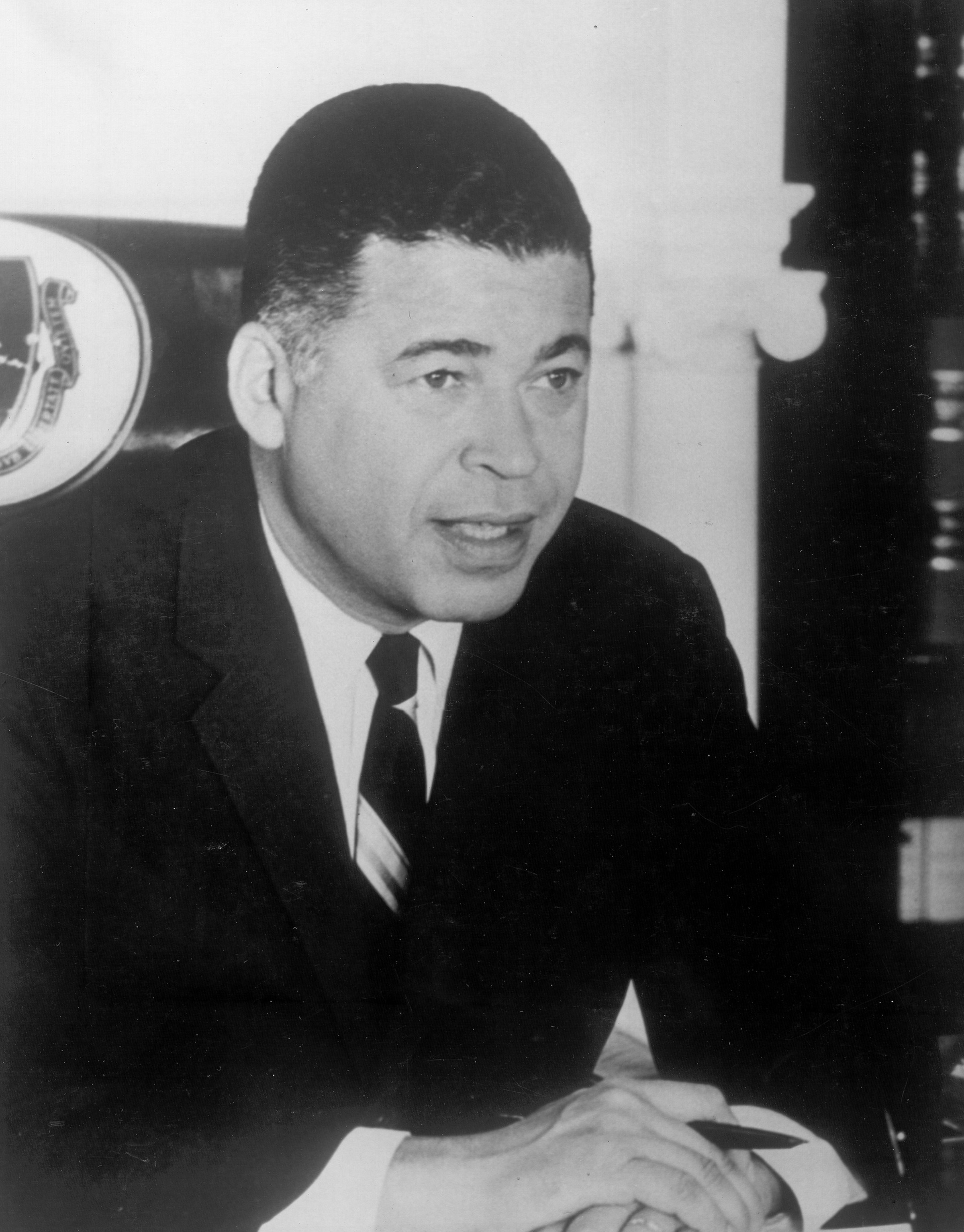
Former US Senator Edward Brooke (wikipedia)
In an election year that the pummeled Democrats, Republicans actually needed victories in New England beyond New Hampshire.  Few thought that they could ever return to their pre-JFK strength in Massachusetts, but at the very least they would like an 80's sized minority and a solid gubernatorial win.  It would have made them competitive in New England generally to hold the line when the GOP loses the districts they otherwise won this year.  Remember, when Democrats lost the House in 1994, the GOP already held seats in Connecticut and Massachusetts that Dems won in 2010 by healthy margins. 
 

Just as importantly, it calls into question the GOP's chances for non-Gubernatorial statewide races.  Treasurer is the only non-Gubernatorial Constitutional office (held by Joe Malone, who lost the Republican nomination for the 10th Congressional district to Jeff Perry) Republicans have won in 40 years.  Before that  Elliot Richardson was the last Republican elected for another statewide office, Attorney General.  His last elected predecessor?  Edward Brooke, the first black Senator since Reconstruction and also the last Republican Senator from Massachusetts until...

...Scott Brown.  The telegenic captain of the New England Republican advance still stands, safely two years removed from reelection, the bodies of his Bay State comrades largely strewn all about.  Looking over his shoulder, Brown now has the target on his back.

Sen. Scott Brown (Boston Herald)

Wednesday, October 27, 2010

Endorsements on Parade: Neal Gets our Seal of Approval...

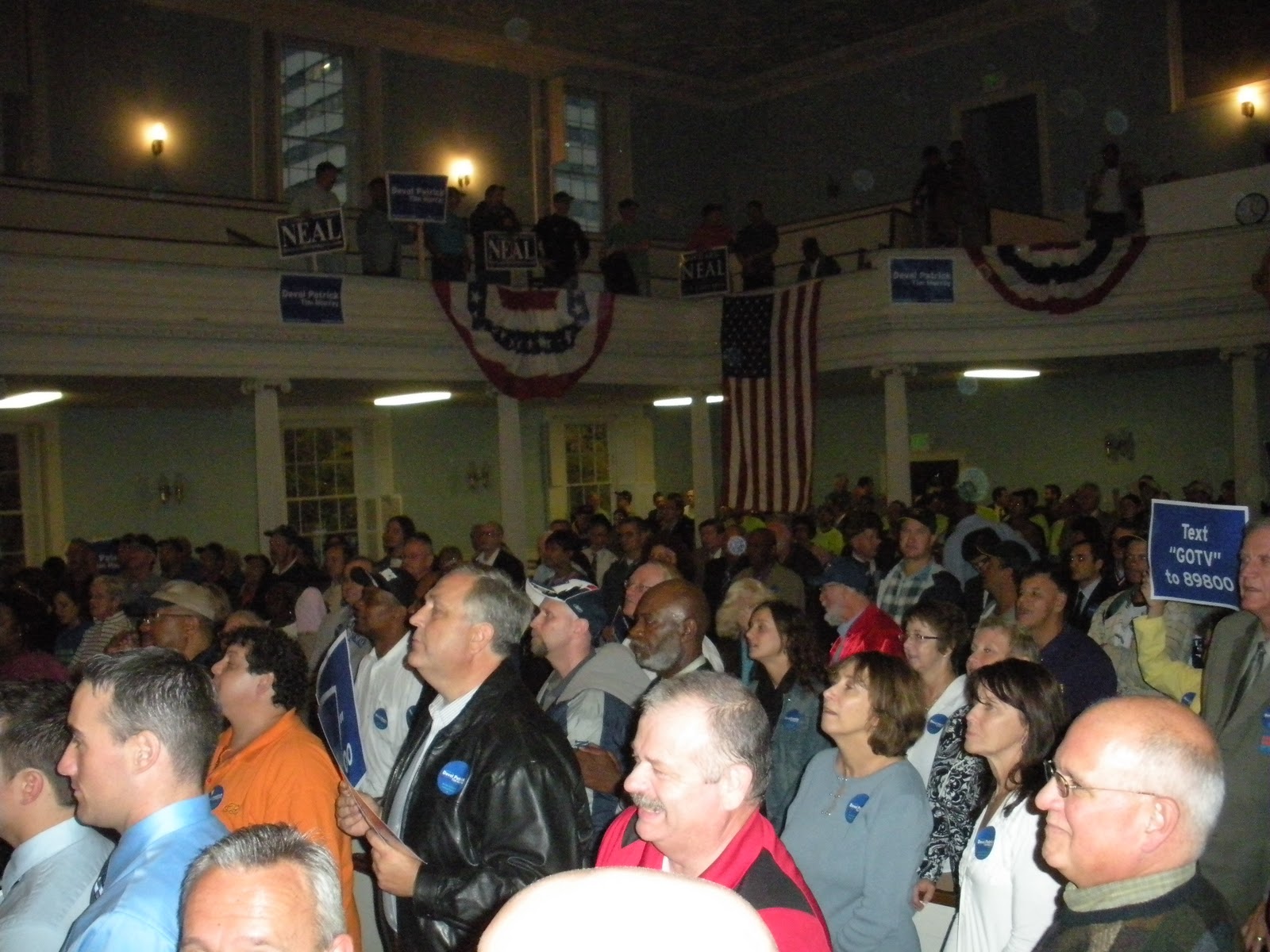
Rock stars seldom come to Springfield, but between the screaming fans, packed seats, and the music of the Black Eyed Peas and the Dropkick Murphys, you would never know it.  Governor Deval Patrick and everybody on down in the Springfield area Democratic party were there, crowded into a sweltering Old First Church for a Get Out the Vote rally.  Speakers included the governor, emcee Hampden County Sheriff Michael Ashe, Springfield Mayor Domenic Sarno, Democratic nominee for Treasurer Steve Grossman, Democratic nominee for Auditor Suzanne Bump, Ward 2 City Councilor Michael Fenton, and, of course, Congressman Richard Neal.

The event was meant to drum up enthusiasm and support for Democratic candidates in Massachusetts for Election Day, which nationally, if not locally, is expected to be tough for Democrats.  For the most part, the candidates appeared to do their job in this regard drawing cheers and applause from the diverse crowd of workers, volunteers, and ordinary citizens.

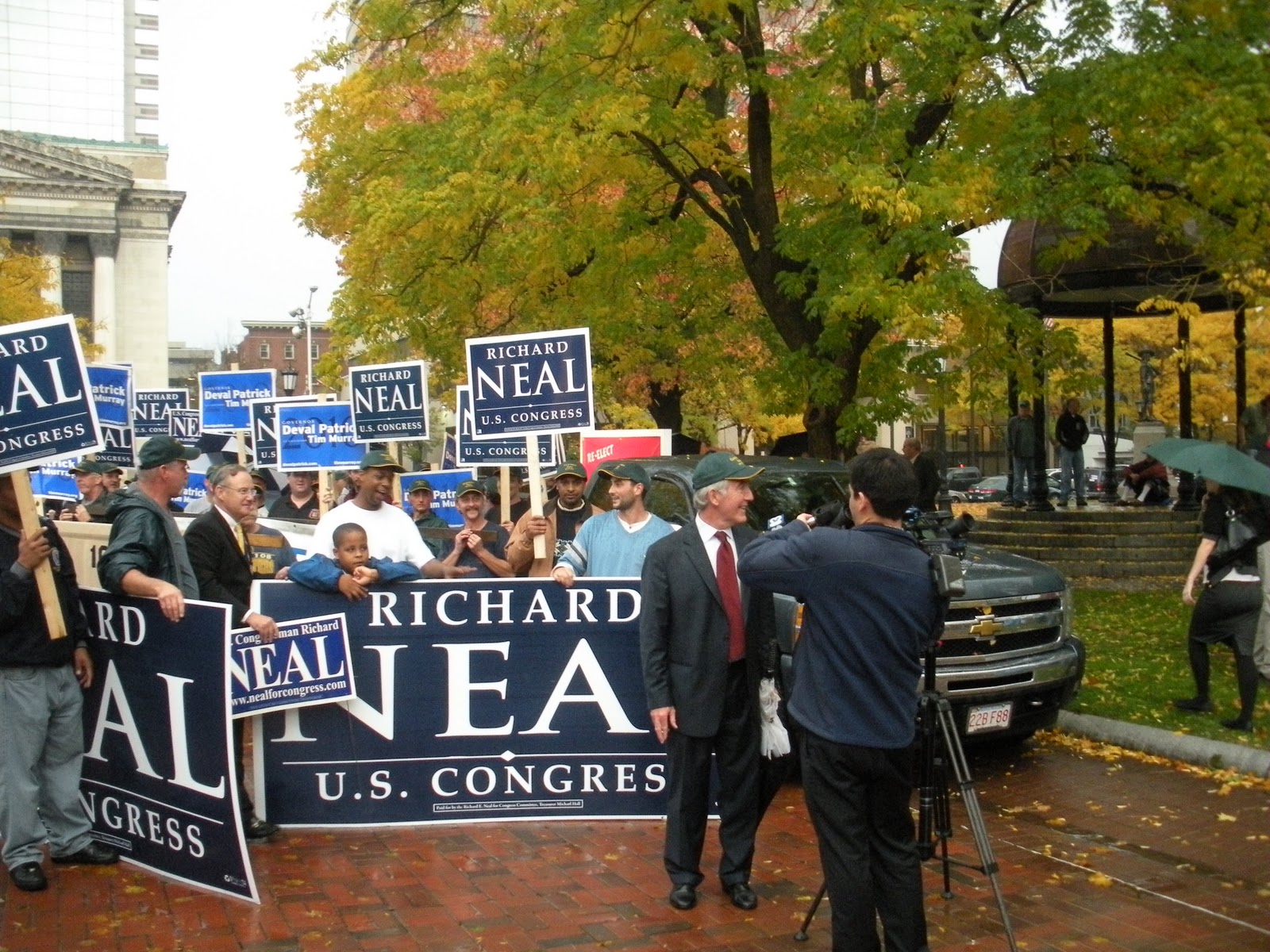
Our focus here, however, is to endorse Congressman Richard Neal for reelection to the United States House of Representatives for the 2nd Massachusetts Congressional District.  His rousing speech only underscored the reasons we mentioned earlier this year as to why he is well-respected and well-thought of in Springfield, Chicopee, Northampton, and the suburbs east which form his district.

Taken in context his remarks were before a friendly audience, though they nonetheless highlighted the fact that many of the nation's greatest social endeavors and economies were overseen by Democrats.  Neal also spoke of the $750 million Iraq war $2.3 trillion Bush tax cuts passed in 2001 and 2003.  All were paid for with debt.

Neal made a particular point to highlight his vote against the invasion of Iraq, while praising the work done by those soldiers that have been deployed overseas.  This statement, alone has not earned our approval.  Neal has been a tireless advocate for tax reform, notably the Alternative Minimum Tax, whose ensnarement of the middle class has its roots in the 1986 tax code.  He has been a tireless advocate for the preservation of Social Security.   A great deal of credit rightly goes to Neal for the peaceful solution in Northern Ireland.

The subject of Ireland, incidentally, brings us to his opponent.  Businessman Tom Wesley of Hopedale spoke before the primary of how Ireland was a model for us since its corporate business tax is among the world's lowest.  However, it is worth noting that the Republic of Ireland has suffered mightily during this fiscal crisis and its economy will absorb billions of euros worth of bank losses, that if their economy was scaled to ours in size, would equal trillions of dollars.  Nowhere near that much has been lost here.  Wesley touts his business experience and good work with numbers, but he filed for bankruptcy ten years ago.  We say these points, not to tear down Wesley, but to illustrate that he is not what he seems.  His mentioning Ireland was clearly a dig on Neal given the Congressman's work regarding the Emerald Isle.  However, it ended up being a cheap shot and hollow one to boot.  Ireland's economy had already nearly disintegrated (by far it was in worse condition than the US economy), when Wesley made that statement.

No, we are fully confident that Neal represents us admirably in Washington.  Much has been made in this election season that the problem is incumbents and politicians, but we submit that they alone are not at the heart of the problem.  We will save a larger reflection of America and society for another time, but we will note that the vitriol, screaming, and anger has not served the interests of anybody.  It is not surprising that people are reacting this way, but any sensible person would agree that the best decisions in our lives are made calmly and thoughtfully.

Our endorsements this election season, if a little predictable, were made with the same thoughtfulness.  One may criticize what seems like a Springfield-centric approach we made in our past assessment of Neal, but that was not the result of provincial attitudes.  The truth is that much of Western and Central Mass, its cities, suburbs, and rural communities share a common destiny and common problems.  We are not Boston with its name recognition and influence nationally and regionally.  For those reasons we need an advocate like Neal who delivers not just reliably, but compassionately.

Some years ago a woman in Chicopee lost the flag given to her after a close relative died.  The rumor was that it had been stolen.  Richard Neal personally delivered a replacement.  Maybe other Congressman have done that, but it does not matter because our Congressman did.

We could go on, but instead, we shall simply end with saying that Richard Neal receives our highest endorsement for election to the US House of Representatives.