Google
Showing posts with label labor. Show all posts

Wednesday, April 27, 2011

The Health of the Bargain...

Beacon Hill (WMassP&I)
Yesterday, the Massachusetts House of Representatives effectively voted to give cities and towns the unilateral right to set deductibles and co-pays for their employees health insurance.  Additionally, communities would no longer required to seek public employee approval to transfer insurance to the state's Group Insurance Commission (GIC).  The 111-42 vote surprised organized labor, while drawing caution from the Senate and Governor Deval Patrick.

The effort to allow communities to join the GIC has been building for years.  It has been consistently road blocked by the public employee unions, largely without explanation.  That the legislature has decided to grant this right over the objection of the unions is not really the news.  While the unions still oppose it, in all likelihood, they knew it was never an important loss to them.

By way of information, Springfield joined the GIC during the Control Board's tenure.  When asked what the deductible/co-pay provision's impact would be on Springfield's budget, the office of Mayor Domenic Sarno had no comment.

What is more striking is the ability to set deductibles and co-pays unilaterally.  Well, technically it is not unilaterally. Under the amendment, which can be read here, municipalities and other government bodies would call the affected public employee reps together and begin negotiating.  However, after 30 days, if no agreement is made the employer's offer wins.  Notably, none of this amendment takes effect unless the governing body like a city council or town meeting "accepts" it as is the language of such local administrative laws.

Speaker DeLeo (WBUR)
Unions are screaming that this is like Wisconsin or Ohio.  House Speaker Robert DeLeo contends that this is a necessary tool to save cities and towns during yet another tough fiscal crisis and that this is exactly the same rights the commonwealth has with its employees.  Frankly, however, neither of them are entirely right.

The unions are right that the ability of municipalities to set their own rates is like what has happened in Ohio.  That state's SB 5, among its many draconian provisions, essentially forces unions to accept the local community's first offer if an impasse ensues.  However, there are some important caveats in the Massachusetts bill.  The unilateralism only appears if the community joins the GIC.  Realistically, only a few communities gain anything by NOT joining, but still.  Additionally, unlike SB 5 in Ohio, virtually all of labor's rights to bargain is intact.

Sunday, February 27, 2011

Less Than You Bargained For...

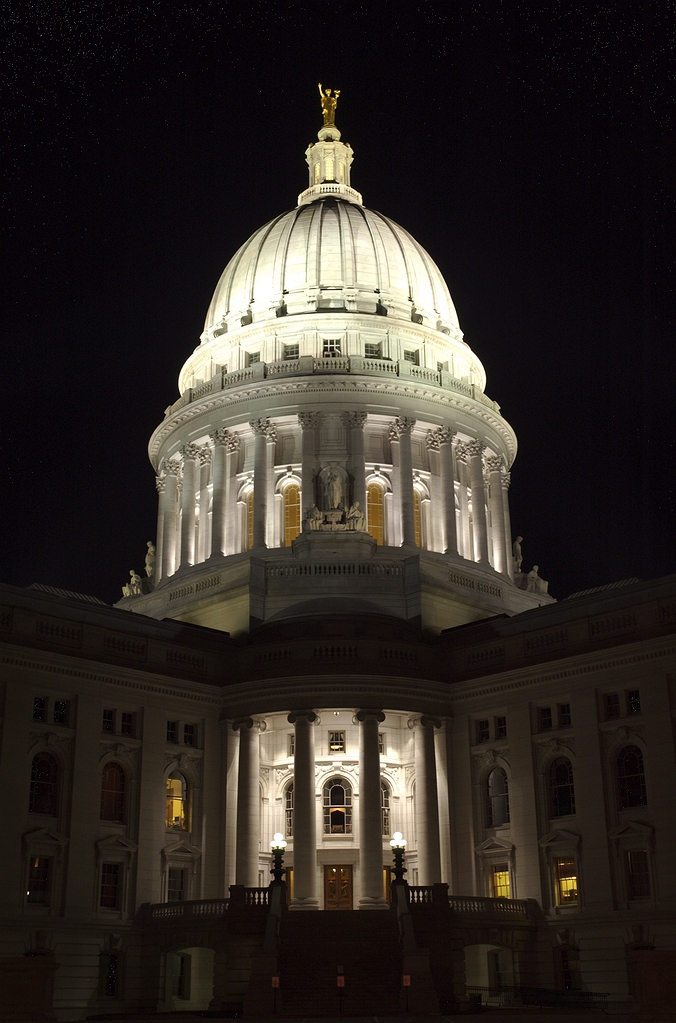
WI State Capitol (wikipedia)
The stalemate in Wisconsin is entering its third week and the second with little or no change since Democrats in that state’s senate took refuge in Illinois beyond the grasp of the State Police.  The entire ordeal has led both sides to harden their stances, but much to the surprise (apparently) of the right, it has galvanized the left in general and labor in particular in a way nothing in the past two years has.  Near constant protests have overtaken the Capitol in Madison with sympathy protests across the country, including in Springfield, Hartford and Boston.

Before we go on, we must take a moment to note that former governor Mitt Romney tried and failed to pull a similar stunt when the city plead for emergency financing in 2004. As Maureen Turner  dutifully noted in her blog, his request was turned back by legislators who  gave the city a loan in lieu of free cash.

The budget repair bill put forward by Wisconsin’s Republican governor, Scott Walker, would among other things, gut collective bargaining rights for state and local workers.  While Walker has claimed—falsely—that rights are intact, in fact workers would be banned from bargaining on anything other than wages, be restricted from winning wages above an inflation index and would need to hold annual elections on whether to maintain the union.  Meanwhile communities would be barred entirely from collecting union dues from workers for remittance to bargaining units’ locals.  To add insult to injury, public safety workers would be mysteriously exempt.  Several police and fire unions endorsed Walker.  Mystery solved.

Unions, in particular public sector unions, are not perfect.  Like any group or institution that can become a boogeyman for the easily misled, unions vices seem to stand out against their virtues.  Public sector unions, like their private counterparts, can create a Byzantine system that makes reorganizations messy if not impossible.  They may slow down changes in response to something that comes up unexpectedly.

(Wikipedia)
The best example of this, coincidentally, are a group of government workers that would, in Gov. Walker’s utopia, not lose their bargaining rights.  For several years the Boston Fire Department and the city locked horns over random drug testing, a common, uncompensated requirement of police and fire departments in Massachusetts. This started after fire in West Roxbury that killed two firefighters.  One was legally drunk the other tested positive for cocaine according autopsy reports leaked to the media.  The union would agree to the testing only if they got a pay bump.  The city balked and contract negotiations stalled until it came before an arbitration panel.  It  ruled in favor of the union, but the contract still needed an appropriation from the City Council.  The ruling infuriated residents and tide of discontent among the council threatened the approval.  The union blinked and agreed to accept the testing sans pay increases.

Now if the above tale has made you mad, that is okay.  However, it must be taken into perspective.  Firefighters are unique because it is nearly impossible to assail them given their well-earned “hero” status.  Most public sector unions could not get away with this, even teachers, who, especially in urban district are on a different kind of front line.

Protesting Dog in Hartford on 2/26 (WMassP&I)
Usually public sector labor disputes come down to three things: pay, health and pension contributions and seniority.  However one of the most important benefits public sector workers (and many union workers in the private sector) receive is a buffer against retaliation or unjust termination.  This, too, would be unavailable to union workers if Walker’s bill passes.  Generally, any government worker is entitled to a degree of due process under the  US Constitution as employment is a property right.  However, this protection is not as good as it sounds.  Due process can be achieved with a kangaroo court hearing and, absent evidence of discrimination, a real court is unlikely to review it.