Google
Showing posts with label John Lysak. Show all posts

Thursday, March 22, 2012

Take My Council, Please: Cheers & Jeers...

(WMassP&I)
Monday was a day of minor victories, but also grim financial news and schizophrenic behavior at the Springfield City Council.  With three members absent, councilors debated a host of resolutions, put off several measures to committee and even took some further steps on ordinances.  Prior to the meeting, bleak numbers from financial officials cast a pall over a rare Committee of the Whole meeting of the City Council.  While digging into those numbers must wait for another time, the short version is cuts in services, increases in fees, flat wages for workers and other depressing news, absent a turnaround on state aid and property tax revenue.  

At-large Councilor Kateri Walsh, Ward 4 Councilor E. Henry Twiggs and Ward 7 Councilor Tim Allen were absent due to personal reasons.

The agenda itself was a mix of routine announcements, paper pushing and substantive policy.  Reports from utilities were accepted from the council as were financial transfers within and to the fire department.  The Fire Department's Overtime budget has come in way over budget, partly a consequence of chronic underfunding of the department over the last decade.  However, the council also approved transfer of the city's fire-training facility to the commonwealth for $2 million.  The transfer will enable Massachusetts officials to train firefighters in neighboring communities nearby rather than sending them to another facility in Stow.  The city will continue to use the Grochmal Street facility, which will be rebuilt, at no cost aside from electricity and phone service.  City officials said the proceeds from the sale will go into the city's general revenue account.

Area Fire Chiefs Showed up to Support the Transfer of
the training center to the state (WMassP&I)
Two other property transfers in the city's South End were also approved by the Council.

The city also received financial reports for this year that indicate the city will retain about $2 million in free cash at the end of the fiscal year.  The council also approved, by a 10-0 vote an authorization for a bond necessary to cap Bondi's Island.  The bond is required under state law for the owner of any landfill and as the city's primary dump faces closure by the end of this decade, the city must maintain a bond under Department of Environmental Protection rules in order to assure the facility is properly closed.  

Another bond was authorized to pay for design work for Elias Brookings School, one of the school building damaged in last year's tornado.  Ward 2 Councilor Mike Fenton questioned the use of bonds, rather than free cash or stabilization reserves, but finance officials seemed to admit the objective was to preserve stabilization.  However, officials noted that the bond may not need to be used and payment for the design work could come from another source, avoiding interest payments.  Fenton cautioned against the use of this approach in the future, but backed the measure.

Two ordinances were also before the council (with a third brought up to get its second step passage).  The two ordinances on the agenda bulked up the large crowd, which was mostly present in support of one of the resolutions before the council.  The first ordinance, sponsored by at-large Councilors Jimmy Ferrera and Tim Rooke, sought to extend to thirty days from ten, the amount of time merchandise at a pawn shop must be held before it can be resold.  Several pawn shop owners turned out in opposition to the new rule, calling it an unfair burden on business.  Ultimately, on a motion from at-large Councilor Thomas Ashe, the measure was sent to committee before any step was taken.

Wednesday, March 07, 2012

Take My Council, Please: Pushing Paper...

Every now and then the Springfield City Council assembles and does little more than ministerial duties dressed up as discretionary acts.  For example, the city cannot accept a grant or money outside of its own tax base or consistent with a general state law unless the council approves it along with the purpose of the money.  Technically, the city can reject the money or disapprove of its purpose, but seldom does the city turn away money.  Monday was one of those meetings heavy on process and light on policy or politics.  Nothing that needed a recorded vote recorded any opposition.  However, rumblings of future trouble may lie in the background.

The rules of the city council dictate the order in which items may be brought before the council for debate, but that may be set aside if no councilor objects.  Last night featured this en masses as councilors bounced from items on economic development funding to grant acceptances to ordinance revisions.

On the agenda were transfers within departments to purchase a new event tent at the Barney Estate Carriage House in Forest Park, fund an economic development position and pay for additional office supplies in the audit department.  Bracket that last one for now.

Elsewhere the council approved a block of reports on utility work for Verizon and Western Massachusetts Electric.  Grants for the Dispatch department to maintain the facility, Fire Department training, at-risk youths (seemingly not the same as the one in the AWAKE controversy), health and human services, the library and for the construction of a parking garage at Union Station.

Pat Burns, the city Comptroller and a report from the Finance Committee both offered grim pictures for the next fiscal year, but the full details will not be known for a few more weeks.  The City Council also passed the first step of an ordinance to exempt livery vehicles who operate under contract from the state.  This would not apply to "for-hire" livery vehicles like taxis and limousines.  Rather it would apply to buses and vans used by private groups to shuttle people to and from events, for example.  The bill moved to the committee on ordinances where further discussion is expected.

Councilor John Lysak (WMassP&I)
Ward 8 Councilor John Lysak also offered a resolves calling on the Massachusetts to establish a provision in the state's property tax laws to enable to the city to collect a different (read higher) rate on dwellings with four or more units.  Lysak's reasons for the measure would be to relieve some of the upward pressure on business property tax rates.  Lysak also notes that it seems ridiculous that multiple family dwellings are taxed lower residential rates while businesses, also investments pay a higher rate.  He justified the higher rate on the thinking that multiple family dwellings also consume more city services than single family residences.  

The resolution drew opposition from some councilors and the Sears family, notable political Illuminati and owners of Sears Real Estate.  The measure was referred to committee, which is itself a somewhat absurd notion since resolves carry little if any weight.  However, Lysak was resigned to the resolve's fate and stated that he was merely looking to start a conversation.  Among the more bizarre aspects of this situation is that Lysak, allegedly the Council's only known Republican, is pushing for higher taxes, sorta.  However, it has also been stated by council insiders that Lysak is, despite his party identification, is to the left of other councilors confirmed to be Democrats.

The earlier matter to transfer funding in the Audit Department came about after the acting head of that department explained that money for salaries in her department were being used to office supplies.  The transfer was quite simple, but the money came from salary positions that went unfilled.  Indeed, the acting director described herself as the only employee in the Audit Department.  While much of the council seemed nonplussed by this fact, others expressed some concern that the part of the city charged with ensuring the city is spending its money responsible has less than a skeleton crew.

The other detail that raised some flags occurred during a discussion started after Ward 7 Councilor Tim Allen suggested that the Council listen a to a report of the finance committee before taking financial measures out of order in the agenda.  By taking these measures out of order, the council often spent a great deal of time asking questions of officials that would be answered in the report.  At-large Councilor Kateri Walsh correctly noted that Allen could always object and force the agenda be maintained (unanimous consent is needed to go out of order).  At-large Councilor Tim Rooke, the chair of the Finance Committee then offered his report on finances.

(WMassP&I)
What was notable about that report was its suggestion to Allen or any interested party that one attend the budget hearings held before Mayor Domenic Sarno will present his budget.  Allen and others were more interested in budget hearings with department heads rather than just finance officials.  Except, those hearings have not yet happened.  The mayors office confirmed with WMassP&I that none had happened and that none were scheduled.  Thomas Walsh, the mayor's communication director, did intimate that they would happen, but not when.  However, it has been noted that at this time last year the budget meetings had already begun and the mayor will need to present his budget by mid-May at the latest.

There is a rising concern among councilors, or at least ones given to deep contemplation of city business, that the mayor's office may limit these budget hearings.  It is at these meetings that some of the most meaningful budget changes occur in contrast to the often blunter and less surgical cuts the council makes while approving the budget.  Combined with the administration's dire warnings about the FY2013 budget, this may suggest an effort on the part of the mayor to rush the budget and force the council to either unwillingly or blithely accept a budget that may endanger the city's solvency and rainy day funds.

Friday, February 17, 2012

Take My Council, Please: Financial Cobwebs...

(WMassP&I)
Under normal circumstances, Monday's meeting of the Springfield City Council would have been a quick one.  There were few controversial items and councilors seemed in agreement about the diciest issues before them.  Rather, since the council had not met since January, a huge amount of dust piled up that needed sweeping.  There were questions about why some expenses magically appeared, but for the most they, and of course a cascade of grants, passed with little complaint.  If there was any passionate moments, it came as the Council passed a home rule petition to change MCAS testing dates in Springfield.

The city financial team told the council that the city's budget is in flux and will require some repair throughout the rest of the year.  Among the measures were additional funds transferred from the last budget's surplus to fund turnover in the city's vehicle fleet, the fire department, the assessors department, veterans affairs, and the election commission.  While the capital budget transfers faced some questions from Ward 2 Councilor Mike Fenton, the others were accepted with minimal complaint.  

Councilor Fenton
(Facebook)
The fire department deficit came from an overestimation of retirements and exhaustion of the overtime budget after the October snowstorm.  Leann Pasquini, the city's budget director, said she did expect some amount of that to be recouped from FEMA, however.  The Fire Department's staffing has been a concern for some time, however it has continued to perform, by any measure, very well including a recent year with no fire-related deaths.  Staffing is down to 220 sworn firefighters from 390 in the 1990's.

Other funding transfers included an upfront payment to step-up assessments for next year's tax rate setting and an increase in demands for veteran's benefits.  Veterans Services Commission Thomas Beltan explained that since the city turns away no veterans that request assistance, the added transfer was simply a function of increased need.  The city will received 75% reimbursement from the state in the next fiscal year.  Finally, Election Commissioner Gladys Oyola requested additional funding from the council to pay for the March 6th Presidential Primary.  She said it was an oversight on her part that led to that primary's exclusion from her budget in June.

The council also accepted grants for the Library and Fire Departments.  Helen Caulton-Harris secured another haul for Health and Human Services of over $75,000.  Community Development accepted a grant from the state to design a parking garage for the Court Square Hotel.  The council sent to committee grants from Comcast received as part of a settlement with the city.

Friday, January 27, 2012

ZBA Burns/Incinerates Biomass Permit...

**This post has been updated with pictures and for grammar.  This post has also been corrected to accurately reflect the comments of one speaker with regard to Massachusetts municipal waste incinerator ban.**

(WMassP&I)
As early as five thirty, a half hour before the zoning board of appeals hearing was set to begin, opponents of a proposed Biomass facility on Page Boulevard were arriving at City Hall.  Opponents from across the city and throughout the region poured into the hearing room that more than fifty years ago housed the second of the city's two legislative bodies.  As the room filled, supporters of the project were limited to a few seats off to the side.  Palmer Renewable Energy's imperious local attorney Frank Fitzgerald opted to stand.

Nobody knew what to expect from the board and between that and the tenor of hearing, many opponents could only guess how the board would rule.  Some were mindful of the high hurdle they would need to clear to sustain their appeal.  They would need not only a strong argument, but they would need to secure a unanimous vote from the board.

Before the ZBA were three matters.  Two involved biomass.  The other, the first one, involved an elderly woman who wanted to erect a temporary carport on her property.  The ZBA approved it with no opposition.

The real battle lay in the other two petitions.  Many had hoped that the biomass issue had died, at least on the city level, when the Springfield City Council revoked PRE's special permit.  However, the situation turned against biomass opponents again when Building Commissioner Steven Desilets issued PRE a building permit on the reasoning that a special permit was unnecessary.  That led to an appeal from local activist Michaelann Bewsee and two residents that live near the plant's proposed location, William and Toni Keefe.  The Springfield City Council, in exercising their prerogative as the authors of the zoning ordinance and issuers of special permits, filed the second appeal.

Michaelann Bewsee
(Michaelann Land Blog)
Bewsee's appeal came first and most of the arguments on the merits were the same for both the council's and her appeals.  However, there were issues of standing, that is were Bewsee and the Keefe's aggrieved parties to Desilets's decision?  While PRE was expected to attack the council's standing as well, that argument would likely fly directly in the face of established case law.

As would become a consistent problem throughout the hearing, ZBA chair Brenda Doherty implored the crowd to limit discussion of public health and air quality to only how it relates to the hearing.  The ZBA's jurisdiction was only zoning and could only consider the public health impacts to the extent they affected standing.  Despite that admonition, both sides veered away at times.

As lead petitioner, Bewsee spoke first.  She outlined the long, sordid history of the project, particularly its switch from burning construction waste to wood chips.  She outlined the project's original plan to burn construction and demolition waste for which the company requested and received a special permit for a recycling center on a 7-2 vote in 2008.  Since then the project changed to burning wood chips and the Springfield City Council completely transformed.  Following that transformation, the council revoked the permit on the grounds that the project had substantially changed.

Behind the desk are from left Commissioners Walter Gould
Brenda Doherty, Henry Nowick, Maria Perez and Daniel
Morrissey (partly obstructed).  Not pictured Commissioner Jose
Gonzelez. (WMassP&I)
Bewsee argued that the building permit was unlawful because Palmer Renewable's air quality permit was being appealed by none other than Bewsee herself and other environmentalists.  The city's ordinance and state regulations require that all air permits be obtained before a building permit is issued from the municipality.

Bewsee then explained how Desilets's decision was contrary to city zoning law.  Although the Page Boulevard property is zoned Industrial A, which is a very permissive designation, PRE was not merely proposing to engage in "processing," one of the approved activities as of right.  Rather the proposed process that the plant involved "incineration," which needs a special permit.  She disputed the notion that the wood being used did not qualify as waste.  Bewsee also defended her standing to appeal because the plant's emission's would affect her respiratory problems, but perhaps more critically, she defended the standing of the Keefes whose commute would be impacted by the trucks hauling waste wood in and ash out.

Pat Markey in 2007 with Karen Powell (WMassP&I)
Pat Markey, an attorney, former City Solicitor and former City Councilor who cast one of the two votes against the 2008 special permit, made the comment that would define the evening.  He told the board that proponents of the plant would offer a bunch of "smoke and mirrors."  He broke down the incineration requirement of the city zoning ordinance to its most basic component, "to burn to ash," and reminded the board that anything beyond that simply does not matter.

Other anti-biomass speakers drifted into air quality issues that Doherty tried to reign in.  The board also heard from a real estate agent who represented the owners of the former Friendly's on Page Boulevard that worried about the impact on that property's marketability.

Desilets was represented by Lisa DeSousa, an assistance city solicitor who, as Markey predicted, began the first round of dissembling.  She said that the plant would not engage in incineration of waste, refuse or offal, but would be burning fuel.  That difference, if it existed at all and expounded upon throughout the hearing, would form the crux of the board's final decision.  She did suggest, if not all that convincingly, that the air quality permit was actually in effect, as Bewsee and others had not requested a stay pending their administrative appeal of the air permit.

Fitzgerald, the lead local PRE attorney, only confidently assured the board that all i's were dotted and t's crossed.  He, too meandered into more detail about the air quality permit than Doherty would have likely preferred, but handed most of the show off to Botson Attorney Thomas Mackie.  Mackie had appeared before the council at the revocation hearing and brought his trademark condescension and attitude that defined much of his earlier remarks before the council.  Absent, however, were the veiled threats of litigation he hurled at the council, as the appeals board members face considerably different political consequences than councilors.  He did display at least a passing respect for Bewsee as the appellant, however.

Monday, January 02, 2012

New Government, Old Faces...

The Mayor's Procession Line (WMassP&I)
In a tasteful, but crowded ceremony at City Hall, Springfield swore in its City Council and its Mayor Domenic Sarno for another term.  Sarno will be serving the city's first four year term following enactment of a ballot question in 2009 that extended the mayor's term.  The School Committee is on a different election calendar and therefore members of that body neither faced the voters last November nor needed to be sworn in.

Typically, the city's inaugurations are held in Symphony Hall, however the city still put on a show which included typical guests like Cong. Richard Neal and speakers on behalf of the Massachusetts Senate and House.  State Senator James Welch and Representative Angelo Puppolo spoke on behalf of their respective bodies.

Also in attendance were Sheriff Michael Ashe and District Attorney Mark Mastroianni.

The invocation was provided by Our Lady of Mount Carmel's pastor, Robert White while City Clerk Wayman Lee administered the oath of office to the council.

Cong. Neal in December, 2011 (WMassP&I)
Congressman Richard Neal offered words of support on behalf of the United States House of Representatives.  He waxed somewhat nostalgic about his own service as mayor of the city and as a councilor remarking that he had taken office in that same chamber some thirty-four years ago.  Neal also emphasized the continuity between the council and the public service careers that began as members of that body.

Welch, in his first speech before Springfield's organizational meeting as one of the city's state senators, offered an anecdote about how his mother told him to say "hi" to mayor Sarno as evidence of the mayor's personable demeanor and its benefit to the city.  He also insisted the area have no more storms.  The legendary weather events that plagued the Springfield area played a prominent role throughout the ceremony.

Puppolo, by contrast, offered more direct praise to Sarno, a former colleague of his.  When Puppolo resigned from the council in 2007, Sarno was still a councilor.  Puppolo conveyed his sense that Sarno had the respect and confidence of both governor Deval Patrick and House Speaker Robert DeLeo following the June tornado and October blizzard.

Sarno w/ Judge Mary Hurley (WMassP&I)
Former Mayor and current Chicopee District Court judge Mary Hurley administered the oath of office to Mayor Domenic Sarno along with City Clerk Lee.

In his remarks before the audience, Sarno struck a notably humble tone, noting that the decision by residents to enact a four year term for the mayor was made for a reason.  Specifically, he said that residents were likely looking for more vision and a capacity to limit the short-term impact of politics upon the mayor's office.  

Saturday, December 31, 2011

The Year in Springfield, 2011...

(WMassP&I)
With another year under Springfield’s belt comes another edition of the Year in Springfield.  In its 375th year of existence the City of Homes suffered through one of the most erratic year of weather on record which brought a range of immense destruction and gross inconvenience.  Politically, it was also a tumultuous time from Springfield City Hall to Beacon Hill to the steps of Harvard University.

The year 2011 opened in Springfield with an eye, as in other places, to Washington, where a cadre of increasingly nihilistic “citizens” took their place in Congress and in state capitals across the nation.  While the boat rocked in Massachusetts with a shrunken, but still massive Democratic edge in the State House, Governor Deval Patrick took the oath of office once more. 


However, America was rocked only eight days into January when Arizona Congresswoman Gabrielle Giffords was shot in the head, by quite literally a madman.  Early accusations pointed to tea party extremism, but ultimately mental disease and not right-wing anarchy drove the young man to shoot Giffords and twelve others while murdering six.  Gifford suffered a traumatic shot to the head, be saved by the quick thinking of her intern of five days.


Cong. Gifford w/ her Mother weeks

after the shooting (PK Weis via Facebook)
President Barack Obama, given his first significant opportunity to play the healer-in-chief gave a stirring speech at a memorial service attended by Arizona’s Senators, its governor with Obama has frequently clashed, Giffords’ husband, Mark Kelly and Supreme Court Justice Anthony Kennedy, who oversees the Ninth Circuit within which the slain judge, John Roll, served.

The event took on somewhat of a local relevance when Congressman Richard Neal held a press conference after the shooting noting that he had known Giffords and had raised money for her ahead of what had been a difficult reelection in 2010.  However, he also urged that parties take down a notch the vitriol and anger that had become pervasive in politics whether Loughner was driven by politics or not.


Also in January Amaad Rivera took office as the Ward 6 Councilor following the resignation of Keith Wright.  He took office because the city’s succession law is only written with only at-large councilors in mind and fills vacancies with runners-up.  Technically, Rivera was a runner-up even though he lost the 2009 election.  The chorus of dissent included this blog and came to a head on a vote for eminent domain as part of Forest Park Middle School renovations.  Rivera invoked Rule 20, the council’s parliamentary motion to delay the project to the shock of other councilors.  While we would settle our differences with Rivera, many remained incensed over the use of Rule 20, ironically including some who would encounter similar anger over its usage.


Councilor Amaad Rivera (WMassP&I)
However, the focus on Rivera would lessen as he became one of a super-majority of councilors that opposed a wood-burning biomass plant.  The special permit had been granted in 2008 by the last council on a 7-2 vote.  All ward councilors and two at-large councilors, including Jose Tosado who voted for the permit in 2008.  The Callahan Family, owners of Palmer Renewable Energy and like-named paving company poured money into experts who dismissed, often condescendingly, the health concerns raised by opponents.  Against the din of protests and threats of legal action the council revoked PRE’s permit on a 10-2 vote.

Monday, August 22, 2011

Campaign High Finance...

**This post has been updated to reflect new information obtained from the governor's office.**

Councilor Rivera (Facebook)
It is always hard to measure what impact scandals will have on a politician.  Nobody seemed to care that Rick Perry received a $25,000 donation from Ken Lay and an Enron executive got a seat on the Utility Commission in Texas.  Likewise, prognosticators assessments notwithstanding, it is hard to know exactly what impact Ward 6 Councilor Amaad Rivera's failure to file his campaign finance disclosure forms will have.  Part of the problem is that there is an open seat and well-known names win.  Another complicating factor is that Rivera courts, more than virtually any at-large candidate has in recent memory, a segment of the electorate that has historically low voter participation rates.

However, the entire affair has spurred us to investigate, not Rivera's doings, but rather the municipal campaign financing in general.  As we have said for years, and especially during the Biomass debate, the same pool of donors tend to give to anybody running for office in Springfield.  However, what about the laws of disclosure themselves?  How have they changed and what impact do they have?  Just as important, what is the record of Springfield candidates generally?

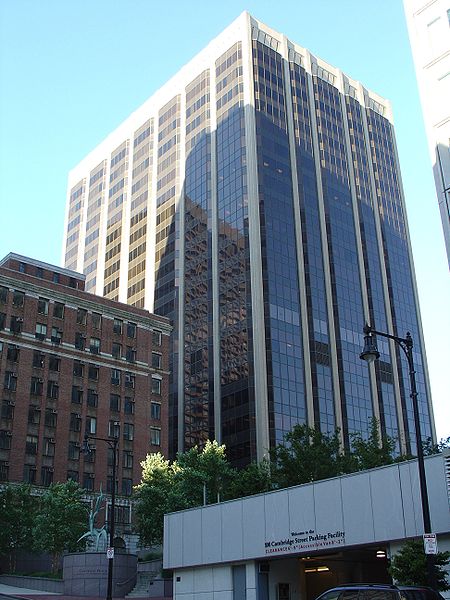
McCormack Bldg, Boston (Wikipedia)
Campaign finance laws are administered by the Office of Campaign and Political Finance.  That agency, headquartered in the McCormack Building next to the State House, enforces campaign finance laws in the commonwealth.  Established in 1973, the office was among many that were established, nationwide, during and after Watergate amid concerns about the influence of money in politics.  While those concerns have erupted once more after Citizens United v. FEC and the Supreme Court's striking of a Arizona Public Financing Law, disclosure requirements, which exist in most states, remain a crucial, if shaky, foundation of efforts to clean up elections.

Chapter 55 of the Massachusetts General Laws, and nominally 55c, the commonwealth's emaciated public financing law, are the laws that OCPF enforces.  However, the office is also the "depository" venue for most candidates to file their fund raising, expenditures and other reports.  Under current law, all candidates for State Office, including the legislature, governors council and the executive constitutional officials, must file with OCPF. 

However, before January 1, 2010 only mayoral candidates and city councilors running for at-large seats in the commonwealth's five largest cities needed to file with OCPF directly.  Even if you were not required to file with the state, candidates raising money for their campaigns for any municipal office had to file reports with their town or city's clerk, or in the case of Springfield, the Election Commission.  Just as Springfield undertook its first ward-based elections in decades, whose candidates needed to file only with City Hall, the commonwealth's municipal campaign finance law received a major shake-up

Gov. Deval Patrick in 2008 (WMassP&I)
The laws that changed this came about amid scandals, resignations and public pressure.  After former State Senator Dianne Wilkerson was arrested for bribery, Governor Deval Patrick convened a task force to suggest changes to public integrity laws.  Ultimately the legislature and Governor Deval Patrick enacted legislation that would toughen the commonwealth's ethics, lobbying and campaign finance laws.  However, passage of that bill, along with reforms to pensions and transportation were in doubt until Patrick said he would veto an increase in the sales tax unless the reforms reached his desk first.  At the bill signing, Patrick said at the time, "This law demonstrates our firm commitment to governing with integrity, with openness and with the public's interest foremost."

The changes expanded the crop of municipal candidates who needed to file wtih OCPF.  On the first day of 2010less than two months after the last municipal electionmayoral and all city council candidates in Boston, Worcester, Springfield, Lowell, and Cambridge were required to file with OCPF.  Mayoral candidates with populations in excess of 40,000, too must now file with OCPF.   For example, a mayoral candidate in Chicopee needs to file with the Boston-based agency, but city council candidates in that city as well as mayoral candidates in Agawam, do not.

Another notable change, though one mostly irrelevant to Springfield, required that city and town clerks put online the campaign finance reports candidates file locally. All of the above revisions to campaign finance law were contained in Chapter 28 of the Acts of 2009.


Friday, July 29, 2011

Moving on Up...

Councilor Rivera (WMassP&I)
The numbers out of the Election Commission indicate plenty of interest in the citywide races slated for this November.  At last count thirteen interested candidates have qualified to compete for the city's five at-large seats and three candidates have qualified for mayor.  As a result there will be a primary in September for both of those offices.  However, the relatively high interest in the city's elected offices at-large were only matched by a near-indifference on the ward level.  The only contested ward race will be in Ward 8 where Orlando Ramos will seek a rematch with current Ward 8 rep John Lysak.  Even ward 6, one of the city's most politically active wards is facing a one man race with Ken Shea seemingly destined to take that seat in January.  

The current occupant of that seat, Amaad Rivera, however, kicked off his campaign for election to one of the city's at-large seats.  At a somewhat humble, but intimate gathering of core supporters, Rivera formally launched his candidacy.  The event was held in the Hall of Local 108 of the Carpenters Union and attended by twenty-five to thirty people, many of them crucial backers of his  2009 run for the Ward 6 seat.

Several long-time supporters of Rivera spoke.  First up was Katie Stebbins a member of the Springfield planning board and wife to former city councilor Bruce Stebbins.  Stebbins, who described both herself and her husband as big supporters of Rivera, recalled several late-night conversations in her kitchen with Rivera regarding issues affecting the city.  Although her husband is a Republican and not necessarily in perfect political sync with Rivera's progressive values, she, her husabnd and Rivera are united in fighting for a stronger Springfield and good government.

Michaelann Bewsee (WMassP&I)
Michaelann Bewsee, the head of Arise for Social Justice, a Springfield advocacy group scolded Amaad for not running Ward 6 because there would be no race there after all (she made a point of noting no disrespect for Shea).  The faux criticism aside, Bewsee extolled Rivera's virtues calling him a "champion for progressive causes" on the City Council.

Arlene Rodriguez, a dean at Springfield Technical Community College called Rivera one of the most "honest, charismatic speakers" that she knows.  She also praised his "passion for people."  Dominic Basile who has known Rivera for years called him an "intensely loyal friend."

Rivera, trying not to play the politician with assurances of a short speech, spoke next.  He led off thanking his family which he described as a group of people where, "It was okay to express what you felt."  He also described how throughout his life in Springfield he felt there existed this (false) notion that there was something wrong with Springfield.  Instead he argued, "We can make a better, stronger Springfield.  

Thursday, June 23, 2011

Take My Council, Please: Fiscal Discilpline, 30 Years Overdue and Still Fresh...

(WMassP&I)
Tonight a somewhat strange thing happened at 36 Court Street.  The City Council fulfilled one of its legal obligations and actually did so by substantial majorities.  Through relatively few votes, the Springfield City Council cut more than $2.8 million dollars from the budget the mayor filed with the city last month.  Among the council's chief concerns, articulated by City Council President Jose Tosado and Ward 2 Councilor and Finance Committee Chair Mike Fenton, were the significant use of stabilization funds to plug the city's yawning budget gap.  That chasm was created through rising personnel costs, weak tax revenue and yet another cut to local aid from Beacon Hill.

Even with the cuts, the city will ultimately rely on roughly $7.5 million in stabilization reserves and another $5 million from an overlay account administered by the Assessors' Department.  Additionally, the city risks losing additional property tax revenue from damaged homes and businesses caught in the June 1st tornado.  Still, with next year's budget looking even more gruesome than this year's (and it will be paired with union negotiations with virtually all city bargaining units), keeping stabilization revenue intact is essential.

Tosado made some comments early on encouraging fiscal discipline only a year after he had refused to lift a finger to support cuts last year.  Still, the council president, perhaps knowing his mayoral aspirations remain dimmed by the tornado no doubt used the opportunity to jab the mayor, yet still doing what was right.

Councilor Tosado (Facebook)
Councilors kicked off the budget session with a vote to eliminate funding for vacant positions within the budget.  Although the mayor protested and even trotted out Police Commissioner Bill Fitchet to support funding for heretofore unfilled dispatch positions, the council rejected the entreaties and eliminated the positions.  Ward 5 Councilor Clodo Concepcion, who would become among the most reliable votes for the mayor's budget as is, attempted to play to councilors' political fear of cutting from public safety.  However, the council eliminated the unfilled positions.  At large councilors Jimmy Ferrera and Tom Ashe joined Concepcion in opposing the cuts.

Next the council proposed a broad cut of 5% to "other than personnel services" across city departments.  These items could be anything from support services to office supplies, basically anything that is not on payroll.  This cut elicited some minor protest for the mayor, but, representing more than a million and a half dollars all by itself, it passed the council easily 11-2. It made up the lion's share of other the budget reductions.  Ferrera and Concepcion dissented.

Ward 6 Councilor Amaad Rivera made an appeal to cut overtime budgets (which would largely come from police, fire and DPW) to save the jobs of eleven or so employees in the budget.  However, the political sensitivities could not be extended that far.  That cut failed 2-11, Rivera and Ward 3 Councilor Melvin Edwards casting the two yes votes.

Councilor Fenton (Facebook)
Whole swaths of the budget were cycled through without so much as a peep from councilors.  Ultimately proposals for cuts of $100,000 were proposed for Information Technology and Finance each, which will likely result in a handful of job losses.  Concepcion, Ashe and Ferrera were the three noes on the finance cuts.  Cuts to IT were much closer on a 7-6 vote.  Tosado, Fenton, and Ashe joined Ward 8 Councilor John Lysak, Ward 7 Councilor Tim Allen, Ward 1 Councilor Zaida Luna and Ward 4 Councilor E. Henry Twiggs to make those cuts.

Later on, Citistat, an office intended to find efficiencies in city government was all, but gutted by the council.  Although Citistat has made considerable progress for the city, it has been accused of hyping minor fiscal victories for the political benefit of city officials.  It died an ignominious death on a 10-3 vote, Rivera, Concepcion and Ferrera casting the votes to spare the office.

Tuesday, May 24, 2011

Take My Council, Please: REVOKED!...

(WMassP&I)
After all of the drama, all the testimony, all the passion, the Springfield City Council voted this evening to deny a permit for a used car dealership on Newhouse Street in the City’s Outer Belt Neighborhood.  Yes, the tension and the anxiety over what may be among the council’s most important votes this year gave way as councilors accepted the concerns of neighbors about the impact the dealership would have.

No, there really was a vote on a car dealership, but it by far overshadowed by the vote of the city council to revoke the permit for Palmer Renewable Energy’s proposed biomass plant on Cadwell Drive and Page Boulevard just off I-291.  Although the chamber was not as packed as it was for last week’s testimony phase, there was a significant showing of plant opponents and a few supporters, mostly craft union members.


Councilor Fenton (Facebook)
Ward 2 Councilor Mike Fenton read into the record a report from City Solicitor Ed Pikula which said that the council had sufficient evidence upon which it could base its decision to revoke the permit.  The City Solicitor stated the changes from the original project may deviate from the permit, could have a profound impact on the neighborhood, environment and public health and may justify the council’s revocation.


Ward 4 Councilor E. Henry Twiggs announced his support for revocation in remarks which outlined the council’s role as a regulatory body.  In that spirit, Twiggs noted that he resisted efforts to broadcast his position.  “We are here to be neutral,” Twiggs said explaining that he felt the contradictions and changes to the biomass proposal led him to oppose the plan


Councilor Walsh (Facebook)
At-large Councilor Kateri Walsh opened the debate for those in support of sustaining the permit.  Walsh said that her own research and calls to state environmental officials had led her to conclude that the impact of this project would not be different from the original plans (WMassP&I’s twitter feed misidentified Walsh’s position as saying it was different).  Absent that difference, Walsh said the city council should not revoke the permit and that she would vote likewise.


Ward 6 Councilor Amaad Rivera reminded the council that they were sitting in a regulatory setting and that their job was to make a judgment as to the status of the permit based on the evidence before them.  It was the council’s duty, Rivera argued, to determine whether the current project was different from the project originally approved, but to do so without being swayed by the prospect of job creation alone.


At-large Councilor Tim Rooke took a similar, but more forceful stand than Walsh.  He suggested that there was “no just cause” for the city to revoke the permit.  He also implied that the council was on a “dangerously reckless path” by voting to revoke.  Rooke appeared to argue that the city was acting out of turn.  Although it is rare for the council to so revoke a permit, it has with time practically become a reserve power of the council, in part because of misunderstanding or indifference to the council’s functions.  In that way, Rooke may have missed the mark in his broad admonition to the council.


Councilor Lysak (Official Site)
Undaunted, Ward 8 Councilor John Lysak, whose district include the site of the plant, replied “no amount of money was worth the risk” to to the health and safety of his constituents and others throughout the Springfield area.  Council President Jose Tosado also reminded Rooke of the posture of the council with regard to the permit.  The council was not acting as a legislative body, but a regulatory one, however elected.  Walsh attempted a parliamentary maneuver to get Tosado to step down to speak (which would have yielded her the dais), but he resisted.  After some additional comments from councilors, the vote was taken.


As the vote proceeded, it became increasingly clear where the result would come down.  Some of the biomass supporters could be heard during the meeting muttering that it was over.  Revocation required nine votes, consistent with special permit actions.  At-large councilor Jimmy Ferrera was absent due to a family emergency, but it clear that by the time City Clerk Wayman Lee had made his way to councilor Amaad Rivera, jubilation was pulsing through the crowd.  With the ninth vote cast for revocation (it happened to be Fenton), the crowd burst out in cheers nearly drowning out the recording of Tosado’s vote.


Wednesday, May 18, 2011

Take My Breath Away...

(WMassP&I)
In many ways, we have abdicated our responsibility on the Biomass issue.  When the permit was rammed through the city council on a 7-2 vote in 2008, it was hailed as a jobs creator period. Since then there has been a growing movement to stop the plant, slated for development off of Page Boulevard near I-291.  Palmer Renewable Energy, owned by the Callahan family that owns a paving company by the same name sought to use renewable energy grants to build the facility.

The plan calls for a power plant fueled by wood chip.  At first biomass was seen as being a great alternative energy source because it was renewable and ostensibly admitted less pollution.  However, it may be helpful to think biomass in the same way as LASIK laser eye surgery.  It is so new we do not have any idea what the long term effects are. As what data we do have began to come to light, the power plant began to look more and more like a liability for public health in the Greater Springfield area.

(WMassP&I)
The council faced a room filled with supporters and opponents of the biomass plant, but the supporters clearly had an advantage in homemade signs and possibly numbers as well.  Both sides were fairly civil throughout the process, but the opponents of the plant held their colorful signs highest on their experts' best points and throughout much of their opponents' comments.

From a legal standpoint, the Council's options are limited to revocation of the 2008 permit.  According to some legal sources, they can vote to revoke it, but as with granting a special permit they need 9 votes.  If last night's vote to close the meeting is any indication, they probably are close if not past that threshold.  However, the council can only revoke it for "just cause." 


As former City Solicitor and City Councilor Pat Markey put it to the Council, they get to decide what just cause is, but they have plenty to base their conclusion on.  Markey noted (he was one of two councilors in 2008 that voted no, Rosemarie Mazza-Moriarty was the other) that the original permit was for a recycling center.  Markey explained that that made sense at the time because the original project called for burned construction and demolition waste to power the plant.  That idea was later abandoned as skeptical regulators demurred.  As such, the new plan uses so-called green wood chips.  These chips are sometimes from tree debris, but other times from living trees.  Markey argued that the new plan fails to be recycling as that term implies previous used material.  This plan is an incinerator, instead, which requires a separate special permit, Markey said.


Pat Markey with Karen Powell in 2007 (WMassP&I)
Markey said the permit change, the change in truck movements, the lower threshold for regulation, and the EPA's own misgivings about biomass amount to plenty of "just cause" for the council.  Furthermore, he assured the council, the worst Palmer Paving could do is sue, win and get their permit anyway.  Susan Reid, Massachusetts Director of the  Conservation Law Foundation, a New England environmental legal group, argued that the increase in relative pollution by the plant could actually negate any positive effect.  Among her arguments was that the pollution increase could raise local temperatures and thereby increase energy usage for Air Conditioning.


A Northampton doctor that works in Springfield noted that the added pollution could have a particularly deleterious effect on days with air quality alerts.  Others spoke to the additional harmful effects caused by the additional truck trips.  Michaelann Bewsee, an activist in the city, took great pains to note that she and others had done their homework on the situation.  An asthma sufferer noted a connection to asthma rates and school absenteeism.


Representing the Biomass plant were Attorneys Frank Fitzgerald and Thomas Mackie.  Fitzgerald protested the legitimacy of this hearing and claimed that the only "just cause" for the city to revoke the permit was non-compliance with the original permit. At times he and his co-counsel claimed that even the original permit were unnecessary.  Fitzgerald also made several references to the direct economic benefit to the city.

Tuesday, May 17, 2011

Take My Council, Please: Trash Fee Lives...Biomass Looms...

 **Programming Note** WMassP&I will be live-tweeting today's BioMass Meeting.  Check out Hashtag #Biomass or visit our Facebook page or Twitter Feed.

(WMassP&I)
Yesterday's City Council meeting in Springfield had some wind taken out of its sails when three potentially contentious issues were unceremoniously withdrawn from the agenda.  Home rule petitions on the Council's succession and term were sent back to committee while the Tax Incremental Financing Plan for F.W. Webb was also withdrawn as questions arose about the fairness of the deal.  Left on the table were plenty of scraps worth digesting, but in many ways the victories of the night were overshadowed by the looming monster of tonight's Biomass Permit hearing.

The speakout was only attended by Springfield Education Association President Tim Collins, who called upon the council to minimize or even reverse declines in spending for the schools and reject suggestions that money allocated for schools be redistributed to the city side of the budget.  The School Department budget typically makes up more than half of the city's overall budget and is almost entirely financed by the state, save for a mandatory 10% contribution from city funds.  With unrestricted local aide in context, it could be argued that the school department is completely funded by the state.

(The Second Speaker was your Editor-at-Large.  Not knowing if the home rule petition to disastrously expand the Council's tenure to four years was withdrawn, I made a plea to not limit Democracy by means of extending the term.  Specifically, the concern rests with the possibility of laziness or inertia that could otherwise check overreach by the Mayor.  Comparisons were drawn between anti-voter bills in Wisconsin and Florida.  Because I did not have prepared remarks I have nothing to post, but when this issue resurfaces, I will again advocate against it.  For now it has again returned to the back burner.)

Councilor Ferrera (Urban Compass)
Boilerplate approvals were granted to transfer funds among departments.  Transfers included funding for advertisements in the newspaper for sales of property (as required under state law) and snow removal.  There were some questions from at-large Councilor Jimmy Ferrera and Ward 4 Councilor E. Henry Twiggs as to the source of additional money needed by the law department.  However, the Law Department urged the council not to worry, but that they would provide more details in a less public setting to satisfy privacy concerns.  Approval was granted to accept a grant as well.

The F.W. Webb proposal drew scrutiny at a recent Finance/Economic Development Committee meeting.  That meeting, according to minutes collected by the City Council office, generated skepticism from councilors in attendance.  The company's proposal includes a minimum promise of less than 40 jobs over the 20 year life of the agreement.  Additionally many of these jobs would probably pay wages topping out at $18/hour.  The city would receive full market value for property on the Smith & Wesson Industrial Park, but the net job creation seems minimal. 

Additionally, the long term tax revenue, when the incremental financing is included, would amount to about $3 million over 20 years.    During the first ten years, the tax incremental financing would save F.W. Webb on average about $50,000 annually.  Perhaps if the job numbers were better this may seem like a deal.  Needless to say the TIF has been postponed.  The property's sale, controlled by the Springfield Redevelopment Authority, is contingent on Council Approval of the TIF.

Councilor Rivera (Facebook)
The home rule petitions on the Council were also withdrawn.  Because we have discussed the Four year term in the past and above (cough, power grab! cough, cough), we will set aside that debate to move onto the other.  Council President Jose Tosado somewhat improvidently called the petition the "Amaad Rivera bill." It was spurred by the resignation of Keith Wright and seating of Ward 6 Councilor Amaad Rivera as the next highest vote getter.  The succession touched off a maelstrom of chatter and outrage among many Forest Park residents (where Ward 6 is principally based) and some councilors.  However, the determination by the City Solicitor and Election Commissioner was correct.

Tuesday, April 05, 2011

Take My Council, Please: We Want More...

(WMassP&I)
Monday was a night of stunning defeats and equally stunning chutzpah.  A dozen or so cops filled the council chamber ostensibly as a show of solidarity ahead of the civilian review vote.  Other measures up included the trash fee, a petition to extend council terms and other measures that were liberated from committee.

Lee Erdmann, the city’s Chief Administrative and Financial Officer briefed the council on finances first.  Essentially, the city projects, based on revenue estimates and expected state aid to have a $40 million deficit.  Erdmann told the council that he and others in the mayor’s administration had pared that down to about $16 million.  That reduction came through department reduction and changes to health and pensions.  It also assumed that there would be additional revenue from the trash fee.

As it stands now, the mayor’s office expects to request that roughly $13 million be used from stabilization funds to cover most of that gap.  Additional reductions and consolidations, thus far undetermined, unused overlay account money and would a 2% increase on the hotel tax would cover the rest.  The increase would put Springfield at the same rate as Cambridge and Worcester, but still under Boston’s rate.

Councilor Ferrera (Urban Compass)
Erdmann also indicated that the city would seek concessions from labor, but would do so primarily to avoid layoffs, which may become necessary absent concessions.  During the debate at-large councilor Jimmy Ferrera pressed Erdmann for the source of his projections.  Erdmann, apparently used to Ferrera’s theatrics, waved off his question, assuring him that he was using the best estimates available given the political and financial situation.

Erdmann also briefly discussed the city’s capital budget, which included replacing 20% of trash bins.  Ferrera also pressed the city on why it was spending money to buy new trash bins.  Allen Chwalek, the city’s Public Works head, anecdotally mentioned that his own trash bin wore out as all of them eventually will.  Chwalek also reminded Ferrera that the current bins were rolled out 12-13 years ago and have an expected life of about ten years.


Rendering of Holiday Inn as a La Quinta (WMassP&I)
From there the discussion switched to less controversial items.  Boilerplate votes were called on accepting grants for the library, fire, emergency management and elderly affairs departments.  A resolve was also passed to support more money from Beacon Hill for Shannon Grants and approval granted to other Shannon Grants, Ward 1 Councilor Zaida Luna sent to committee last time.  A report on the Biomass plant was also accepted by the council.  Blessings were also granted to a 5 year contract for school food service (after details as to the need were presented to a subcommittee) and to Community Block Development Grant loan guarantee for the renovation of the former Holiday Inn.

A report from the finance committee on the trash was given somewhat before the actual debate on the item itself.  Ward 2 City Councilor Mike Fenton, chairman of the finance committee explained how his amended ordinance would increase the discount for seniors, veterans and indigent homeowners to 33% from 25% (the base fee would remain $75).  Fenton noted that leaving an additional $3 million gap in the budget was unacceptable.