**UPDATED 3-3-12** This post has been updated with additional commentary and for grammatical corrections.
"You are not going to go off on a tangent about Olympia Snowe and Maine politics now," you are probably thinking, right? Well, yes and no, but the reasons run deeper than merely dissecting a nearby, but ultimately non-Bay State community.
"You are not going to go off on a tangent about Olympia Snowe and Maine politics now," you are probably thinking, right? Well, yes and no, but the reasons run deeper than merely dissecting a nearby, but ultimately non-Bay State community.
 |
| Sen. Olympia Snowe (wikipedia) |
On Tuesday Maine Republican Senator and today's world moderate Olympia Snowe announced that she would not run for reelection. The move sent shockwaves through Washington as Republicans, confident that the Senate would be their, suddenly confronted their likely loss of what would have been an easy win had Snowe stayed in. The move also scrambled Maine politics as both Democratic congressmen from the state, two former governors and others consider the Senate race, while a dozen or so other politicians circled the Congressional seats of those two Democrats.
There was a time when Snowe may have been the most liberal/moderate Republican in the Senate. Certainly after Lincoln Chafee, now Rhode Island's governor, was kicked out of office by Ocean Staters, she may have been. Arlen Specter of Pennsylvania may have edged her out in that category, but he became a Democrat in 2009. However, over the last few years and especially in 2011, Snowe had taken a rightward-turn that should have shocked even her longest-standing supporters. Still, Snowe provided critical votes on the stimulus, Dodd-Frank (without demanding banks be coddled as a certain senator to be named soon) and for both of President Obama's nominees to the Supreme Court.
In a statement about her decision to retire, Snowe, 65, was confident she would win reelection (a fact most took for granted), but felt that in the short term the partisanship of Washington led her to beg off another six years in the Senate. While media outlets were not wrong in noting her distaste for how the health care bill passed into law, it seemed hard to not see the greater partisan demons were within her party. Between the increased pandering to tea partyism to likely incessant threats from Madman Mitch, Snowe probably had more than enough from her Republican "colleagues."
Perhaps as a demonstration of that, Snowe became the sole Republican to vote for the absurdly broad Blunt Amendment today, which if made law, would allow ANY employer to deny coverage for ANY health care for reasons of "moral conviction," an undefined term. Ironically, her fellow Maine Republican, Susan Collins, voted for the bill, breaking that senator's record of being the most bipartisan senator of this Congress when it comes to sane votes.
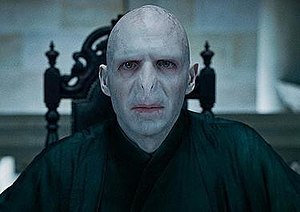 |
| Mitch McConnell, likely before creating another Horcrux (Image of Voldemort from Wikipedia) |
The radicalism of GOP votes stepped up considerably after the Democrats narrowly took back the Senate in 2006. It is our theory that when Mitch McConnell became the leader of his caucus after Bill Frist left the Senate, he was furious that he would not be Majority Leader. Why? Because early on in 2005, he knew he would become Majority Leader. Republican had just triumphed after Bush's reelection. How could things go wrong? Frist was going to keep his promise to serve only two terms (having first been elected in 1994) and therefore McConnell, then Senate Majority Whip would ascend. Then George W. Bush's second term happened. Republicans were falling left and right in 2006 including just enough senators. McConnell's dreams were crushed. But rather than become a cooperative Minority Leader, he became a vindictive one and pushed the Senate into becoming a parliamentary body where members are forced or threatened to remain in lockstep with leaderships.
This kind of behavior is virtually necessary in Canada or the UK and acceptable in the House of Representatives, but never intended for the Senate as Snowe's column illustrates. Democrats are not blameless in this regard, but it seems that McConnell took a behavior that had begun to creep into the Senate in 1980 and 1994 and used it wholesale. Democrats, rightly or wrongly, felt they could not unilaterally disarm and fought fire with fire. Thus the Senate of today.










 Posts
Posts


